Rethinking Dopamine: Not Just a Reward, But a Return
We’ve been taught that dopamine is a reward for doing more. But what if it’s actually a return signal? A whisper from your nervous system that says: “This is familiar. This is safe. Do this again.” Dopamine is a brain chemical that helps you feel pleasure and motivates you to repeat things that feel good or safe.
For high-functioning women of color navigating neurodivergence, hustle culture, and alexithymia, the idea of home often feels abstract. Yet your dopamine system is constantly seeking it, not just through achievement, but through pattern and familiarity (Cleveland Clinic, 2025; PMC10634822).
Dopamine doesn’t only spike after big accomplishments. It also rises when the brain recognizes emotional familiarity and safe, repeated experiences (PMC10634822).
Rituals Reclassify Action as Safe
Repetition changes how your brain categorizes input. An action that once triggered stress can, through gentle ritual, be reclassified as safe. This is neuroplasticity in action—your brain’s ability to change and grow new connections through repeated experience (PMC3032992; Number Analytics, 2025).
Lighting the same candle while journaling. Sitting in the same chair to wind down. Wearing the same calming hue on hard days. Each time you do it, dopamine says: “I know this. I like this. I trust this” (PMC10634822).
Sensory Symbols of Safety: Matcha, Brushstroke, Scarf
Sensory rituals help your brain connect certain actions with feelings of comfort and safety. You don’t have to chase dopamine. You can curate it.
In your own life, that might look like:
- A soft scarf that signals transition from work to rest
- The swirl of a brush on textured paper
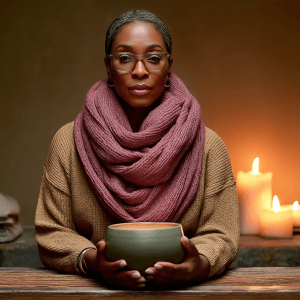
- The earthy warmth of your matcha bowl
Each sensory act becomes a neural signature—a pattern your brain learns to recognize as safe (Mediamatic, 2022).
Micro-Moment Ritual: The Homecoming Cue
You don’t need an hour. You need one moment that means something.
Try This: Matcha Sip + Gentle Stroke
- Make your favorite matcha. Use a ceramic bowl if possible.
- Hold the bowl with both hands. Feel the weight. Feel the heat.
- Before sipping, gently trace your fingertips over a textured surface—a stone, fabric, woodgrain.
- Sip slowly. Inhale. Say to yourself: This is my cue. I am safe to return.
This isn’t just self-care. It’s neural retraining—teaching your brain what home feels like through repetition and gentle sensory cues (PMC3032992; Number Analytics, 2025).
Reflective Close: What Moment Feels Like ‘Home’ to You?
Home isn’t a location. It’s a pattern your body learns to trust.
So tonight, ask yourself:
What moment in your day deserves to be marked as ‘home’?
It might be a tea cup. A certain chair. The act of brushing your hair with both hands.
Whatever it is, mark it.
Because dopamine isn’t just a reward. It’s a recognition. And ritual makes it real (PMC10634822; Cleveland Clinic, 2025).
Ready to make ritual your new rhythm?
Explore how the Neuroaesthetic Reset™ helps you curate daily moments of dopamine—not through performance, but through peace.
👉 Learn more about the program and reclaim the feeling of home in your own nervous system.