When the Story Becomes the Medicine — Closing the Arc on the Her Series
I want to tell you something about how this blog arc was written — not the content of it, but the experience of producing it — because the experience itself is the most honest demonstration I have of what narrative medicine actually is.
Every time the writing was wrong, my body knew it first.
Not my editor's eye. Not my clinical judgment. My body. There was a particular quality of tension that would move through me when a draft landed off — a kind of low-grade rejection that I can only describe as my nervous system refusing to adopt something that wasn't true. And when the words finally landed right, when the sentence carried the actual story and not some managed, polished, observed version of it, something released. The tension discharged. My body relaxed into the truth of what had been written the way it relaxes into a space that feels safe.
That is interoception. The body's capacity to sense its own internal state and use that information as data. And for a woman with alexithymia — a condition that makes verbal emotional expression difficult — my body has always been the more reliable narrator. It knows before I do. It registers what is true and what is performance long before my conscious mind catches up. Learning to trust that — to listen to the discharge, to follow the ease — has been one of the most important clinical lessons of my own healing. And it is why I built the Neuroaesthetic Reset Method around the body first, before the mind, before the protocol, before anything else.
The Her Series was not just content. It was a practice in following the body's truth.
What the Inner Child Series Was Really Doing
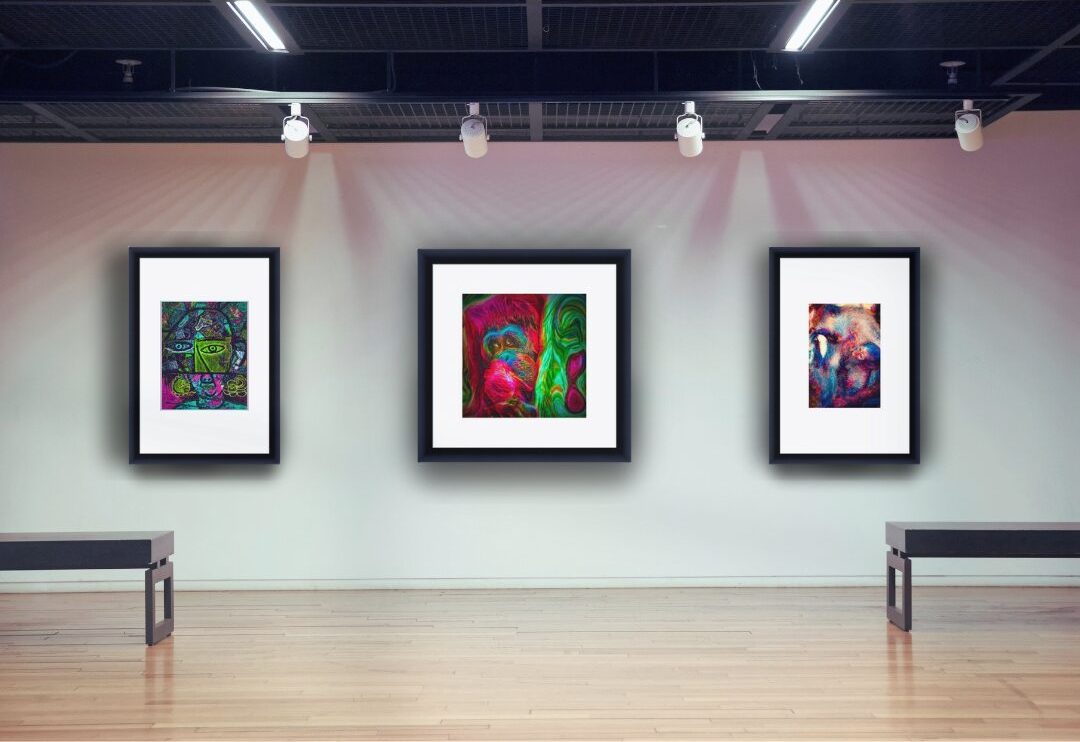
The Fragments to Fusion collection began with five pieces I call the Inner Child Series — Quiet Before the Storm, Dysregulated, Fairy Orange Chicken, Frog Prince Forgotten in the Bayou, and Panda's Storytime. When I made those pieces, I was not thinking about narrative medicine. I was thinking about survival. About the specific, concrete experiences of a childhood organized around chaos and violence, and what it cost a little girl to move through that environment without the language to name what was happening to her.
What I understand now — after the exhibitions, after the writing, after sitting with these pieces long enough to hear what they were trying to say — is that those five works were the body telling the story the mind had been keeping at a safe distance for decades. I have alexithymia. I could not always reach the feelings directly. But the art could reach them. The color could reach them. The form of a panda sitting in quiet contemplation, or a frog alone at the bayou's edge, could hold what my verbal language never quite managed to carry.
A 2024 systematic review published in Trauma, Violence & Abuse examined sixteen studies on the use of dance and movement therapy for women healing from interpersonal trauma and found something that speaks directly to what the Inner Child Series was doing for me long before I had the clinical framework for it — that body-oriented creative expression produces mind-body integration, aids trauma processing, and creates the internal experience of safety that talk-based therapy alone often cannot access. (DOI: 10.1177/15248380241243399) The body was doing the healing work through the art. I was just showing up and making the pieces.
Getting My Voice Back
Here is what I did not know when I started making art: I was getting my voice back.
Not my speaking voice. The deeper one. The one that had been managed and suppressed and rerouted since childhood — first because the environment required it, then because surgical training required it, then because the accumulated weight of decades of performing a version of myself that was acceptable to the rooms I was moving through required it. The voice that belonged to Allante, the girl with the stage name, the girl who wrote raps and felt most alive in bold colors and the electricity of a room that was moving with her — that voice had gone underground. And the art brought it back up.
Each piece in the Fragments to Fusion collection was a layer of that retrieval. The Inner Child Series named what happened. The shadow work section — Am I Looking in the Mirror, Piercing My Soul, The What Ifs — looked at it directly without flinching. And the Her Series declared what had survived it. See Her said: I was here the whole time, even when you couldn't see me. Be Her said: I am done asking permission to be myself. Teach Her said: everything I survived, I survived forward — for the girls who come after me. And Modern Muse closed the arc with a woman who has come through all of it and is gazing forward, adorned in butterflies of sapphire and mother of pearl, her ancestral knowledge intact in her green eyes, her single pearl earring carrying the wisdom of every layer of pressure that made her who she is.
That was not a content calendar. That was a woman finding her voice again through the only language that had always been available to her — color, form, and the particular courage of making something that tells the truth.
What Writing the Her Series Posts Did to My Body
When we started the process of rewriting the Her Series posts for this site — moving them from Ceyise Studios to drstaceydenise.com and regrounding them in my current clinical voice and the full truth of the story — I learned something I had not anticipated.
The body has opinions about words.
When a draft landed in language that sounded like it was observing me from a distance — narrating my story from the outside, organizing my experience into clean analytical paragraphs that had the shape of my life but not the feel of it — my body rejected it. Not dramatically. Just a quiet, consistent, unmistakable refusal to settle. The tension stayed. The discharge didn't come. Something in me kept saying: that's not it. That's not the true version.
And when the writing finally landed in the actual voice — in the rhythm of how I actually think, in the warmth of how I actually talk to a woman I know and respect, in the fullness of the story rather than the managed summary of it — my body relaxed. The energy moved. Something released that had been held.
That is narrative medicine. Not as a theoretical framework. As a lived, somatic, interoceptive experience of what happens when a story is finally told in its true form and received by the body that lived it.
For women with alexithymia, this is profoundly significant clinically, because the conventional assumption is that verbal processing is the primary route to healing. You name it, you claim it, you integrate it. But for those of us for whom language has always been the harder road, the body's response to story — to art, to color, to the particular quality of words that carry truth versus words that manage it — is often the more reliable signal. My body knew before my mind did, every single time, whether the writing was right.
The Oldest Medicine
Human beings have been telling their stories around fires since before we had written language. The oral tradition — the passing of experience from one person to another through the form of story — is not a therapeutic modality we invented in the twentieth century. It is the original medicine. It is how communities processed collective grief, how elders transferred wisdom to the next generation, how individuals found their way back to themselves after the kind of loss that doesn't have a clean name.
What I have been doing with the Fragments to Fusion collection — and with every piece of writing that came out of it — is practicing that tradition. Not as an artist with a conceptual framework. As a healer who needed to hear her own story told back to herself in the true form before she could fully integrate what had happened and move forward from it.
And here is what I am taking from that experience into my clinical practice with the women who come to me in perimenopause, many of them late-diagnosed autistic, many of them carrying decades of stories that have never been fully told or received: the art exercises, the music, the Mandala work, the biological compass mapping — these are not complementary tools added onto the clinical work. They are the clinical work. They are how we give the story a form the body can finally set down. They are how a woman who has been managing and masking and performing for thirty years gets to say, maybe for the first time: this is what actually happened. And then her body — her brilliant, truth-telling, interoceptive body — gets to exhale.
You tell your story. And then you put the story back to yourself so you can honor it, acknowledge it, and reclaim the parts of you that got buried inside it. Because that is what giving your story a true form does.
It gives you back parts of you.
What Comes Next
The Her Series is complete. Modern Muse is published. The spoken word poem from that November evening in Houston's Third Ward will have its own post — its own space and its own weight — because it deserves that.
And the narrative medicine work that began with seventeen pieces of art on a gallery wall is now inside the practice, inside the sessions, inside the framework I bring to every woman who finds her way to a telehealth visit with me and says: something is wrong, I don't know what it is, but my body has been trying to tell me for a very long time.
Listen. That's the instruction. Not to me. To the body.
It has been telling the truth this whole time.
The arc this post closes: Modern Muse — What It Actually Was → Teach Her — What Breaking the Cycle Actually Looks Like → Be Her — The Coming Out Party Nobody Sent Me an Invitation To → See Her — A Declaration of Visibility →
The narrative medicine thread continues here: You've Always Been a Wish: Five Element Medicine, Masking, and the Story That Sets You Free →
Join the Auntie Menopause Circle →
If this resonated with you, you are not alone in this journey. The Auntie Menopause Circle is where women who are done being dismissed come to learn, heal, and find each other.
Sources
Liang CX, Bryant T. The use of dance and movement for the embodied healing of interpersonal trauma in women and girls: A systematic review. Trauma, Violence & Abuse. 2024. DOI: 10.1177/15248380241243399
Mesa N et al. Breast scars and creative well-being: Personal stories and experiences of healing. Women's Health. 2025. DOI: 10.1177/17455057251327839