
The Missing Sense: What Interoception Explains About Why You Feel Everything But Can't Find the Words
Have you ever felt your chest tighten in the middle of an argument and not been able to tell if it was stress or sadness or just exhaustion?
Or woken up in the middle of the night with your heart pounding and had absolutely no language for what was happening in your body — only the knowledge that something was wrong, something was very wrong, and that it had been wrong for a long time?
That silence between what your body is doing and what you can put into words has a name. It is called alexithymia. And underneath it, doing the quiet work that makes that silence possible, is a sense most of us have never been taught to pay attention to.
That sense is called interoception. And it may be the most important piece of your perimenopause picture that nobody has talked to you about.
In Episode 9 of The Nervous System Eats First Podcast, I sat down with Dr. Kelly Mahler—an occupational therapist, author of over a dozen publications and resources including the Interoception Curriculum, which is now being used in over 30 countries worldwide; and what she calls on her own LinkedIn bio an interoception groupie—and what she shared in our conversation has not left me since.
🎧Watch or listen to the full episode here →
What Interoception Actually Is
Kelly describes interoception as the newest sense defined by neuroscientists, and I want to stay with that for a moment because I think it matters that this is not a concept someone invented in a wellness retreat. Neuroscientists named this. It is a sense — the same way sight and hearing and touch are senses — and what it does is help you notice the internal sensations coming from your body.
The tight chest. The racing heart. The clenched muscles. The hollow feeling in your stomach before you can identify that you are anxious. The flutter that tells you something is exciting before you have had a single thought about why. The way your body knows you need to cry a full minute before your eyes cooperate.
Kelly put it this way in our conversation: those body signals are giving you information about the condition of your body — not just the physical condition, but the emotional one too. And your brain translates them into emotional meaning. Or it is supposed to.
The problem, and this is where it gets real for my patient population, is that interoception can be disrupted. And when it is, the translation breaks down. The signals are still there, still firing, but the pathway between what the body is feeling and what the brain can name goes quiet.
That is where alexithymia lives.
Alexithymia Is Not the Ceiling. It Is the Floor.
When I work with clients who have alexithymia — the condition where you genuinely struggle to identify and name your own emotional states — I used to approach it at the level of emotions. Here are some words for feelings. Which one matches what you are experiencing right now?
And it kept not working. Not because my patients were not trying, but because Kelly helped me understand something that changed the way I practice: emotion words only have concrete meaning if you have the body signal experience to back them up.
She gave this example in our conversation that I keep coming back to. If someone asks you what the word "excited" means, you might give a scripted answer — it is when you are jumping up and down and smiling, it is that kind of energy. But if you authentically understand excited, you describe it from your own interior experience. The flutter in the chest. The energy spike that makes you want to move. The specific way your body physically feels when excitement is what is happening.
If that body-to-word translation pathway is disrupted, you are reaching for emotion language that has no interior anchor. You are essentially working with definitions that have no meaning underneath them. And when therapy keeps handing you emotion wheels and asking you to point at how you feel, and you genuinely cannot access the body signal that would tell you the answer, the therapy does not work — and the shame that comes from believing you are the problem, that you cannot do this thing that seems so simple to everyone else, that shame compounds the disconnection.
A 2023 study in Behavioral Sciences confirmed what Kelly and I see clinically — in adults with autism spectrum disorder, higher levels of interoceptive confusion were significantly associated with greater alexithymia and poorer emotional regulation, and the researchers found that training interoceptive ability has meaningful potential for improving emotional clarity in this population. (DOI: 10.3390/bs13040312)
And a 2022 study in Research in Developmental Disabilities found that in the ASD group, interoception correlated negatively with alexithymia — meaning the lower the interoceptive connection, the higher the alexithymia. These are not separate problems. They are the same system failing at different levels. (DOI: 10.1016/j.ridd.2022.104378)
What this means clinically is that you cannot fix alexithymia at the level of emotion words. You have to go deeper — into the body, into the signals, into rebuilding the pathway that should have been trained from childhood but was not, for any number of reasons, and now needs to be cultivated deliberately.
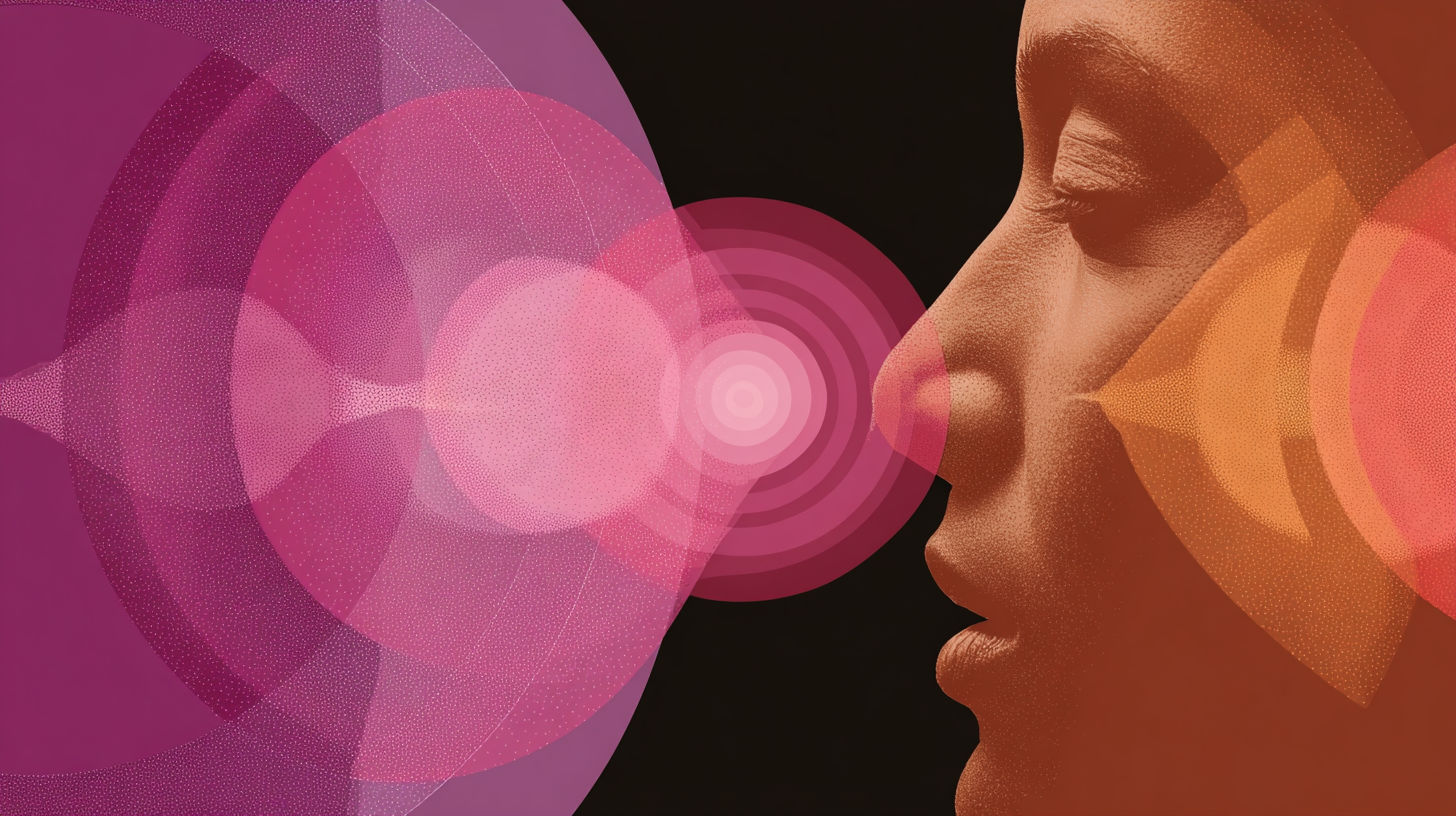
This is what Kelly's interoception curriculum does. And this is exactly where the color work inside The Neuroaesthetic Reset Method™ meets her framework, because using color as a proxy for emotional state — asking not "how do you feel" but "what color does your body feel like right now" — is a way of building interoceptive awareness through a pathway that does not require words to start with.
Why This Is Not Your Fault, and Why Masking Made It Worse
One of the things Kelly said in our conversation that I want every neurodivergent woman listening to hear is this — what we have been conditioned to do for most of our lives is persist in environments at the expense of what our bodies are telling us.
She used the example of the overwhelming classroom. The child covering their ears because the noise is genuinely painful to her nervous system, and the teacher — from a loving place, with no malice — saying "you can't possibly need to leave again" or "it's not that loud in here." What that moment is actually teaching that child is: what you are feeling cannot be true. Your body's signals are not reliable. The environment's demands matter more than what you are experiencing inside.
That child learns to mask. She learns to dissociate from her internal world in order to push through. She learns to function — brilliantly, sometimes — while severing the connection between what her body knows and what she is allowed to acknowledge.
And that masking continues into the workforce and into relationships and into every medical appointment where someone asks her what is wrong and she says "I don't know, I just don't feel right" and the doctor runs the labs and tells her everything is normal and sends her home.
For Black women, this severing happens in an additional layer — the social conditioning of having to perform composure and competence in environments that are not safe, of managing how you are perceived at the expense of what you are actually experiencing, of decades of learning that what your body knows cannot be spoken out loud in this room, with these people, in this system.
Masking is not a personality quirk. It is a survival strategy. And what it costs, over time, is the ability to hear your own body.

The Gap Nobody Has Filled Yet
Here is something Kelly said in our conversation that I want you to actually feel in your body for a moment.
She told me she did a search of the literature before our recording to see what research exists on interoception and menopause. And she could not find a single study.
Not one.
There is an emerging body of research — over 5,000 studies on interoception now, Kelly said, most of them published in just the last five years — and none of it has been applied to the menopausal transition and what happens to a woman's interoceptive awareness when her hormones are shifting, when her nervous system is losing the estrogen buffer that was helping her manage sensory input, when she is simultaneously navigating the late diagnosis of neurodivergence that explains so much of her entire life.
This is the research gap I live in. And it is why Kelly and I both agreed on the podcast that these studies need to be done, and that women in this transition deserve to have their interoceptive experience taken seriously as a clinical variable and not just as a hormone problem.
Because here is what I see in my practice every day: women who are on HRT, whose labs look appropriate, whose hot flashes have improved, who are still telling me they do not feel right. Still numb. Still flat. Still unable to name what is happening inside them. And the medical system has nothing more to offer because the prescription is filled and the numbers are normal.
Interoception is the missing piece. Not instead of the hormones — alongside them. Because how do you know if a treatment is working? You have to be able to feel what your body is telling you about it. And if that pathway is disrupted, you are navigating your own health in the dark.
What Kelly Recommends: Starting to Reconnect
Before we ended the episode, I asked Kelly for something practical — a place to start for the woman who has been so disconnected from her body signals that she does not know where to begin.
What she offered was so gentle and so specific that I want to share it here.
Find a moment when you are in a space where you feel safe. When your body is as regulated as it can be right now. Not when you are in crisis. Not when the noise is too loud and the lights are too bright and the demands are stacking up. When things are as quiet as they get.
Then pick one body part — a neutral one, and neutral will be different for everyone, but she suggested hands as a starting point for many people — and just take a quiet moment to notice how that body part feels. Not what you think it should feel like. Not what you have been told it should feel like. What it actually feels right now in this moment.
If you feel nothing, that is okay and it is also information. You can evoke a sensation — give your hands a quick shake, squeeze them into a fist, do something that creates a stronger signal to notice — and then try again.
And here is the piece I love most: if a word comes, that is valid. If a color comes, that is valid. If an animal comes or a texture or a sound, that is valid. There is no wrong way to describe what your body is experiencing, and there is no wrong way to feel it. The goal is not to use the right vocabulary. The goal is to start building a connection with the signals that have been going unheard.
Because as Kelly said — and I am going to keep saying this in my practice for the rest of my career — those body signals are not noise. They are information. And reconnecting with them is not a soft skill or a wellness trend. It is the clinical foundation of everything else we are trying to do.
The Nourish or Numb Segment
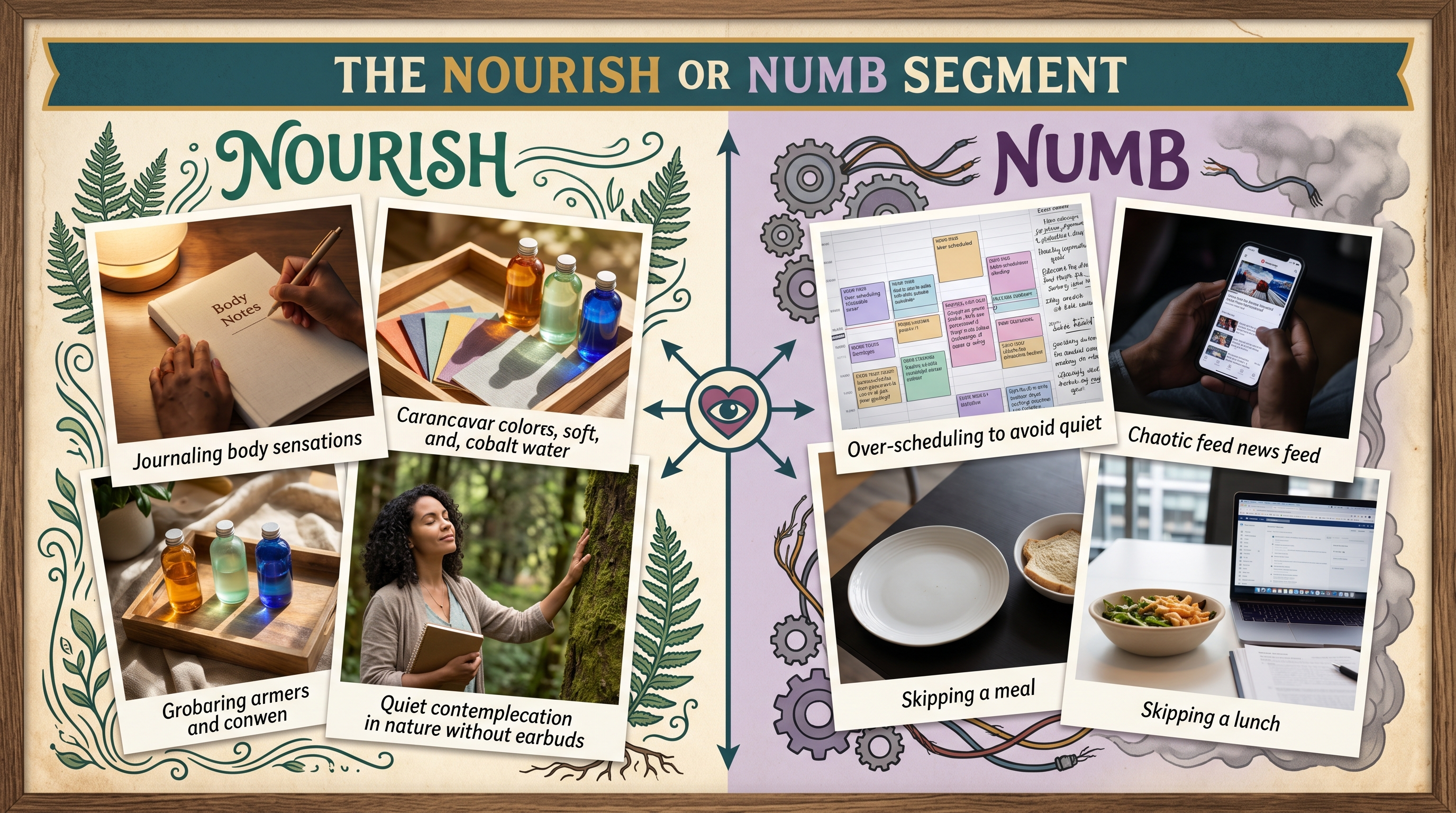
At the end of every episode I have a segment called Nourish or Numb, where I name a common habit or pattern and ask my guest whether it is nourishing interoceptive awareness or numbing it. Kelly's answers were too good not to share.
Skipping meals until hunger feels extreme — her first instinct was numbing, but then she got curious. Why are you doing it? She has had clients use this deliberately to numb anxiety. The why matters before the prescription.
Journaling body sensations before naming feelings — nourishing. Every time.
Over-scheduling to avoid quiet moments — numbing.
Pausing to choose one color that matches your body today — nourishing. And this one made me smile because this is exactly the bridge between her interoception work and mine. Color as a body-to-language bridge. A proxy for the word that has not formed yet.
Spending a few minutes in nature without earbuds — nourishing for most people, she said, but potentially disarming for some. Because for sensory-sensitive women, the sounds of nature are not always calming. That matters and Kelly held the complexity of it rather than collapsing it into a universal prescription.
Kelly's One Practice
I always end by asking my guests what one practice always nourishes them to stay connected to their own body, no matter how noisy life gets.
Kelly said walking her dogs. Without her phone.
Not a protocol. Not a curriculum. Just a body in movement in the world, without a screen between her and what she is experiencing.
Sometimes the practice that keeps us most connected to ourselves is the simplest one.
Find Kelly's Work
Dr. Kelly Mahler's books, curriculum, and free interoception resources are available at kelly-mahler.com. Her Interoception Curriculum is being used in over 30 countries and has resources for both children and adults.
Begin Your Own Reset
If this episode landed somewhere in your body before you had words for why — that is interoception doing its work. Trust that signal.
If you are ready to understand which patterns are keeping your nervous system stuck, start with the Color Archetype Quiz. It is designed for women who process the world differently, and it meets you where your body actually is rather than where it is supposed to be.
Take the Color Archetype Quiz →
This episode connects directly to the Polyvagal Theory work we have been building: Your Home Is Either Medicine or It Is Making You Sick: Designing for Peace Through the Polyvagal Lens →
And if the alexithymia piece resonated with you, read this next: What Is Neuroaesthetics? The Gentle Science of How Beauty Heals Your Brain →
Sources
Bonete S, Molinero C, Ruisanchez D. Emotional Dysfunction and Interoceptive Challenges in Adults with Autism Spectrum Disorders. Behavioral Sciences. 2023. DOI: 10.3390/bs13040312
Ben Hassen N et al. Emotional regulation deficits in autism spectrum disorder: The role of alexithymia and interoception. Research in Developmental Disabilities. 2022. DOI: 10.1016/j.ridd.2022.104378