
10 Ways Art Sends Your Nervous System the Safety Signal It's Been Waiting For
Updated: April 2026
There is a distinction I want to make before we go anywhere else in this post, because it changes everything about how you understand what art is actually doing for your health.
Most wellness content frames art as a stress reliever. Something that helps you unwind, something pleasant, something that lifts your mood. And while all of that is true in the loose, general sense, it misses the clinical mechanism entirely. It misses why art works. And for the women in perimenopause who are reading this — women whose nervous systems have been running a continuous low-grade threat response for years, sometimes decades — understanding the mechanism is the difference between treating art as a nice-to-have and treating it as the intervention it actually is.

Here's the mechanism. Dr. Stephen Porges, the neuroscientist whose Polyvagal Theory I studied through my trauma certification work with the Trauma Research Foundation, makes a distinction that I want you to carry with you: safety is not the absence of threat. Safety is an active set of cues that your nervous system has to receive in order to down-regulate its defenses. Without those cues actively present, your nervous system's default response is a threat response. The foot comes off the brake and the stress circuitry goes back online — not because something bad is happening right now, but because the signal that it's safe to rest has not arrived.
Art delivers that signal. Color, form, beauty, creative engagement — these are safety cues. They communicate directly to the part of the nervous system that is scanning the environment for evidence that it's okay to stop defending. And for a woman in perimenopause whose progesterone-mediated calming has declined, whose HPA axis is more reactive than it used to be, whose body has been in a state of elevated vigilance for longer than she can remember — that signal isn't optional. It's clinical.
A 2025 paper by Dr. Porges himself published in Frontiers in Behavioral Neuroscience revisited Polyvagal Theory and its clinical applications, specifically emphasizing neuroception — the neural process by which safety and threat are detected without conscious awareness — as foundational to understanding how the environment shapes our autonomic state. (DOI: 10.3389/fnbeh.2025.1659083) Your nervous system is scanning your environment right now, reading every sensory input for evidence of safety or threat. Art is one of the most powerful safety inputs available. Here's how.
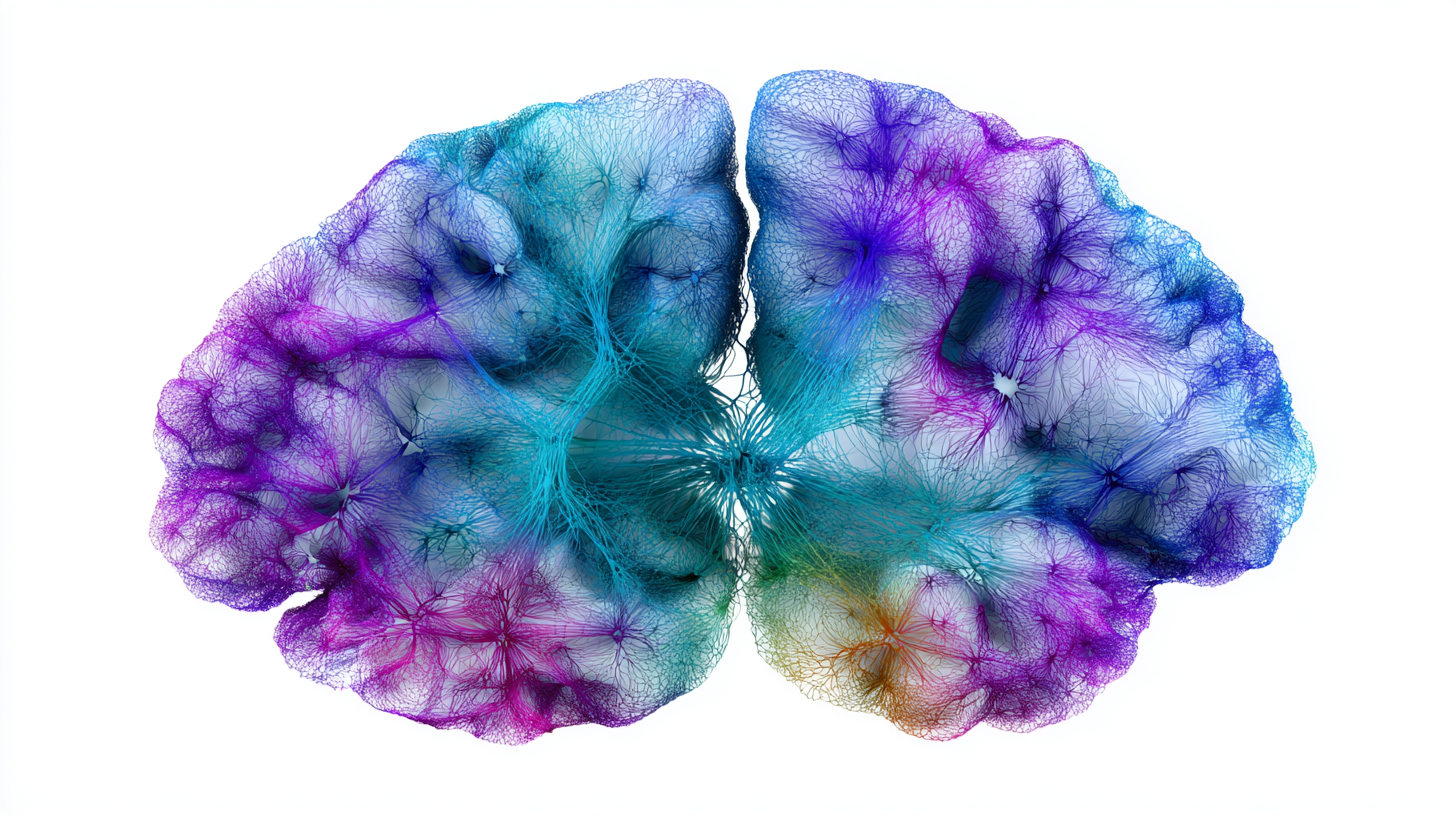
1. Art Reduces the Threat Signal Before You've Had a Single Thought About It
Your neuroception — the unconscious scanning your nervous system does continuously — registers color, form, and visual beauty before conscious thought forms. The signal travels from your retina through the limbic system before your prefrontal cortex has a chance to evaluate it. Which means that a piece of art in your environment is sending your autonomic nervous system a message before you've consciously decided how you feel about it.
When that message is safety — soft color, familiar organic form, visual beauty that your body registers as non-threatening — the vagal brake engages and the sympathetic response begins to quiet. Not because you decided to relax. Because the environment gave your nervous system evidence that relaxing was appropriate.
2. Art Making Gives Your Body Permission to Express What Language Can't Hold
Dr. Porges' model of the social engagement system explains that the ventral vagal complex — the circuit associated with safety, social connection, and rest — is directly tied to vocalization, facial expression, and the prosodic quality of voice. It is, in other words, the part of the nervous system most associated with expression. When we suppress expression — when we manage our emotional reactions, mask our responses, and perform a regulated exterior over a dysregulated interior — we are working against this circuit.
Art making is expression without the social stakes. It doesn't require a witness. It doesn't require the right words. For women with alexithymia for whom the emotional experience exists but the verbal label for it doesn't arrive on command — making art gives the body a channel to express what language has failed to carry. And when the body gets to express, the ventral vagal circuit activates. The safety signal arrives not from the outside but from the inside. The act of making becomes the medicine.
3. Art Builds Community — And Community Is a Biological Safety Cue
We tend to think of community as a social nice-to-have. Polyvagal Theory says it's a biological requirement. Mammals — and we are mammals — are wired to detect safety through the cues of other safe humans. The prosodic voice, the accessible body posture, the face that communicates openness rather than threat — these are the signals that tell our nervous system we are among allies, not adversaries, and that we can stop defending.
Engaging with art in community — in a gallery, in a class, in an online space where people are making and sharing and responding to beauty together — floods the nervous system with these cues simultaneously. The Auntie Menopause Circle exists in part for this reason. Not just for information. For the co-regulation that happens when a woman who has been defending alone for a very long time finally finds herself in a room — real or virtual — where the people around her are signaling safety.

4. Art Builds Confidence — Which Rebuilds Your Relationship With Your Own Body
For women in perimenopause who have been experiencing symptoms that feel unfamiliar, even frightening — the hot flash that arrives without warning, the mood that shifts without apparent cause, the cognitive fog that makes the familiar feel strange — the body can begin to feel like a source of threat rather than a home. The nervous system begins to treat internal sensations as danger signals. And that internal threat detection on top of the external one is exhausting in a way that no amount of sleep addresses.
Creating art — choosing a color, making a mark, completing a piece — is an act of agency that the body registers as competence. The nervous system gets evidence that you can make decisions, that your choices produce outcomes, that you have some degree of control in your environment. That evidence is regulatory. It rebuilds the relationship between your mind and your body from one organized around unpredictability to one organized around capacity.
5. Art Anchors You in the Present — Which Is the Only Place Safety Lives
The threat response is almost always oriented toward the future — anticipating what could go wrong, rehearsing possible dangers, staying ready for something that hasn't happened yet. The nervous system in chronic sympathetic activation is fundamentally future-oriented, and that orientation keeps it from being able to rest in the present moment where the actual threat level can be assessed.
Art making requires present-moment attention. The color you're mixing right now, the line you're drawing right now, the texture under your hands right now — these are present-moment inputs that pull the nervous system out of future-threat scanning and into present-moment sensing. That shift is not just psychological. It's physiological. The autonomic state changes when attention shifts to present sensation. The heart rate variability increases. The vagal tone improves. The body begins to receive the evidence that right now — in this moment, with this color, on this page — nothing is requiring a defense.
6. Art Therapy Is Clinical Medicine With an Evidence Base
I want to be direct here because the term art therapy still gets treated in some medical circles as a soft alternative to real treatment. It isn't. A systematic review published in The Arts in Health documented the evidence base for arts engagement across mental health outcomes in adults and found consistent, clinically meaningful effects on depression, anxiety, and quality of life across a range of arts-based interventions. The mechanism matters: these are not placebo effects. They are measurable shifts in the autonomic, emotional, and cognitive systems that conventional medicine also targets — just through a different channel.

For women who can't tolerate or don't want pharmaceutical intervention — and for women like me for whom HRT is contraindicated — that channel is not supplementary. It is primary.
7. Beautiful Environments Regulate the Nervous System Continuously
The art in your environment is not decorating your space. It is running your biology. Every color your visual cortex registers, every form your limbic system processes, every sensory input your environment sends — all of it is being read by your neuroception as evidence of safety or threat. A beautiful, intentionally designed space sends safety signals continuously, even when you're not paying attention to it, even when you're doing something else entirely.
This is why the neuroaesthetic dimension of menopause care isn't a luxury. The woman whose bedroom walls are sending her nervous system a threat signal at 3am, when she's already awake from a hot flash and already in sympathetic activation — she needs her environment to be doing the regulatory work for her. The art on her walls, the color of her space, the quality of her light — these are clinical variables. They belong in the treatment conversation.
8. Art Honors Cultural Identity — Which Is a Safety Signal for the Whole Self
One of the most painful dimensions of medical dismissal for Black women, for women of color, for women whose healing traditions and cultural frameworks have been systematically excluded from conventional medicine — is the experience of being seen only in part. The part that fits the clinical model. The part that doesn't require the practitioner to expand their understanding of what healing looks like.
Art that reflects your heritage, your story, your aesthetic language, your cultural identity — art that sees you whole — sends the nervous system a signal that the part of you that has been dismissed is not actually a liability. That signal is not only psychological. It is somatic. It lands in the body as safety. And safety is the prerequisite for every other healing mechanism to work.
9. Appreciating Art Doesn't Require Any Skill — Only Presence
This matters because the barrier to entry for the healing benefits of art is lower than most people realize. You don't have to make it. You don't have to understand it. You don't have to have training or vocabulary or confidence in your aesthetic judgment. You only have to be present with it long enough for your nervous system to receive what it's offering.
Research on the default mode network and aesthetic experience shows that when a person encounters art they find genuinely pleasing, the brain's meaning-making and self-referential processing networks activate in a way that is time-locked to the experience itself — the brain is integrating the experience into the self, building coherence and meaning, doing the kind of internal organizational work that the nervous system needs to function well. All of this from simply standing in front of something beautiful and staying.
10. Making Art Gives You Back the Authorship of Your Own Story
For women who have spent years — sometimes decades — in a body that felt like it was happening to them rather than a body they were inhabiting and directing, the act of creation is a reclamation. You decide what goes on the page. You decide what color, what form, what gets expressed and what gets transformed. You are the author.
For the woman in perimenopause who has been told that what's happening in her body is normal, or imagined, or just aging, or not worth the kind of clinical attention she's been asking for — this authorship is not a small thing. It is the beginning of the nervous system organizing around a different story. One in which she is not the passive recipient of a difficult transition but an active participant in her own healing.
That's what art does. It doesn't just make you feel better. It gives your nervous system evidence — through beauty, through expression, through community, through presence, through creative agency — that it is safe enough to stop defending. And when your nervous system finally receives that evidence, everything else becomes possible.
The Polyvagal science underneath this work: Your Home Is Either Medicine or It Is Making You Sick →
The brain health research that pairs with this post: Art Isn't Just Good for Your Soul. It's Good for Your Brain. →
The color layer of the safety framework: Every Color You See Is Talking to Your Nervous System. Here's What It's Saying. →
If this resonated with you, you are not alone in this journey. The Auntie Menopause Circle is where women who are done being dismissed come to learn, heal, and find each other.
Sources
Porges SW. Polyvagal theory: a journey from physiological observation to neural innervation and clinical insight. Frontiers in Behavioral Neuroscience. 2025. DOI: 10.3389/fnbeh.2025.1659083
Belfi AM et al. Dynamics of aesthetic experience are reflected in the default-mode network. NeuroImage. 2018. DOI: 10.1016/j.neuroimage.2018.12.017
NOTE: This post originated as a general wellness list post titled "10 Ways Art Enhances Mental Health" on Ceyise Studios. It has been fully rewritten here on drstaceydenise.com through the clinical lens of the Neuroaesthetic Reset Method™ — centering Dr. Porges' Polyvagal Theory, the construct of neuroception, and the specific clinical relevance of art as a safety cue for women in perimenopause whose nervous systems have lost their hormonal buffer. The 10 ways have been reframed from general wellness tips into 10 documented mechanisms by which art sends the nervous system the safety signal it requires to heal.
Originally published on Ceyise Studios on September 21, 2022. Updated: April 2026.