
Why Your Nervous System Hates "Self-Care" (And What It Actually Needs)
Vivienne, you tried the bubble bath.
You tried the yoga retreat. You bought the expensive candle with the calming label.
But you came back to a house that feels loud. Lights that feel sharp enough to cut skin. A brain that refuses to turn off.
You scroll past another influencer telling you to "just relax" while you're sitting in a room where the hum of the refrigerator sounds like a jet engine and the clutter on your counter registers as a physical threat.
You aren't failing at self-care.
Your dropping estrogen stripped away your sensory filters, and now your environment is actively fighting your menopause.
Why Perimenopause Turns Your Home Into a Threat
For women living with high-functioning neurodivergence—autism, ADHD, or sensory processing sensitivities—"self-care" often feels like just another item on an impossible to-do list.
And in perimenopause? Everything gets worse.
Here's what's actually happening in your body:
Estrogen doesn't just regulate your periods. It regulates your nervous system's threat filter.
When estrogen drops in perimenopause, your sensory processing changes. The world gets louder. Lights feel sharper. Textures that never bothered you suddenly feel intolerable.
The hum of fluorescent lights. The texture of polyester sheets. The visual chaos of an unmade bed. All of it registers in your amygdala as "not safe."
And when your nervous system is stuck in threat mode? Your cortisol stays elevated. Your melatonin never peaks at night. Your circadian rhythm cannot reset.
You cannot sleep your way through menopause if your bedroom is screaming danger signals at your brainstem.
Listen.
This is why I created neuroaesthetic medicine for menopause. Because I don't design spaces to be "pretty." I design them to lower your cortisol so your estrogen can do its job.
"Dropping estrogen doesn't just cause hot flashes. It strips away your sensory filters. And when your environment fights your neurology? Your cortisol stays elevated. Your melatonin never peaks. Your body cannot sleep."
The Bridge: Why I Use Design to Treat Menopausery Self
As a board-certified physician specializing in circadian biology and sleep architecture, I've seen the same pattern over and over:
Women come to me after trying HRT, supplements, sleep hygiene, therapy. They've optimized everything. And they're still waking up at 2 a.m., wired and exhausted.
The problem isn't just hormones. It's polyvagal safety.
The Undoing Hypothesis in psychology tells us that positive, low-arousal environments don't just "look nice"—they actively undo the physiological damage of stress.
When you walk into a room that honors your sensory needs:
- Your heart rate drops
- Your blood pressure lowers
- Your amygdala (the threat detector) stands down
- Your vagus nerve activates rest-and-digest mode
- Your cortisol drops so your declining estrogen can still regulate sleep
But when you walk into a home that fights your neurology? You stay in survival mode.
And in perimenopause—when your sensory filters are already collapsing—this becomes the difference between sleeping and not sleeping.
You follow what I'm saying?
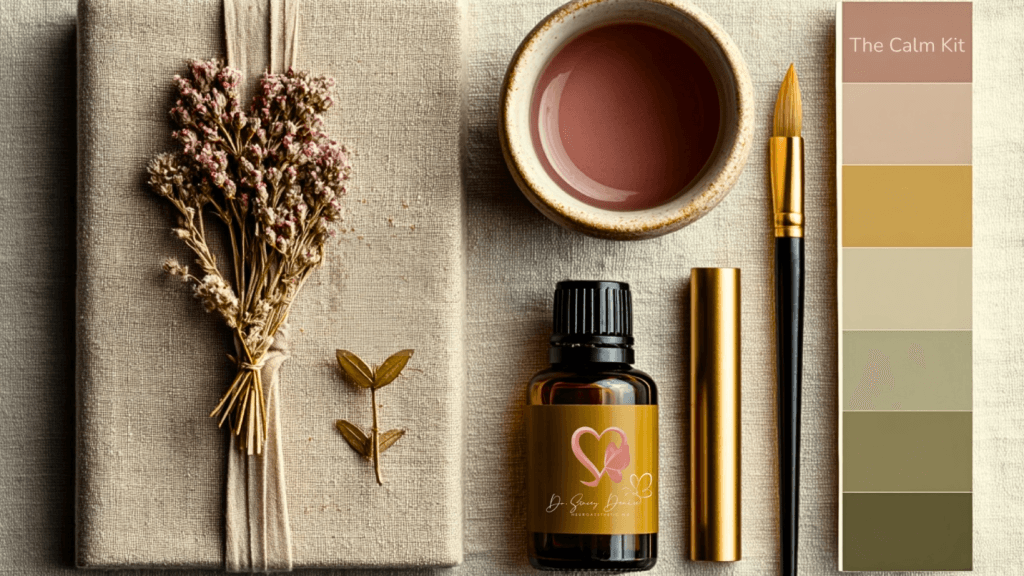
This is Precision Circadian Medicine for Neurodivergent Menopause. And it's why neuroaesthetic design isn't decoration—it's a medical intervention.
The Ritual: 5 Pillars to Design Your Menopause Healing
You don't need a renovation. You don't need to move. You need a nervous system reset that works with your changing hormones, not against them.
Here are the five pillars I use in my practice:
1. Visuals: Color as Cortisol Medicine
For many of us, emotion lives beneath the surface. Alexithymia means you might feel the weight of "sadness" on your chest but have no words for it.
In perimenopause, this gets worse. Your emotional regulation pathways are already scrambled by fluctuating hormones. Talking doesn't always work.
Research shows that engaging with art—whether viewing it or creating it—activates brain networks involved in memory, emotion, and self-understanding. This process helps integrate sensory and emotional experiences, offering a pathway to coherence even when words fail.
Why this matters for menopause: When your nervous system sees a color that signals safety (soft blues, earth tones, warm greens), your amygdala stands down. Your cortisol drops. And your declining estrogen has more bandwidth to regulate your sleep-wake cycle.
The Ritual:
- If you feel chaotic, look at Healing Aqua (soft blue-green that signals water and safety)
- If you feel frozen or flat, look at Magenta Flame (vibrant, activating)
- Let the color enter your eyes and tell your brain what you cannot say
You don't need the language for your feelings to honor them.
2. Biophilia: When Your Estrogen Can't Buffer Threat Anymore
Your nervous system knows what "safe" feels like. It feels like wood, stone, and low light. It does not feel like fluorescent bulbs and polyester.
Before perimenopause, your estrogen helped buffer small threats. You could tolerate the hum of the fridge. The overhead lights were annoying but manageable.
Now? Your sensory threshold dropped. The fluorescent lights feel like an assault. The polyester sheets trigger your nervous system every time you touch them.
Biophilic design brings nature indoors to activate your parasympathetic nervous system (rest and digest). Research confirms that environments with natural materials, gentle lighting, and organic textures lower stress hormones and support cognitive clarity.
For neurodivergent women in menopause, these sensory anchors become critical. Your estrogen can't protect you from overstimulation anymore. Your environment has to do the work.
The Ritual:
- Swap one plastic object for something real—a wooden bowl, a stone paperweight, a living plant
- Replace overhead fluorescent lights with warm-toned lamps (this also supports melatonin production at night)
- Add one natural texture to your bedroom (linen sheets, wool throw, cotton curtains)
Watch your shoulders drop. Watch your sleep improve.
3. Sound: Brown Noise for a Nervous System That Can't Filter Anymore
The vagus nerve responds to rhythm and resonance. The hum of modern life is often the wrong frequency for a neurodivergent brain.
And in menopause? Your auditory processing changes. Sounds you used to tune out now register as threats.
Brown noise (lower frequency than white noise) dampens the sharp edges of the world. It's not a trend—it's a biological tool that helps your nervous system filter what your dropping estrogen can no longer filter for you.
The Ritual:
- Turn on a brown noise playlist or heavy rain track at night
- Use it as a "sonic blanket" that muffles the threat signals (refrigerator hum, traffic noise, neighbor sounds)
- Let your nervous system register: "The predator sounds are gone. We can rest."
This is circadian medicine. Because when your nervous system feels safe, your melatonin can peak. And when your melatonin peaks, you sleep.
4. Scent: Frankincense for a Brain That's Lost Its Safety Anchor
Scent is the only sense that bypasses the thalamus (the logic center) and goes straight to the amygdala—your emotional core.
For women navigating perimenopause, this becomes powerful. Your thinking brain is already overwhelmed trying to manage fluctuating hormones, sleep deprivation, sensory overload.
Aromatherapy bypasses all of that and speaks directly to your threat detector.
Why this matters for menopause: When you inhale a scent that signals safety, your amygdala stands down. Your cortisol drops. Your vagus nerve activates. And your body can finally shift into the rest-and-digest mode where healing happens.
The Ritual:
- When you cross the threshold of your home, inhale Frankincense
- It signals to your ancient brain: The hunt is over. We are safe now.
- Lavender for sensory overload. Peppermint for ADHD focus. Bergamot for emotional lift.
Scents don't ask you to feel. They remind you that feeling is still possible.
5. Taste: Gustatory Satisfaction When Your Metabolism Is Recalibrating
Stop force-feeding yourself "healthy" textures that make you gag.
For neurodivergent women, eating isn't just about nutrition—it's about regulation, safety, and identity. Many live in a body that reacts strongly to taste, texture, temperature, and scent.
And in perimenopause? Your metabolism is recalibrating. Your insulin sensitivity is shifting. Your relationship with food changes.
I call this Gustatory Satisfaction. It means nourishment includes pleasure, flavor integrity, and texture sensitivity.
Why this matters for menopause: Your body is already under stress from hormonal shifts. Forcing yourself to eat textures that trigger sensory aversion raises your cortisol even more. Your nervous system can't heal when it's force-fed.
The Ritual:
- Create flavor rituals that match your metabolic needs: protein-rich meals with textures you actually enjoy
- Prioritize texture-friendly meals that respect sensory thresholds—soft, smooth, or layered dishes that don't overstimulate
- Use aesthetic plating and slow savoring as daily sensory mindfulness
Your plate becomes your palette. And when your nervous system feels nourished, your sleep improves.
"I created neuroaesthetic medicine because I watched too many women get told their menopause symptoms were 'just stress.' Your biology is not your failure. Your environment is your medicine."
When Your Nervous System Needs More Than Design
If you are reading this and thinking, "Dr. Stacey, I optimized my space and I still can't sleep," I hear you.
Sometimes the block isn't just in your environment—it's in your hormones, your cortisol rhythm, your thyroid, your iron, your nutritional genomics.
This is where precision medicine comes in.
As a physician specializing in circadian biology and sleep architecture, I look at when your body produces melatonin, when you burn fat, when you heal. Because menopause isn't just about estrogen. It's about your entire metabolic and circadian system recalibrating.
I'm just saying.
If you are ready to stop guessing and start sleeping, take the first step:
Step 1: Identify Your Sleep Pattern
Take the Sleep Quiz to find out which Sleep Saboteur is keeping you awake—the 2 a.m. Crash, the Bathroom Bandit, or Wired and Tired.
Step 2: Understand How Color Regulates Your Nervous System
🎧 Listen: Color Is a Reset
In this episode, I walk through exactly how I use color as a biological tool for menopause—not decoration, but nervous system medicine. You'll learn:
- Why certain colors activate your amygdala (and which ones calm it during perimenopause)
- How to build a personal color palette that regulates your emotions when hormones can't
- The neuroscience of why "looking at blue" isn't woo-woo—it's polyvagal therapy for dropping estrogen
Step 3: Get a Real Plan
If you're in Texas or Ohio, I can be your doctor. We'll look at your hormones, your metabolic markers, your sleep architecture, your nutritional genomics—and build a plan that fits your neurology and your menopause transition.
Schedule a 60-Minute Clarity Call.
The World I'm Building
I am building a world where:
Women like Vivienne are not gaslit. They are validated. Their sensory collapse in perimenopause is recognized as biology, not "just stress."
Black women are not dismissed. They are seen. Their sleep disruption and metabolic shifts are treated as the medical emergencies they are.
Autistic women are not forced to mask. They are celebrated. Their need for sensory-safe environments is honored as a medical requirement, not a preference.
Menopause is not a crisis to survive. It's a phase to thrive in—when your environment supports your changing neurology instead of fighting it.
Your bedroom is not just a room. It's medicine. It's where your melatonin peaks, your cortisol drops, and your body heals.
Your genes are not your destiny. Your environment is your choice. And when you design your space to work with your nutritional genomics and circadian biology, you stop fighting your body and start supporting it.
I want to be known globally for one thing:
I teach women that safety is a medical intervention.
And I show them how to create it in their homes, in their bodies, in their menopause.
This is Precision Circadian Medicine for Neurodivergent Menopause.
Welcome to the practice. Welcome home.
Dr. Stacey Denise
Board-Certified Physician | The Neuroaesthetic MD™
Founder, The Color Reset Method™ & The Neuroaesthetic Reset™
www.drstaceydenise.com | @drstaceydenise
References
- Lane, S.J. et al. (2019). Sensory processing and emotional regulation. Journal of Occupational Therapy.
- Fredrickson, B.L. (2000). The undoing hypothesis: Positive emotions undo cardiovascular reactivity. Psychological Science.
- Magsamen, S. (2019). Your Brain on Art: How the Arts Transform Us.
- Khatib, A. et al. (2024). Biophilic design and stress reduction in neurodivergent populations. Frontiers in Built Environment.