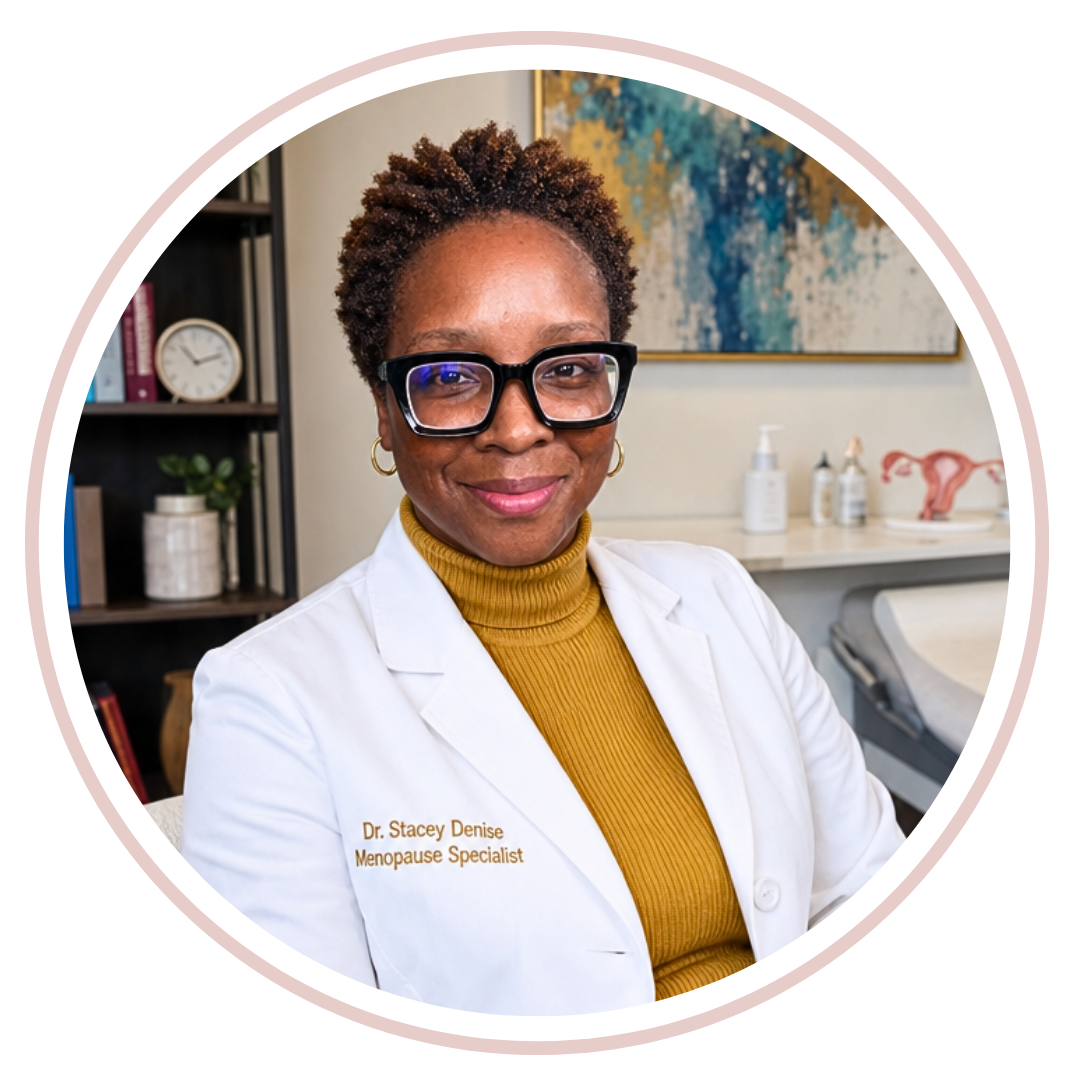
Why I Don't Take Insurance as a Menopause Doctor
I want to tell you why I walked away from insurance-based medicine. Not because I burned out—though I did. Not because the paperwork was exhausting—though it was. I walked away because I couldn’t be the menopause doctor my patients needed inside that system, and the women who needed me most were the very ones it failed the hardest.
Fifteen Minutes Is Not Medicine
Let me tell you how it works when you have insurance.
You call your doctor about the night sweats that started six months ago, the brain fog that makes you forget words mid-sentence, the weight that shifted to your midsection even though nothing about your eating has changed, the anxiety that showed up out of nowhere and now sits on your chest every morning. You get an appointment three weeks out.
When you finally see your provider, you have 15 minutes. Maybe 12 after they finish reviewing your chart. In that window, your doctor is supposed to hear your symptoms, connect them to your history, consider your labs, weigh your options, document everything for billing, and somehow arrive at a treatment plan.
Fifteen minutes for a body in transition. Fifteen minutes for symptoms that touch every system you have. Fifteen minutes for a woman who may have already been dismissed by two or three other providers before she landed in that chair.
It was never enough. It will never be enough.
What I Saw From the Inside
I trained in surgery. I worked in critical care. I have stood in rooms where seconds mattered and made decisions that could not wait. And I have also stood in rooms where the system moved so fast that no one stopped to ask the right questions.
I watched women get prescribed antidepressants when what they needed was progesterone. I watched providers glance at lab results, see numbers inside the reference range, and tell women "everything looks normal" when those women were barely holding their lives together. I watched colleagues order imaging and referrals and follow-ups because there was no time to sit with the patient and actually listen to what she was saying.
I watched my own mother nearly undergo a procedure she did not need because no one slowed down long enough to advocate for a different path.
The physicians were not the problem. Most of them were doing the best they could inside a structure that was never built for this kind of care. The structure was the problem, and I couldn't keep pretending the structure was going to fix itself.
The Science They Did Not Teach Us
Here is something I learned after residency.
I remember sitting across from a woman in her late 40s. She wasn't sleeping. Her mood had shifted. Her body felt strange to her. And I realized I had almost nothing to offer her. Not because I was a bad physician, but because no one had taught me to recognize menopausal symptoms.
According to a study out of the Mayo Clinic, only about 7% of residents in family medicine, internal medicine, and OB-GYN felt adequately prepared to manage menopause, and more than 20% received no lectures on the subject at all. About a third of them said they would not even offer hormone therapy to a symptomatic woman with no contraindications. (DOI: 10.1016/j.mayocp.2018.08.033)
So what does that mean?
We train physicians to deliver babies, to perform procedures, to manage pregnancy. But we don't train them to take care of women as they transition through menopause, and then we send them into practice with almost nothing to offer women in their 30s and 40s who have either undergone surgical menopause or are transitioning naturally later in life.
I don't see this as an accident. This is a system that decided menopause care and women's health is not worth learning.

What Weathering Does to a Body
Let me tell you about what I'm actually seeing.
I had a woman sit across from me. She was 47. She had not slept through the night since her mid-30s. Her blood pressure was elevated. She had been so tired for so long that she didn't even remember what rest felt like. Her body felt like it belonged to somebody else. And she had been told, over and over again, your labs are normal.
Listen. The research that explains what is happening to her was performed by Dr. Arline Geronimus at the University of Michigan, and she coined the term allostatic load. This is when the biological cost of stress is held in the body for a long period of time. It elevates cortisol, it increases blood pressure and inflammatory markers, it changes your metabolism. The wear and tear that accumulates when a nervous system never fully gets to rest. (DOI: 10.2105/AJPH.2004.060749)
What she found made me pause.
Black women carry the highest allostatic load of any group in the United States, and it's not explained by income. Poor Black women had the highest scores. Affluent Black women had the second highest. At every income level, Black women were carrying more biological stress than their white counterparts.
She called this weathering.
By age 45, half of Black women in that study had elevated allostatic load scores. By 64, more than 80% did.
Sit with that.
I'm just saying, when a woman like this walks into my office, menopause is not landing on a blank slate. It's landing on a body that has already been carrying weight for decades. A body that has been told to push through, to stay silent, to tough it out. A body that learned early on to keep going no matter the cost.
And when you only have 15 minutes with her, you will never see that.
That's why I had to build something different.
Why I Chose Cash Pay
When I opened my practice, I made a decision. No insurance. No 15-minute visits. No pretending I could do this work inside a system designed to move women through as fast as possible.
My initial consult is 90 minutes.
Ninety minutes to hear the whole story. To understand not just what your symptoms are, but when they started, what else was happening in your life at that time, what you have already tried, what you are afraid of, what you are hoping for. I ask about your sleep. I ask about your stress. I ask about your nervous system, your history, your relationships with the medical system before you found me. I ask what it has been like to live in your body.
And then I listen.
This is not luxury medicine. This is what medicine is supposed to be.
What Happens When Someone Actually Sees You
Here is what happens when there is time.
I can connect the insomnia to the cortisol pattern and connect the weight gain to the insulin resistance and connect the anxiety to the progesterone drop. I can see that your symptoms are not random, they are a story your body is telling, and it makes sense once someone takes the time to read it.
I can order labs that actually answer questions instead of checking boxes. I can build a plan that starts with your nervous system, because nothing else works if your body is still stuck in survival mode. I can follow up with you and adjust what is not working instead of sending you back into a queue for another three-week wait.
I can say things like, your symptoms make sense in the story of your life. I can say, this is not your fault, this is your physiology. And I can mean it, because I have actually heard enough of your story to know.
The Cost Question
I know what you are thinking. Cash pay sounds expensive.
And I understand why. On the surface, it seems like insurance would save you money. But here is what insurance-based menopause care actually costs when you add it all up: the copays for appointments that do not help, the prescriptions that get denied, the referrals to specialists who also do not have time, the supplements you buy because no one gave you a real plan, the months of trial and error, the lost productivity, the relationships that strain because you are exhausted and no one can tell you why.
Cash pay is transparent. You know what you are paying and you know what you are getting. And when the care actually works the first time, you stop spending money on care that doesn't.
I accept HSA and FSA. I provide superbills you can submit for potential reimbursement. I am not trying to make this inaccessible. I am trying to make it actually work.
Who This Is For
I built this practice for women who have been through the system and come out the other side without answers.
Women who have been told their labs are normal when they know something is wrong. Women who have been handed antidepressants when what they needed was someone to ask about their sleep. Women who have been weathering for decades and are finally ready for care that sees the whole picture.
Black women. Autistic women. Sensory-sensitive women. Women who have learned to mask and push through until their bodies refused to keep going.
You are not losing control. Your hormones are recalibrating. And you deserve a physician who understands what that actually means.
Your Next Step
If you are in Texas or Ohio and ready for something different, I invite you to book a 90-Minute Deep Dive Consult.
We will map your symptoms, review your history, and build a plan that fits your body and your life. I will ask about your sleep, your stress, your nervous system. And I will listen.
No rushing. No dismissing. No "your labs are normal" when you know something is wrong.
Just someone finally seeing the whole story.
P.S. Want to understand your sleep patterns before we meet? Take the free Sleep Pattern Decoder Quiz and find out which Sleep Saboteur is disrupting your nights.
SOURCES CITED
- Kling JM et al. "Menopause Management Knowledge in Postgraduate Family Medicine, Internal Medicine, and Obstetrics and Gynecology Residents." Mayo Clinic Proceedings. 2019. DOI: 10.1016/j.mayocp.2018.08.033
- Geronimus AT et al. "'Weathering' and Age Patterns of Allostatic Load Scores Among Blacks and Whites in the United States." American Journal of Public Health. 2006. DOI: 10.2105/AJPH.2004.060749