When “It’s Just Your Hormones” Becomes Harmful: A Menopause Doctor’s Take
You did not imagine the shift.
Your sleep changed. Your body shape changed. Your moods started moving in ways that don't feel like you. One day your brain is sharp, the next you can't find a word you've used a thousand times. You're hot, then freezing, then fine. Your labs keep coming back normal.
And everywhere you turn, the message sounds the same: it's your hormones. Balance them and everything falls into place.
So you try the protocol. The pellets. The supplements. The hormone reset program.
And if you still feel off — if the protocol doesn't fix it — the story quietly turns on you. You didn't try hard enough. You must not want it badly enough. Maybe you're too stressed. Maybe you need more mindset work.
I want to say something before we go any further.
That is not a clinical assessment. That is shame wearing a wellness label.
Hormones Matter. They Are Not the Whole Painting.
As a board-certified surgeon who transitioned into lifestyle medicine specializing in the menopause transition, I prescribe hormone therapy. I believe in it when it's appropriate, when the timing is right, when the risk profile supports it. Estrogen, progesterone, testosterone, cortisol, insulin — I take all of it seriously.

But here is what I've also learned, from years of clinical practice and from being a Black woman navigating this same medical system from the other side of the exam table: if your gut is dysregulated, your sleep is destroyed, and your nervous system has been running in a threat state for twenty years — adding hormones is like painting a house with a crumbling foundation. The paint might look good for a minute. The structure is still compromised underneath.
Sleep, the gut, and the nervous system are not separate departments. They are one system. Fix all three and the hormones have somewhere to land. Ignore two of them and wonder why nothing is working.
That's not a philosophy. That's the clinical reality I see repeatedly — and it's the piece most hormone-focused content never mentions.
What the Hormone-Only Story Does to Black and Brown Women
The hormone-optimization wave has done real good. It has pushed menopause care into the mainstream. It has challenged physicians who undertreated women for decades. Some of that was necessary.
But here is what happens when hormones become the only lever in the conversation.
A woman tries the protocol and it doesn't fully work. And because the story only has one answer — hormones — the failure has nowhere to go except back onto her. She didn't do it right. She's not committed enough. She's too stressed. This is reduction dressed up as empowerment.
For Black and brown women, that reduction lands on top of something much older.
Serena Williams had to fight to be believed about her blood clots after childbirth. She is one of the greatest athletes who has ever lived and they still almost let her die because someone did not take her symptoms seriously. That is not an anomaly. That is a pattern medicine built.
I reviewed the literature in PubMed and came across a University of Virginia study that found that half of white medical students and residents endorsed false biological beliefs about Black patients — including that Black people's skin is thicker and their nerve endings less sensitive — and those who held these beliefs rated Black patients' pain lower and made less accurate treatment recommendations. This was published in the Proceedings of the National Academy of Sciences. (DOI: 10.1073/pnas.1516047113)
Let that land. Half of people in medical training. Believing that Black people feel less pain because of the color of their skin. Think about what that means biologically — the same neuroanatomy, the same pain pathways, the same signal traveling from the peripheral nervous system to the brain. There is no biological mechanism that makes pain less real in a Black body. None. This is mythology that got laundered into medical education and was never fully corrected.
So when a Black woman walks into that perimenopause appointment and feels like she is on trial instead of being cared for — she is reading a room that medicine built. Her body already knows this history. Her nervous system has been registering it for decades.
The Body That Arrives at Menopause
Dr. Arline Geronimus introduced the weathering hypothesis in 1992. The premise is this: Black women's health deteriorates earlier than white women's not because of genetics but because of the cumulative biological cost of living in a society that extracts from them continuously.
Based on articles retrieved from PubMed, Geronimus and colleagues found that Black women had higher allostatic load scores than white women at every age studied — particularly between 35 and 64. Both poor and non-poor Black women ranked highest. These racial differences were not explained by poverty. (DOI: 10.2105/AJPH.2004.060749)
Read that again. Even non-poor Black women carried the highest biological wear and tear scores. Because this is not about resources. This is about what the body pays for living in a race-conscious society over a lifetime.
By the time a Black woman reaches her late forties, her body has already been carrying a load that most clinical trials were never designed to account for. Her cortisol has been running differently. Her inflammatory markers tell a different story. Her nervous system has been operating at a lower-grade threat level for longer than the hormone-reset industry has ever asked about.
And then perimenopause hits. And the hormonal buffer that was quietly managing some of that load starts to shift.
The hormone protocol wasn't built for that body. It was built for a body that arrived at menopause with a different history.

What the SWAN Data Confirmed
The Study of Women's Health Across the Nation followed racially and ethnically diverse women for over two decades. It is the most important longitudinal study of menopause in existence.
Based on articles retrieved from PubMed, SWAN documented significant racial and ethnic differences in vasomotor symptoms, sleep, cardiovascular health, and psychological wellbeing across the menopause transition. Black women reported more frequent and more severe hot flashes and night sweats than white women, and these symptoms persisted longer. (DOI: 10.1097/GME.0000000000001424, DOI: 10.1016/j.ogc.2011.05.006)
And in a 2022 SWAN analysis, hormone therapy was associated with higher quality of life in white women — but lower quality of life in Black women on the same therapy. (DOI: 10.1097/GME.0000000000002087)
The same intervention. Different outcomes by race.
The science confirmed what Black women's bodies already knew and were not being believed about.
Where I Start Instead
I trained as a surgeon. I came up in an institution where the standard of care was built on data that mostly excluded women — and nearly entirely excluded Black women. I learned to work inside that system, and I also learned its limits from the inside.
I'm also completing my trauma certification through the Trauma Research Foundation — because I kept seeing women whose labs looked managed and whose nervous systems were still running old survival programs that no hormone protocol had ever touched.
The nervous system connection: Estrogen does quiet regulatory work throughout the body — including in the brain's threat-detection circuits. When it drops, some of that regulation goes with it. For Black women who have been carrying allostatic load for decades, that shift can feel like the floor dropping out. The sensory overwhelm gets louder. Sleep gets harder. The masking that used to be automatic starts to fail. That is not anxiety. That is a biology that finally ran out of buffer.
The neurodivergent consideration: Many late-diagnosed autistic and ADHD women describe perimenopause as the moment their coping stopped working — not because they changed, but because the hormonal scaffolding underneath shifted. A hormone-only lens will never explain that. A whole-system lens will.
I still prescribe hormones when they're appropriate. And I also ask questions nobody asked me when I was the patient: What has your nervous system been carrying? How long has your cortisol been dysregulated? What is your gut doing with the estrogen your body is still producing? What does your environment do to your threat response every day?
Because fixing the paint when the foundation is compromised is not care. It's management. And women in perimenopause deserve more than managed.
A Quick Filter for Menopause Advice That Feels Wrong
When menopause content makes you feel scolded or defective, you're allowed to question it. You don't need a medical degree to ask:
Does this person make one thing the hero? "It's all hormones," "It's all gut," "It's all mindset" are all flags. Real clinical medicine lives in the land of "it depends."
Do they acknowledge that Black and brown women face different outcomes and different barriers? If race never enters the conversation, the plan was probably not built with you in mind.
Do they shame women when results aren't fast or linear? That is the program's failure, not yours.
Do they tell you to change medications without involving your clinician? That is a safety issue.
Step away from what doesn't serve you. That is not giving up. That is discernment.
When to Escalate Clinically
If you've tried the protocols and still don't feel like yourself — the missing piece may not be a different hormone. It may be that nobody has looked at the full picture yet.
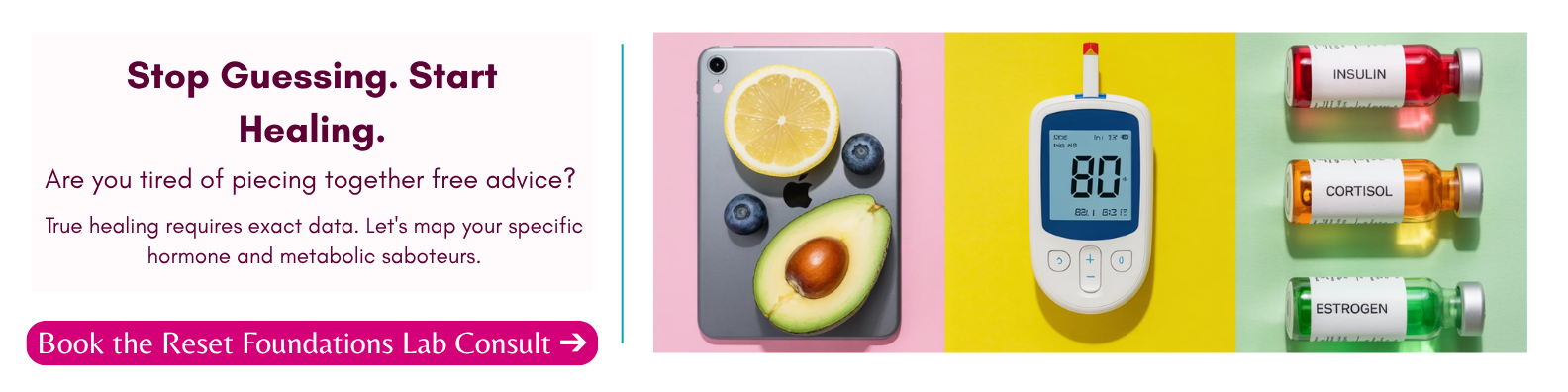
I order comprehensive labs before our first appointment. Reproductive hormones, adrenals, thyroid, metabolic markers — the complete clinical picture — because I want to walk into that conversation knowing what your body is dealing with, not guessing.
If you're in California, Georgia, Kentucky, Maryland, Ohio, Texas, or Virginia, book a Reset Foundations Consult here.
Take the Next Step
Your body is not the problem. The framework you've been given may simply be too small for the body you're actually living in.
Start with the free Color Archetype Quiz — five minutes and a personalized nervous system map that shows you where stress, gut, and sleep disruption are showing up in your body right now.

Sources
Hoffman KM et al. Racial bias in pain assessment and treatment recommendations, and false beliefs about biological differences between blacks and whites. Proceedings of the National Academy of Sciences. 2016. DOI: 10.1073/pnas.1516047113
Geronimus AT et al. "Weathering" and age patterns of allostatic load scores among Blacks and Whites in the United States. American Journal of Public Health. 2006. DOI: 10.2105/AJPH.2004.060749
El Khoudary SR et al. The menopause transition and women's health at midlife: a progress report from SWAN. Menopause. 2019. DOI: 10.1097/GME.0000000000001424
Thurston RC, Joffe H. Vasomotor symptoms and menopause: findings from SWAN. Obstetrics and Gynecology Clinics of North America. 2011. DOI: 10.1016/j.ogc.2011.05.006
Christmas M et al. Menopause hormone therapy, quality of life, and racial/ethnic differences: SWAN. Menopause. 2022. DOI: 10.1097/GME.0000000000002087
Dr. Stacey Denise is a board-certified surgeon transitioned into lifestyle medicine specializing in the menopause transition. She sees patients in California, Georgia, Kentucky, Maryland, Ohio, Texas, and Virginia.