7 Ways to Use Light to Lift Your Mood — A Trauma-Informed Guide for Women in Perimenopause
Updated: April 2026
I get SAD. Not as a figure of speech — I mean Seasonal Affective Disorder, the kind that shows up in the fall like an uninvited houseguest and doesn't leave until April. I grew up in Cincinnati, where the winters are gray and long and the sun disappears for months at a time. And I didn't fully understand what was happening in my body every November until I started connecting the science of light to the science of the nervous system — and realized they're the same conversation.
If you've ever noticed that your mood, your energy, your sleep, and your ability to function feel dramatically different depending on the season or the time of day — you're not imagining it. You're not being sensitive. Your nervous system is reading the light around you and making biological decisions based on what it finds. And in perimenopause, when your hormonal buffer is already thinning, those decisions hit harder and faster than they used to.
Here's what I know from both the research and my own body — and seven practical ways to start using light as the mood tool it actually is.
First — Why Light Hits Differently in Perimenopause
So when you add declining estrogen, a dysregulated nervous system, and light-depleted winters together, you get a woman who isn't just tired — she's biologically under-resourced. And light is one of the most direct resources she can reach for right now.
Here are seven ways to start.
1. Get Morning Light Within the First Hour of Waking
This is the single most important thing on this list. I'm just saying.
Natural light in the morning — even overcast daylight, even through a window — sends a direct anchoring signal to your circadian clock that tells your entire hormonal cascade what time it is. Cortisol peaks appropriately. Serotonin starts rising. Melatonin gets the signal that it's done its job and steps back. Your mood regulation system gets a clean start.
You don't need to go for a run. You don't need to sit in direct sun for thirty minutes. Two to five minutes of outdoor or ambient daylight exposure within the first hour after waking — with your phone not in your hand — is enough to begin resetting the clock. Make it a ritual. Coffee on the porch. A walk to the end of the driveway. Your body knows what to do with it.
2. Know What Each Light Tone Is Telling Your Nervous System
Your nervous system isn't just registering that there is light. It's reading the tone of the light and drawing conclusions about what time of day it is and whether it's safe to relax.
Here's the shorthand I use in my practice:
White light signals vigilance. It says be alert, stay sharp, the day is happening. This is appropriate during work hours. It's disruptive at 9pm.
Yellow light signals warmth and safety. It says you're okay, you can soften a little. This is your late afternoon and early evening tone.
Red and amber light signals closure. It says the day is ending, the nervous system can begin its descent. This is your evening and pre-sleep tone — and it's the only light that won't interfere with melatonin production when you need to get up at 3am.
Most women I work with have their homes lit in white or blue-spectrum light from sunrise to midnight and then wonder why they can't transition into sleep. Your nervous system can't read a bedtime story in the same lighting it reads a spreadsheet.

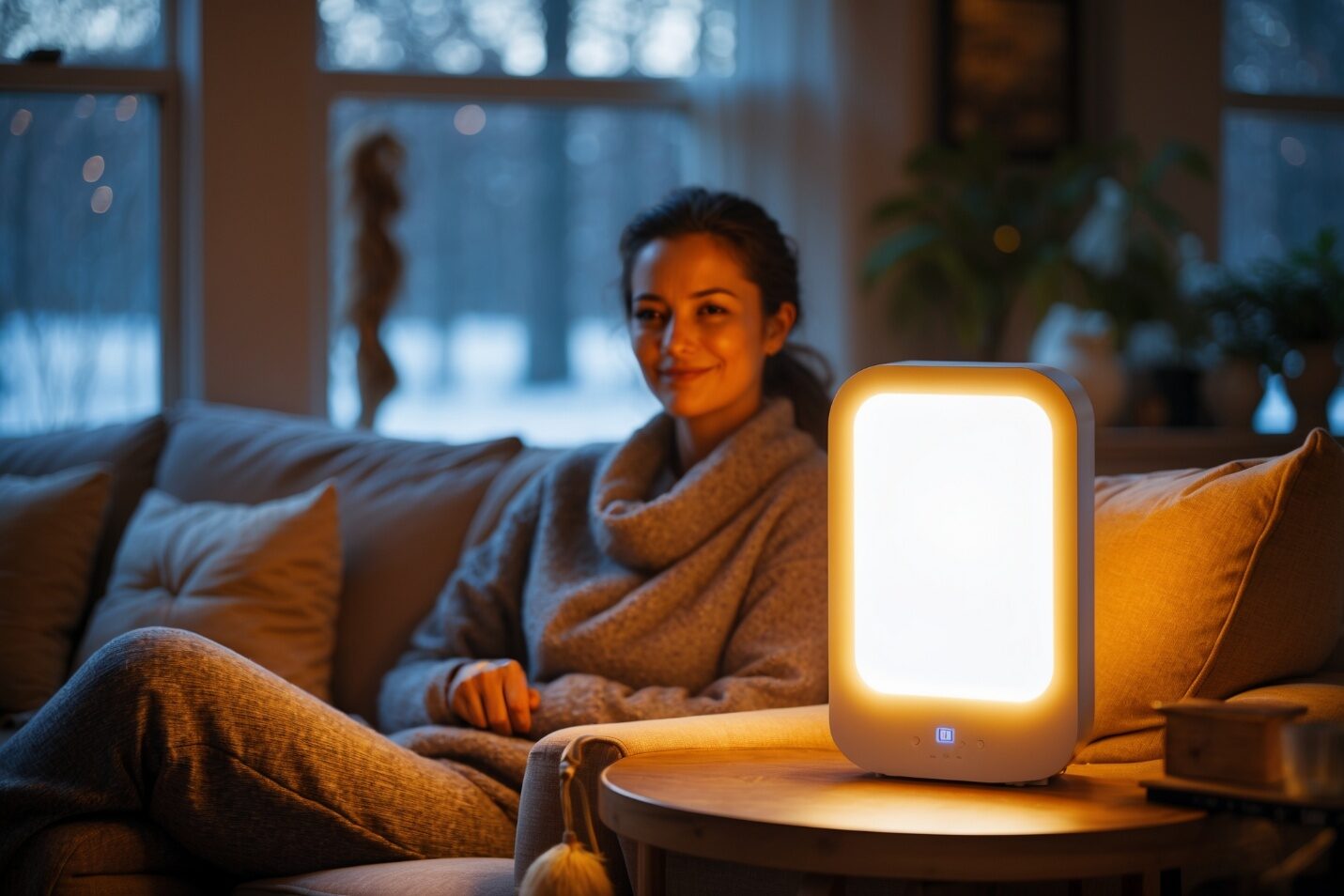
3. Try a Light Therapy Lamp — Especially in Fall and Winter
If you live somewhere with limited winter daylight — or if you notice your mood reliably drops between October and March — a light therapy lamp is worth serious consideration. This isn't a wellness accessory. It's a clinical tool.
A bright light therapy lamp — typically 10,000 lux, used for twenty to thirty minutes in the morning — mimics the intensity of natural daylight and has been shown to effectively treat Seasonal Affective Disorder and non-seasonal depression by resetting the circadian clock and supporting the serotonin-melatonin pathway. The research on this goes back decades and it's consistent.
Position it at eye level or slightly above while you eat breakfast, drink your coffee, or do your morning reading. Don't look directly into it. Just let it do its work while you do yours.
4. Use Red or Amber Light for Nighttime Bathroom Trips
I've talked about this before and I'll keep talking about it because it changes the second half of so many women's nights.
When you wake at 2 or 3am and flip on a bright white overhead light, your brain reads it as dawn. Melatonin drops. Your nervous system begins preparing to wake up. And then you lie back down in the dark wondering why you can't get back under — and the answer is that you just sent your circadian clock a false sunrise signal.
A twelve-dollar red or amber night light in your bathroom is a clinical sleep intervention. Your brain doesn't read red-spectrum light as a wake signal. You can navigate safely, do what you need to do, and return to bed without resetting your entire hormonal clock. Try it for one week.
5. Build a Light Arc Through Your Day
One of the most grounding practices I teach in the NRM framework is what I call the Light Arc — consciously shifting your light environment to match your body's natural energy arc across the day rather than fighting it with constant artificial light.
It looks like this:
Morning: Bright, white or natural light with movement. Let your body know it's time to be alert.
Midday: Natural light where possible. A walk outside, a window seat, stepping away from the screen.
Evening: Amber and warm light only. Lamps instead of overheads. Candles if that's your thing. Screens down or filtered.
Pre-sleep: Near darkness. Red night light only if needed. Signal to your pineal gland that the day is genuinely done.
This isn't a productivity schedule. It's a nervous system schedule — and for women whose bodies have been running on stress-time and artificial urgency for decades, giving the nervous system permission to follow the actual arc of the day is quietly revolutionary.

6. Let Yourself Have SAD — And Then Treat It
One of the most validating things I can say to you is this: Seasonal Affective Disorder is real, it affects women disproportionately, and it's not a character flaw or a mindset problem. It's a biological response to a light-depleted environment in a body that was designed to follow the sun.
If you notice every fall that you get heavier, slower, more withdrawn, more carbohydrate-seeking, more exhausted, less able to concentrate — that pattern has a name and it has treatments. Light therapy, consistent morning light exposure, vitamin D optimization, and in some cases medication are all legitimate tools. You don't have to power through five months of seasonal depression and call it winter.
If this is you, bring it to your next clinical appointment and name it specifically. You deserve care that matches the season your body is actually in.
7. Honor the Absence of Light Too
This is the one most people miss. Just as your nervous system needs the right light at the right time, it also needs real darkness. Not dim-ish. Not screen-off-but-city-glow-coming-through-the-curtains. Actual dark.
Darkness is the signal that it's safe to shut down, that the day's demands are over, that the nervous system can finally stop scanning for threat. In a world where the earth is never truly dark — streetlights, phone notifications, ambient glow from every device — genuine darkness has become a kind of nervous system luxury. And for women in perimenopause whose HPA axis is already reactive, the absence of darkness is a low-grade continuous stressor that compounds across every night it's missing.
Blackout curtains, a sleep mask that actually fits, red digits on any clocks — these aren't indulgences. They're environmental medicine. Let your nervous system have the dark it was designed to need.
Light is one of the most accessible, most immediate, and most consistently overlooked tools you have for mood regulation, nervous system support, and hormonal health during perimenopause. It doesn't require a prescription. It doesn't require a perfect routine. It just requires paying attention to what your environment is telling your body — and beginning to tell it something truer.
If you want to understand the full picture of what's disrupting your sleep and your mood right now, start with the quiz. It'll tell you which saboteurs are running in your nervous system and where to focus first.
Take the Sleep Saboteur Quiz → drstaceydenise.com/takethequiz
The circadian biology behind all of this lives here: When Your Sleep Won't Come — And the Light in Your Room Is Why →
For how your environment talks directly to your nervous system: Your Home Is Either Medicine or It Is Making You Sick →
New here? Start with the framework: What Is Neuroaesthetics? The Gentle Science of How Beauty Heals Your Brain →
Sources
Rybakowski J. Forty years of seasonal affective disorder. Psychiatria Polska. 2024. DOI: 10.12740/PP/186721
NOTE: This post originated as a general design and lifestyle piece on Ceyise Studios about how to use light to improve mood and eyesight. It's been fully rewritten here on drstaceydenise.com through the trauma-informed clinical lens of the Neuroaesthetic Reset Method™ — weaving in the Light Arc framework, circadian biology, Seasonal Affective Disorder, and what perimenopause does to the nervous system's relationship with light.
Originally published on Ceyise Studios. Updated: April 2026.