Workplace Neuroaesthetics & Menopause: Design Your Space to Think
Updated: April 21, 2026
Let me tell you what I said when a magazine asked me why the information gap around menopause and work still exists.
I said it was a triangulated failure. The medical community hasn't given women the vocabulary to name what is happening to them. Society has conditioned us to treat women's health as a private secret. And corporate culture is still designed for a male hormonal baseline.
Men have aging bodies too. But they don't experience the precipitous drop in the hormones that fuel cognitive resilience. For decades, many women rely on estrogen and progesterone to power through their careers with sheer grit and determination. And when those hormones decline, that grit stops working the same way.
And here is what happens next. A twenty-year veteran — a high-value corporate asset — suddenly feels like she is losing her capacity. She isn't failing. Her body is changing. But her environment is static. And nobody in the building knows what to do about it because nobody was ever trained to ask the right questions.

The Numbers Before We Talk Science
I want to start here because this conversation often gets dismissed as a wellness trend, and it is not a wellness trend. It is an economic reality.
A 2023 study published in Mayo Clinic Proceedings surveyed over 4,400 employed women between the ages of 45 and 60 and found that 13.4% reported at least one adverse work outcome directly caused by menopause symptoms. More than 10% missed work in the preceding year, with a median of three days missed per woman. Based on those numbers alone, the researchers estimated an annual loss of $1.8 billion in the United States — from missed work days only. (DOI: 10.1016/j.mayocp.2023.02.025)
That is $1.8 billion in missed work. That does not count the presenteeism — the woman who is physically at her desk but cognitively running at half capacity because she spent the night fighting hot flashes and woke up on three hours of fragmented sleep.
A cross-sectional study published in Occupational Medicine found that 65% of menopausal employees reported that their work performance was impacted by their symptoms, with fatigue, difficulty sleeping, poor concentration, and poor memory as the most common culprits. Nearly one in five had taken sick leave. And when the researchers asked what the most beneficial workplace supports would be, the top two answers were manager awareness about menopause and flexible working times. Not medication. Not accommodation. Awareness and flexibility. (DOI: 10.1093/occmed/kqad078)
And a 2025 study in Healthcare looked specifically at women physicians — arguably the most high-performing, high-achieving professional demographic you can study — and found that nearly half reported a severe menopausal symptom burden, 40% felt it had negatively impacted their work performance, and a significant proportion reported fewer promotional opportunities as a result. (DOI: 10.3390/healthcare13212699)
Women physicians. Not women who were unprepared for this. Women who had spent their careers understanding the human body, who had every clinical tool available to them, who were still experiencing severe symptom burden with no adequate support system in the workplace built to catch them.
If this is happening to physicians, it is happening to everyone.

The Environment Is Not Neutral
Here is what I want every HR director and every CEO and every well-meaning manager to understand before they reach for a wellness app subscription as the solution.
The physical environment your employees spend eight to ten hours inside every day is either supporting their nervous systems or activating their stress response. This is not a soft claim. It is the clinical foundation of neuroaesthetics — the science of how sensory input shapes biological state — and it has direct implications for the woman in perimenopause whose nervous system is already under hormonal strain.
When estrogen declines, the nervous system loses a significant regulatory buffer. The hypothalamic thermostat becomes more reactive, which is why hot flashes are a sympathetic nervous system activation event, not just a temperature inconvenience. The HPA axis becomes more sensitive to stress signals. Sensory processing thresholds shift. The woman who managed fluorescent lighting and open-plan noise with relative ease at 38 may find both genuinely dysregulating at 48 — not because she has become less resilient, but because the hormonal scaffolding that was absorbing those inputs is no longer present at the same level.
And your office building is still running the same fluorescent lights, the same open-plan acoustics, the same conference room temperature that was set for a 170-pound man in a jacket.
That is not a medical problem. That is a design problem.
What the Neuroaesthetic Workplace Actually Looks Like
I am not talking about putting up motivational posters or painting an accent wall teal. I am talking about four concrete pillars that every company can operationalize without a renovation budget.
Pillar One — Environment.
Light is the most powerful biological input in the workplace and it is almost universally mismanaged. Overhead fluorescent lighting is high-frequency, high-intensity, and activating — which is useful for about four hours of focused cognitive work and genuinely harmful for sustained all-day occupancy. The perimenopausal woman whose sensory threshold has shifted is not overreacting to the lights. She is accurately reporting a dysregulating input that her nervous system can no longer filter the way it once did.
The intervention is not complicated — layered warm-toned lighting at desk level, access to natural light, and dimmer options in spaces designed for recovery rather than output. This is not an accommodation. It is good architecture.
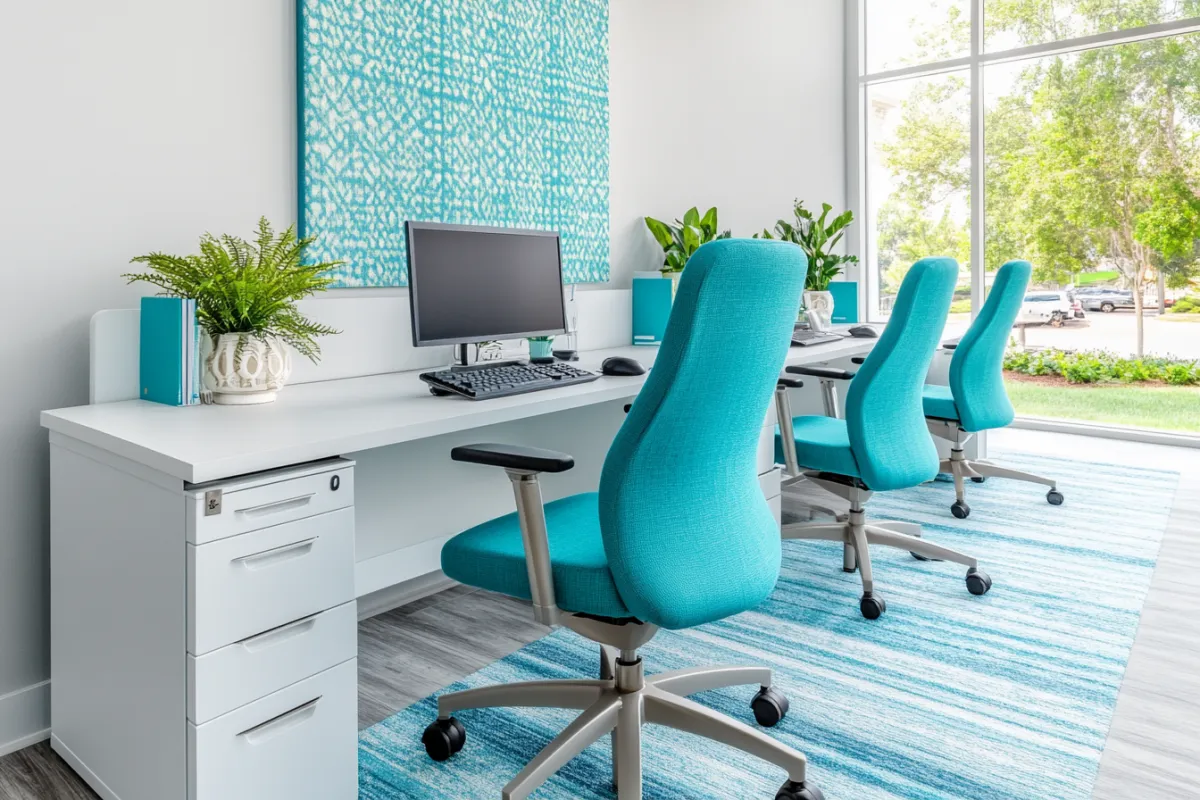
Color follows. Blues and greens in spaces requiring sustained focus and concentration. Warmer earth tones in recovery and collaboration spaces. This is not design opinion — it is the applied science of how spectral input influences cortisol regulation and autonomic tone. The woman managing brain fog does not need a more stimulating office. She needs an environment that is giving her nervous system consistent signals of safety rather than ambient demands.
Temperature is the third element and the most directly relevant for women managing vasomotor symptoms. A personal cooling device at the desk should be standard equipment, the same way a monitor stand is standard equipment. It should not require a conversation with HR, a doctor's note, or a formal accommodation request. It should just be there.
Pillar Two — Policy.
The 1 to 3 PM cortisol dip is not unique to perimenopausal women. It is a biological reality for every human being in your building. The difference is that for the woman navigating perimenopause, that dip lands on top of a nervous system that may have been running elevated cortisol since 3 AM because of fragmented sleep and night sweats.
Designating that window as camera-optional or deep work time is not a special accommodation. It is a performance infrastructure decision. And I want to name the double standard directly, because it is real and it affects retention: if a male CEO puts a 20-minute cognitive rest block on his public calendar, he is optimizing. If a perimenopausal woman needs the same block, she is seen as slowing down. That asymmetry is costing companies their most experienced talent. You are not paying for her hustle. You are paying for her wisdom. And the wisdom needs a recovery window to keep delivering.
The nap post I wrote about this — Why the C-Suite Needs a Siesta — makes the full economic case. A 20-minute nap during the natural circadian dip is not a productivity loss. It is a brain-clearing reset that improves working memory, verbal fluency, and decision quality for the second half of the day. Your Spanish colleagues have known this for generations. The research is now confirming it. The only thing missing is American corporate culture's permission to act on it.
Pillar Three — Metabolic Support.
Walking into a meeting with only bagels and cookies is a metabolic disaster for a perimenopausal woman. Simple carbohydrates drive glucose spikes and crashes that destroy sustained cognition in a nervous system that is already managing elevated cortisol and disrupted insulin sensitivity. This is not a diet preference. It is a neuroscience argument.
Subsidizing whole-food options, providing high-protein choices in meeting catering, and making cold water immediately accessible rather than a three-floor hike away are small infrastructure changes with measurable cognitive return. You cannot ask your most experienced leaders to make complex decisions on a glucose crash and then wonder why their performance is inconsistent.
Pillar Four — Language.
Language shapes what is possible. Right now, corporate culture uses language that makes this entire conversation feel like a burden — menopause accommodation, special needs, aging out. That language guarantees silence, which guarantees the $1.8 billion annual bleed continues.
Replace menopause accommodation with performance optimization. Replace special needs with biological safety. Replace aging out with institutional wisdom.
When you build an environment that supports the biological reality of your most experienced workers, you are not being generous. You are being strategic. You are securing assets that took twenty years to develop and that cannot be replaced by a new hire who still needs fifteen years to catch up.
For the Woman Reading This Who Is Not Waiting on Her Employer
If the company you work for is not there yet — and many are not — I want you to have the framework to advocate for yourself without making it personal.
Advocate from performance, not pain. Don't bring a complaint. Bring a plan. HR is often overwhelmed and genuinely does not know how to help. If you hand them a solution that is framed around productivity rather than accommodation, you make it easy to say yes.
Find your cohort. If you go alone, you risk being labeled a complainer. If you go as a group — women with perimenopause, PCOS, surgical menopause, neurodivergent women navigating sensory overload — you are a demographic with a documented performance gap that requires a solution.
And know your value before you walk in the room. A younger employee might use sheer speed to go from point A to point B to point C. A woman in her fifties with two decades of institutional knowledge can often leap from A to Z in two steps. That is not decline. That is efficiency. And the company that cannot see that is the company that loses her — and pays for the loss for years after she leaves.
The Bigger Picture
The Color Reset Method™ and the Neuroaesthetic Reset Method™ were built for this exact intersection — the woman whose nervous system is navigating a major hormonal transition inside environments that were never designed for her biology. Whether that environment is her home or her office, the principles are the same: safety signals regulate the nervous system, and a regulated nervous system performs.
The workplace piece matters because Vivienne spends more waking hours inside her office than anywhere else. And the office that is wiring her nervous system up rather than winding it down is not a separate problem from her sleep disruption, her brain fog, her afternoon crash. It is the same problem, expressed in a different room.
If you want to understand which patterns are running in your nervous system and which environmental interventions are most likely to help you regulate — the Color Archetype Quiz is where I start with every patient before we change anything else.
Take the Color Archetype Quiz →
And if you are a leader who wants to take this conversation to your organization — let's talk. The Sleep Foundations Lab Session is where we build your personal biological baseline, and from there we can build the case your company needs to hear.
Book a Sleep Foundations Lab Session →
The napping science lives here: Why the C-Suite Needs a Siesta: The $26 Billion Case for Napping in Menopause Leadership →
The home environment piece: From Space to Mind: How Your Home Environment Is Either Wiring You Up or Winding You Down →
The clinical foundation: What Is Neuroaesthetics? The Gentle Science of How Beauty Heals Your Brain →
Sources
Faubion SS et al. Impact of Menopause Symptoms on Women in the Workplace. Mayo Clinic Proceedings. 2023. DOI: 10.1016/j.mayocp.2023.02.025
O'Neill MT, Jones V, Reid A. Impact of menopausal symptoms on work and careers: a cross-sectional study. Occupational Medicine. 2023. DOI: 10.1093/occmed/kqad078
Brent SE et al. Workplace Impact of Menopause Symptoms Among Canadian Women Physicians. Healthcare. 2025. DOI: 10.3390/healthcare13212699
NOTE: This post was originally published on Ceyise Studios, my design and neuroaesthetics platform, and has been brought here to drstaceydenise.com because it is foundational to the clinical work I now do with neurodivergent women navigating perimenopause and menopause. Some of those original posts have been retired. Others have been expanded into updated companion pieces that go further than the original could. Where a newer version exists, you will find a link to it at the top or bottom of this post.
Originally published on Ceyise Studios, October 9, 2022. Updated: April 2026.