When You Can't Clean Because You're Depressed — And You're Depressed Because You Can't Clean
Updated: April 2026
There is a particular kind of paralysis that happens when you are depressed and your home is a mess at the same time, and I want to describe it because most of the advice about decluttering treats it like a motivation problem when it is actually a neurobiology problem.
You look at the pile. The pile is real. The pile has been there for days or weeks or longer, and part of your brain knows it is making everything worse, and another part of your brain cannot even begin to figure out where to start, and the gap between knowing and doing is so wide that you sit back down and nothing happens and you feel worse about yourself and the pile does not get smaller.
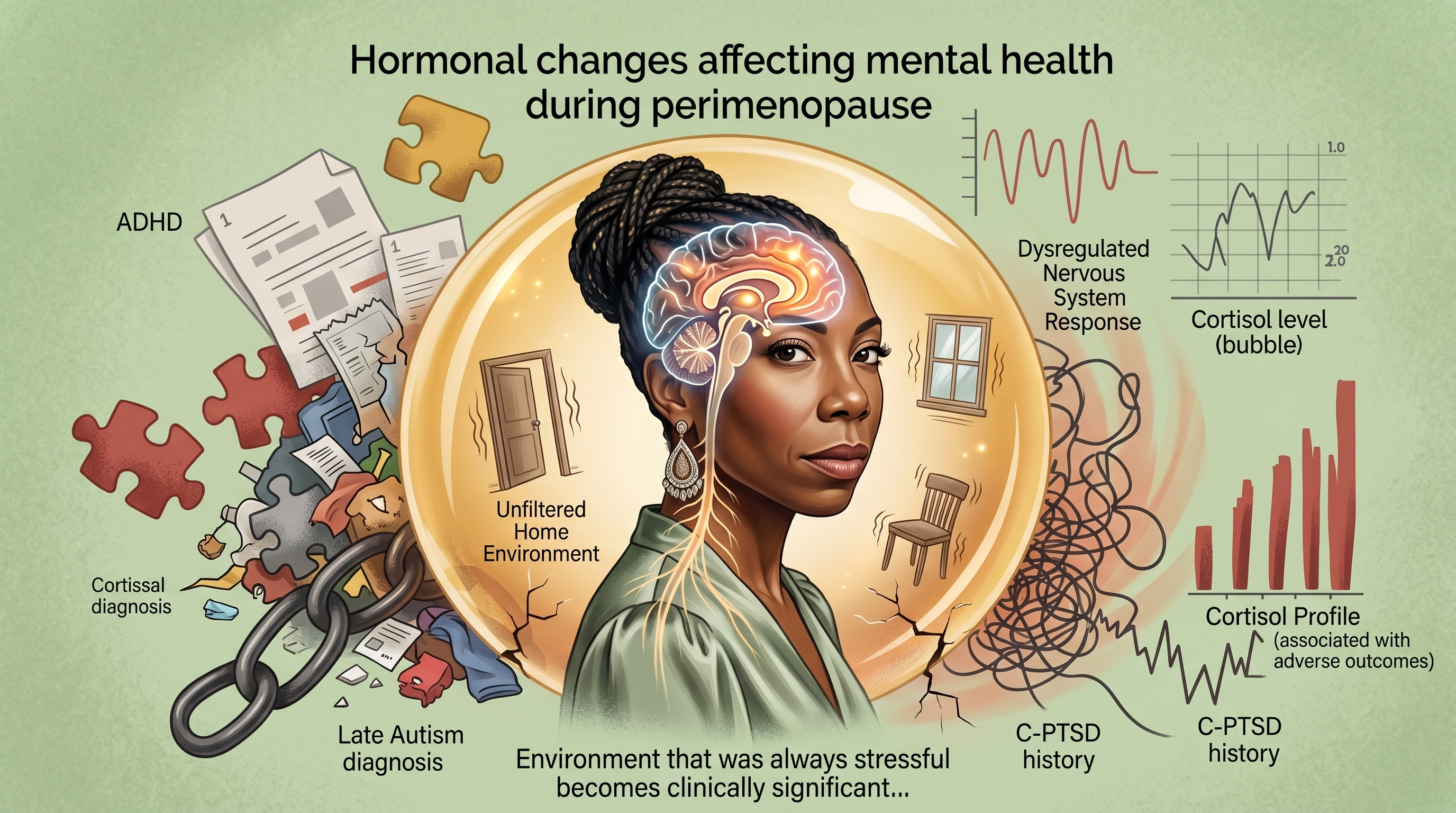
That is not laziness. That is what happens when depression has flattened the executive function that initiates tasks, when ADHD has made sequencing and prioritization feel impossible, when perimenopause has removed the last of the hormonal scaffolding that was helping you manage both, and when the environment is actively feeding back into the nervous system state that makes all of it harder.
The mess and the mood are in a loop. And understanding the loop is the first step to breaking it.

What Your Home Is Doing to Your Cortisol Right Now
I came across a UCLA study published in Personality and Social Psychology Bulletin that I think about every time a patient describes her home to me in terms that carry shame and exhaustion and the sense that everything is out of control, and what the researchers found was this — women who described their homes using language associated with clutter and unfinished tasks had measurably flatter diurnal cortisol slopes across the day, and flatter cortisol slopes are a pattern that the research consistently associates with adverse health outcomes including depression, fatigue, and immune dysfunction. (DOI: 10.1177/0146167209352864)
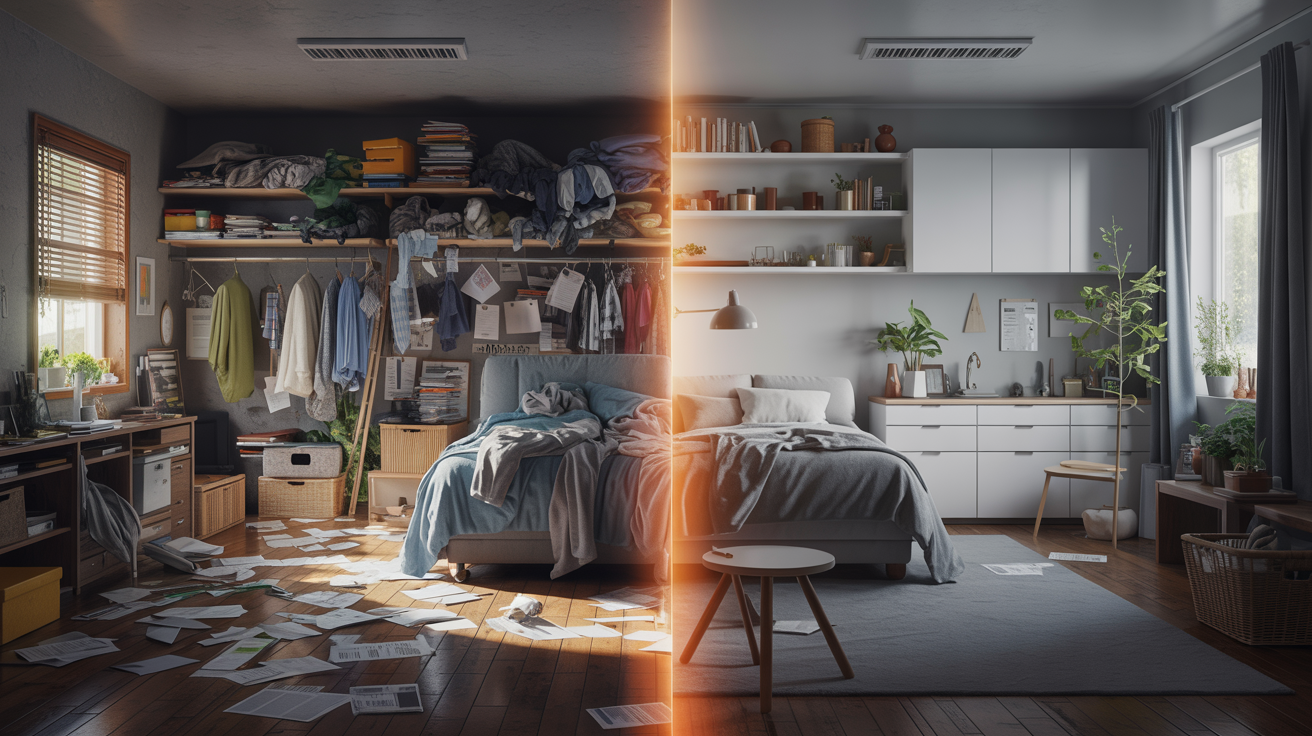
And the reverse was also true. Women who described their homes with restorative language — words associated with rest, nature, order — had steeper cortisol slopes and decreased depressed mood across the day.
What that means in practical terms is that your home environment is not just reflecting your mood. It is contributing to the biological stress load that is shaping your mood, and it is doing this through your cortisol system, continuously, whether you are consciously attending to the mess or not.
Your nervous system is scanning the environment at all times. Piles of unfinished things register as unfinished demands. Disorder registers as something that requires processing. And for women in perimenopause whose estrogen is no longer buffering the HPA axis the way it used to — whose cortisol response is already more reactive, whose recovery from stress is already slower — a chronically cluttered environment is a low-grade but continuous stressor that costs something every single day.
This is not a character judgment. This is physiology.
The Perimenopause Layer Nobody Talks About
A 2024 review in The Lancet — the most rigorous menopause mental health review I have read in years, synthesizing 12 prospective studies — confirmed something important about depression and the menopausal transition that I want to name clearly, because it changes the clinical picture in a way that matters for how we think about this. (DOI: 10.1016/S0140-6736(23)02801-5)
The review found that depression during the menopausal transition is not universal — it is not simply something that happens to every woman at midlife — but it is significantly elevated in specific subgroups, and those subgroups are defined by factors including vasomotor symptoms that disturb sleep, a longer duration of the transition, and stressful life events. And critically, the risk for major depressive disorder was highest in women who had a history of previous depression — meaning women whose nervous systems had already learned a particular stress-response pattern.
For women with ADHD, for late-diagnosed autistic women, for women with a history of C-PTSD who have been managing a dysregulated nervous system for decades — perimenopause does not create the depression so much as it removes the hormonal buffer that was helping contain it. And then the environment that was always stressful becomes clinically significant in a way it was not before.
The pile that was always there becomes the thing that is now contributing to a cortisol profile associated with adverse health outcomes. The home that was always imperfect becomes the environment that is feeding back into a nervous system that no longer has the same capacity to filter it.
This is why standard decluttering advice does not work for this population. You cannot motivation-hack your way out of a neurobiological loop. You need a different approach entirely.
The ADHD and Autistic Brain and Clutter — It Is Not What You Think
I want to hold something that the original version of this post did not hold, which is that for some neurodivergent women, clutter is not the enemy.
For some ADHD brains, visual access to everything is a functional system. Objects on surfaces are a memory aid — out of sight genuinely does mean out of mind, and the pile on the desk is the working memory system that executive dysfunction cannot maintain internally. Forcing this woman into a minimalist environment is not calming. It is disabling. Her chaos has a logic that nobody else can read, and she can find anything in it.
For some autistic women, the familiar arrangement of their things — even if it looks chaotic to everyone else — is a sensory anchor, a predictable visual field that tells their nervous system nothing has changed and everything is still in its place. Disrupting that arrangement in the name of decluttering can genuinely dysregulate the nervous system it was supposedly helping.
The question is not whether your home is cluttered. The question is whether the clutter is working for your nervous system or against it, and that answer is specific to you and to what state you are in right now.
What I find in my practice is that the clutter stops working — that the visual field that used to feel like productive chaos starts feeling like overwhelm — in perimenopause, because the estrogen that was buffering sensory processing is declining and the brain can no longer filter the environmental input the way it used to. The pile that was a functional system at 38 has become a stressor at 48, not because anything changed about the pile but because the nervous system processing it has less capacity.
When that shift happens, it is worth paying attention to. Not with shame, but with clinical curiosity.
What Actually Works — The Nervous System Approach
The original post said start small, track your progress, ask for help. Those are not wrong but they are missing the biological layer that makes them workable for this population.
Here is how I think about this through the NRM framework.
The first move is not cleaning. It is regulation.
Because if your nervous system is in sympathetic overdrive — if you are wired and tired, if the pile is making you more anxious the longer you look at it, if the executive function required to start the task is not coming online no matter how long you sit there — cleaning is not the entry point. Regulation is. Walk outside for ten minutes. Put on a binaural beat. Hum. Do whatever your nervous system needs to come down from the edge of the window of tolerance, because below that edge is where choices become possible and above it they do not.
Then pick the one thing that is costing you the most.
Not the whole room. Not the whole house. The one surface that your eyes land on from wherever you spend the most time resting. The one pile that is closest to your bed or your eating space or wherever your nervous system is supposed to be able to downshift. Clear that one thing. Not because it will fix everything but because your nervous system is reading that surface constantly and giving it a signal of order changes the cortisol feedback even when nothing else has changed.
The UCLA study showed that the language women used to describe their homes — the stressful words versus the restorative words — correlated with their cortisol and their mood across entire days. One cleared surface is one piece of the environment moving from stressful language to restorative language. It is small. It is real. It counts.
Ask for help without waiting until you deserve it.
This is the piece that depression makes hardest. Depression tells you that you have to have tried harder and failed more visibly before you are allowed to ask someone to come and sit with you while you sort. That is not true. You do not earn the right to help by suffering alone first. A body double — someone who is simply present in the space while you work — is a clinically documented support for ADHD executive function. Your brain is more likely to initiate and sustain a task when someone else is in the room. That is not weakness. That is how some nervous systems work.
Let go of what was working at 38.
If the system that was holding your home together for the last ten years is no longer working, that is information about your nervous system right now, not a verdict about your character. Perimenopause changes the way your brain processes sensory input. A system that worked before estrogen started declining may need to be rebuilt for the brain you have now. That is not failure. That is adaptation.
The Bigger Picture
The link between clutter and depression runs in both directions and the research is clear on that. Your environment is feeding your mood and your mood is feeding your capacity to change your environment, and when perimenopause adds a nervous system under hormonal strain on top of ADHD executive dysfunction on top of decades of masking and managing — the loop can feel genuinely unbreakable.
It is not.
But breaking it requires understanding that this is a nervous system problem before it is an organizational problem, and that the sequence matters — regulate first, then act, then build the environment your nervous system actually needs now, not the one it managed in a different hormonal chapter.
If you want to understand which patterns are running in your nervous system right now and which environmental interventions are most likely to help you regulate — the Color Archetype Quiz is where I start with every patient before we talk about anything else. Because the home that heals you and the home that harms you are not generic categories. They are specific to your nervous system state, and that state changes as perimenopause progresses.
Take the Color Archetype Quiz →
The Polyvagal framework underneath all of this lives here: Your Home Is Either Medicine or It Is Making You Sick →
For the space clearing ritual version of this work: Rituals for Clearing Space: Why Your Neurodivergent Brain in Perimenopause Needs This More Than You Know →
Start here if you are new: What Is Neuroaesthetics? The Gentle Science of How Beauty Heals Your Brain →
Sources
Saxbe DE, Repetti R. No place like home: home tours correlate with daily patterns of mood and cortisol. Personality and Social Psychology Bulletin. 2010. DOI: 10.1177/0146167209352864
Brown L et al. Promoting good mental health over the menopause transition. The Lancet. 2024. DOI: 10.1016/S0140-6736(23)02801-5
NOTE: This post was originally published on Ceyise Studios, my design and neuroaesthetics platform, and has been brought here to drstaceydenise.com because it is foundational to the clinical work I now do with neurodivergent women navigating perimenopause and menopause. Some of those original posts have been retired. Others have been expanded into updated companion pieces that go further than the original could. Where a newer version exists, you will find a link to it at the top or bottom of this post.
Originally published on Ceyise Studios, July 17, 2024. Updated: April 2026.