From Space to Mind: How Your Home Environment Is Either Wiring You Up or Winding You Down
Updated: April 2026
She is exhausted by 3pm.
She could fall asleep at her desk. She drags herself through dinner, through the evening routine, through whatever is left on the list, and the moment she finally gets into bed and turns off the light, something shifts — and she is wide awake, her brain doing laps, her body tense, her nervous system convinced it is not finished with the day yet.
That is not a willpower problem. That is not a sleep hygiene problem in the standard checklist sense. And it is not — before anyone says it — just stress.
That is a nervous system that never got the signal that it was safe to downshift, and in many cases, that signal was never given because the environment she came home to and spent her evening inside never sent it.
I want to talk about what your home is doing to your brain. Because for neurodivergent women in perimenopause, the spaces we inhabit are not neutral — they are either working with our nervous systems or working against them, and that difference shows up at 2am when the ceiling is the only company we have.
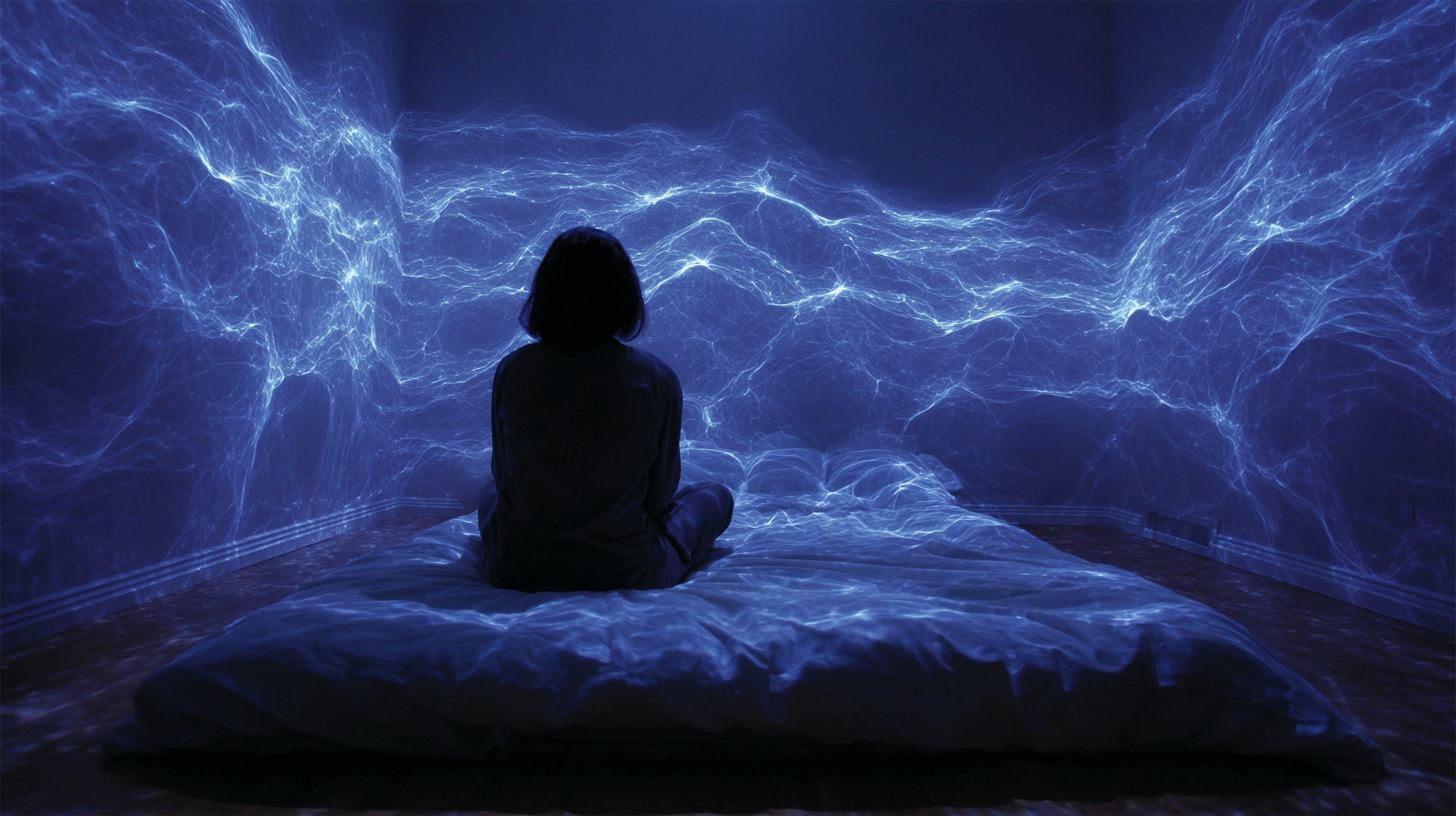
The Wired and Tired Pattern — And Why Your Home May Be Feeding It
If you have ever taken the Sleep Saboteur Quiz and landed on the Wired and Tired profile, you already know part of this story — your nervous system runs too hot for too long, it cannot find the brake, and by the time you need to sleep your cortisol curve has gone the wrong direction.
What the quiz captures in your symptom pattern, your environment is capturing in real time every single evening. Because here is what is happening from a circadian biology standpoint: your brain needs a series of environmental cues across the late afternoon and evening hours that tell it the day is ending, threat detection can downshift, and melatonin production can begin. Light is the most powerful of those cues. Temperature is the second. Sound and visual complexity are the third and fourth.
And most homes — most modern, ordinary, well-intentioned homes — are sending the wrong signals on all four of those channels simultaneously.
The Light Problem Your Home Is Probably Creating
A 2018 systematic review in Chronobiology International looked at 128 studies on light exposure and circadian rhythm and found that two hours of evening exposure to blue-spectrum light — the kind emitted by overhead lighting, screens, and most modern LED bulbs — measurably suppresses melatonin production, with the maximum suppressing effect coming from the shorter wavelengths at the cooler end of the spectrum. (DOI: 10.1080/07420528.2018.1527773)
What that means in practical terms: if you are watching television under bright overhead lights from 7pm until 10pm, your brain's melatonin window — the hormone that signals your body it is time to transition toward sleep — is being chemically blocked by the light in your own living room. By the time you turn the lights off, your melatonin has not risen. Your cortisol has not fallen. And your nervous system is sitting in a biologically awake state that has nothing to do with how tired you feel and everything to do with the spectral content of the light you just spent three hours bathing in.
For the neurodivergent woman whose sensory system is already more reactive to light than neurotypical peers — the woman who has always needed sunglasses sooner than everyone else, who finds fluorescent lights physically aversive, who notices light quality in a way most people cannot explain — this suppression is not subtle. It is the difference between a nervous system that was already at the edge of its regulatory capacity having the one environmental support it needed pulled out from under it.
The correction is not complicated, but it requires intention. Warm amber light sources — lamps, candles, salt lamps, smart bulbs set below 2700K — in the spaces where you spend your evenings, transitioning to lower and warmer light after 7pm, and screens off or filtered with warm-tone apps at least an hour before bed. Not because wellness culture said so, but because the circadian biology is clear that the light in your environment is setting your melatonin clock whether you are paying attention to it or not.

The Temperature Your Body Is Asking For
A 2019 randomized controlled trial published in Indoor Air measured sleep quality, REM sleep duration, and morning cortisol concentrations in subjects sleeping in rooms at different temperatures and with different airflow conditions, and what it found was that even a small excess heat load — a room that was slightly too warm with inadequate airflow — led to significantly reduced total sleep time, reduced REM sleep, and morning cortisol concentrations that were measurably higher than in subjects who slept in thermally neutral conditions. (DOI: 10.1111/ina.12599)
Higher morning cortisol from a bedroom that was three degrees too warm. Not from a traumatic event or a crisis — from the temperature of the room.
For perimenopausal women whose thermoregulation is already disrupted by the narrowing of the thermoneutral zone that comes with falling estrogen — the women whose hot flashes are not just uncomfortable but are actually sympathetic nervous system activation events that spike cortisol and fragment sleep architecture — the thermal environment of the bedroom is a clinical variable, not a comfort preference.
The bedroom should be cooler than the rest of the house in the evening, typically in the 65 to 68 degree range, with airflow that moves across the body evenly. For women whose hot flashes are nocturnal, a ceiling fan that circulates air without a cold blast, breathable natural fiber bedding, and removing the electric blanket from the mix are not small choices. They are the difference between a nervous system that gets to downregulate and one that keeps firing because it is too hot to stop.
What Visual Complexity Is Doing to Your Sleep
This is the one most people never think about, and for neurodivergent women it may be the most important piece.
Your nervous system does not stop processing your visual environment when the lights go down. It processes everything your eyes take in during the hours before sleep and uses that input to maintain or reduce its state of activation. A visually complex, cluttered, or chaotic bedroom — a room where the surfaces are covered, where unfinished tasks are visible, where the visual field has no place to rest — is a room that keeps your brain's threat-scanning system lightly engaged even when you are trying to wind down.
For the ADHD woman whose executive function system is already working overtime to manage a world full of competing inputs, the bedroom that doubles as an office or a storage space or a laundry staging area is not a rest environment — it is another workspace, and her nervous system knows it.
For the autistic woman whose sensory processing system registers every object in her visual field whether she is consciously attending to it or not, visual complexity in the sleep environment is a continuous low-grade sensory load that her nervous system has to work to filter, and that filtering costs regulatory capacity she needs for sleep.
The bedroom — specifically the visual field from your pillow — should have as little information density as possible. One surface cleared. One object that your nervous system associates with safety and rest. Unfinished work moved out of the room or covered. The goal is not minimalism as an aesthetic. It is visual quiet as a nervous system instruction: nothing here requires your attention. You are allowed to stop.
Sound Is Not Just Noise — It Is Information
Your nervous system is scanning for threat through sound during the hours before sleep and throughout the night, and certain sound profiles keep the threat detection system lightly activated even when you are asleep.
For neurodivergent women with auditory sensitivities — the woman who wakes at every creak of the house, who cannot tolerate the HVAC cycling on and off, whose partner's breathing patterns register as stimuli worth monitoring — the sound environment of the bedroom is not background. It is foreground, even when her conscious mind is not attending to it.
What the research on autonomic regulation and sound consistently shows is that irregular, unpredictable sounds — sudden peaks in volume, environmental sounds that vary in timing — keep the nervous system in a light alert state that prevents the deep, restorative sleep stages where the brain does its repair work. Consistent, low-frequency sound — brown noise, a fan, the soft and unchanging hum of a white noise machine — provides an acoustic mask that the nervous system can predict and therefore stop monitoring.
For the Wired and Tired sleep saboteur specifically, the sound environment is often the final piece of a nervous system that has done everything right and still cannot cross into sleep, because the acoustic field of her bedroom has not been cleared of the unpredictable inputs that keep her threat detection system lightly running.
Designing Your Space for Sleep — The NRM Approach
I want to give you something practical here because everything I have described above has a corresponding design intervention, and none of them require a renovation.
Light: After 7pm, turn off overhead lights and switch to one or two warm-toned lamps at floor or table level. If your bedroom has no dimmer, get one lamp with a warm bulb on a timer. Screen filter or off by 9pm.
Temperature: Drop the bedroom thermostat two degrees lower than the rest of the house before you get into bed. If night sweats are a dominant symptom, a ceiling fan on low, moisture-wicking natural fiber sheets, and removing any synthetic bedding is the intervention. Cool the room before you need to, not after the sweat wakes you.
Visual field: Clear one surface that your eyes land on from the bed. Move one category of visual complexity out of the bedroom — even temporarily. The goal is not a perfect room. It is one visual anchor that says to your nervous system: this space is tended and quiet.
Sound: If the acoustic environment of your bedroom is unpredictable, introduce a consistent sound source before sleep. A brown noise playlist, a fan on low, or a small white noise machine. Let your nervous system stop monitoring the field.
Scent: This is the sensory channel most people skip and it is the one with the most direct pathway to your limbic system and your emotional regulation network. A scent you associate with rest — lavender, chamomile, sandalwood — diffused or applied to your pillow before bed is a conditioned cue that tells your nervous system this is the sequence that means sleep is coming.
Do You Know Which Sleep Saboteur Is Running in Your Body?
The Wired and Tired pattern is one of five sleep saboteur profiles that show up in neurodivergent women navigating perimenopause, and each one has a different relationship to the environment, a different set of triggers, and a different intervention hierarchy.
If you have not yet identified your specific pattern, the Sleep Saboteur Quiz is where I start with every new patient before we do anything else — because treating the hot flash hijack the same way you treat the 2am crash, or the bathroom bandit the same way you treat the wired and tired, is why so many women have tried everything and nothing has fully worked.
The quiz takes a few minutes and gives you your specific pattern, so the environmental interventions and the clinical interventions can go in the right order.
Take the Sleep Saboteur Quiz →
The Polyvagal Theory framework underneath all of this lives here: Your Home Is Either Medicine or It Is Making You Sick →
For the color layer of your sleep environment: Color Is Not Decoration: What the Color Reset Method™ Reveals About Your Nervous System →
And start here if you are new to this work: What Is Neuroaesthetics? The Gentle Science of How Beauty Heals Your Brain →
Sources
Tähkämö L, Partonen T, Pesonen AK. Systematic review of light exposure impact on human circadian rhythm. Chronobiology International. 2019. DOI: 10.1080/07420528.2018.1527773
Lan L, Xia L, Tang J, Zhang X, Lin Y, Wang Z. Elevated airflow can maintain sleep quality and thermal comfort of the elderly in a hot environment. Indoor Air. 2019. DOI: 10.1111/ina.12599
NOTE: This post was originally published on Ceyise Studios, my design and neuroaesthetics platform, and has been brought here to drstaceydenise.com because it is foundational to the clinical work I now do with neurodivergent women navigating perimenopause and menopause. Some of those original posts have been retired. Others have been expanded into updated companion pieces that go further than the original could. Where a newer version exists, you will find a link to it at the top or bottom of this post.
Originally published on Ceyise Studios. Updated: April 2026.