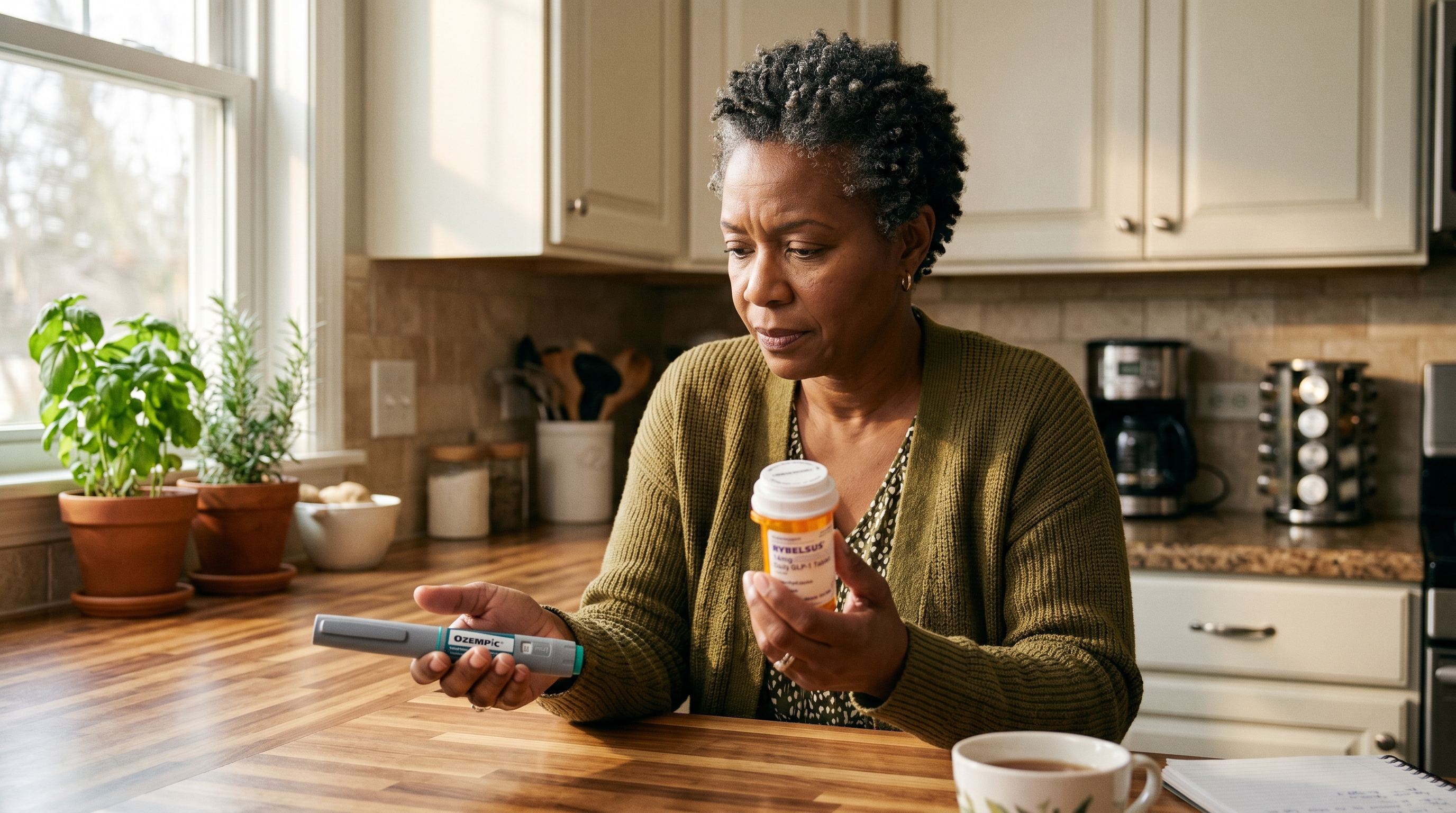
GLP-1 Pills vs Injections for Midlife Women
GLP-1 Pills vs Injections: How to Choose When You're a Midlife Woman With a Busy Brain
If you only remember one thing from this post, let it be this.
The best GLP-1 option isn't the strongest one. It's the one your nervous system, your schedule, and your menopause brain can actually live with week after week. Pills and injections aren't just different formats - they create different demands on your routine, your attention, and your body. And if nobody has asked you about your routine, your sensory reality, or what your mornings actually look like before writing you a prescription, that's a problem worth naming.
Why Format Matters When You're Already Overloaded
If you're a midlife woman juggling work, caregiving, and a body that feels different every month, you don't have infinite bandwidth for one more complicated medication routine. If you're autistic, ADHD, alexithymic, or a high-masking woman who has been running on compensatory strategies for decades, that bandwidth can be even tighter - especially now, when perimenopause is lowering the hormonal buffer that used to help you hold everything together.
Daily oral GLP-1s come with very specific timing rules around fasting, water, and food. Oral semaglutide requires a strict pre-dose fasting window because absorption drops significantly without it - which means mornings with complex rules, every single day. Weekly injections can feel emotionally bigger at first, but in real life, they're often easier to remember and easier to fit around a dysregulated schedule. A once-weekly ritual you can set, track, and forget about is a different cognitive load than a daily pill with conditions.
The question isn't which one is better in a vacuum. The question is which one your nervous system can actually follow without falling apart.
Setting Expectations So You Don't Quit Too Early
GLP-1 treatment feels different from most diets because your hunger signals change - but it still takes time to find a dose and routine your body tolerates. Here's what helps my patients stay steady, especially in perimenopause and menopause.
Appetite and cravings often shift before the scale does. Early wins look like smaller portions, fewer urgent cravings, and easier food decisions - not an overnight clothing-size drop. Dose changes are a big deal for your nervous system. Many side effects are really dose-change effects, so pacing and meal strategy matter, especially if your gut and stress system were already running hot before you started. Weight loss is rarely linear. For midlife women, hormones, sleep, and stress can move the scale even when the plan is working exactly right.
The one that doesn't get talked about enough: low appetite can quietly become low nutrition. That's where fatigue, hair shedding, constipation, and mood shifts show up - especially for women who already have narrow safe foods, sensory-based eating patterns, or interoceptive differences that make it hard to notice when they've undereaten. Protein, fluids, and strength training aren't optional here. And your job throughout this process is to bring patterns. You report what you're noticing - appetite changes, bowel changes, sleep, routine. My job is to interpret those patterns and adjust the plan safely.

Pills vs Injections: What You Actually Need to Know
Most GLP-1 questions get simpler when you separate three things. What the medication is changing biologically. What your daily routine has to look like for your nervous system, gut, and sleep to tolerate it. And what would count as a red flag in your specific situation.
Online, people talk like one option is magic and another is weak. In clinic, the pattern is different. The best option is the one you can access, tolerate, afford, and stay consistent with - while we protect muscle, micronutrients, mood, and midlife brain health.
Oral GLP-1s require stricter timing and empty-stomach rules. That's a significant ask if mornings are already chaos or your executive function is stretched thin. For autistic, ADHD, or high-masking women, remembering a pill with complex conditions every single day may drain more capacity than a once-weekly injection. Many women find that a small weekly injection becomes a Sunday night ritual they can set and forget. Side effects overlap across both formats - nausea, reflux, slower digestion, constipation - because they come from how GLP-1s slow the gut and change appetite signaling, not from the delivery device. And no pill or pen replaces protein, strength training, sleep, nervous system regulation, and a realistic plan for stress and gut health. The format is a tool. The foundation still has to be built.
A Practical Plan for Deciding
You don't need a perfect plan. You need a plan your body and nervous system can repeat.
Be honest about preference and sensory reality. If the thought of injections makes your whole body brace, say that. If swallowing pills or fasting triggers sensory or trauma responses, say that too. Preference matters because adherence matters - and a plan you won't follow is not a plan.
Map the routine before you choose. What time of day does this pill need to be taken? What are the food and water rules? What happens if you work nights or care for kids who need you in the morning? Do the same for injections. What day of the week? How do you handle travel? Ask how missed doses are handled. The rules for a missed pill versus a missed injection are different. Knowing the plan ahead of time prevents panic and unsafe guessing.
Build a side-effect prevention plan from the start. Regardless of format: smaller meals, lower-fat foods during titration, consistent hydration, gentle movement, and fiber introduced slowly. Track more than weight. Note appetite changes, bowel habits, sleep quality, energy, and mood. These patterns tell us whether the plan is working for you - not just the scale.
Minimum Nutrition Foundation When Appetite Is Low
When appetite drops, many women under-eat without realizing it. For neurodivergent women who already have narrow safe foods, this can become a real clinical problem. This is the floor, not the ceiling.
Fluids first. Sip water consistently through the day. If you're eating less, consider electrolytes to prevent weakness, dizziness, and headaches. Protein anchor at every meal - yogurt, eggs, fish, lean meat, tofu, beans, or a tolerated protein shake. This protects muscle, steadies appetite, and supports brain function. Fiber slowly - too much too fast worsens bloating, too little worsens constipation. Introduce gradually. Colorful produce and quality protein become more important as portions shrink, because each bite needs to carry more nutritional weight. Gentle movement after meals - even a short walk - supports digestion, blood sugar, sleep, and mood. You don't have to crush workouts to protect your body on a GLP-1.
The Questions My Patients Actually Ask
Which works better for weight loss - pills or injections? There isn't a single best option. The most effective plan is the one you're eligible for, can tolerate, can afford, and can pair with realistic habits around food, movement, and sleep. For some women, an oral option fits best. For others, a weekly injection gives steadier results.
Are side effects different between pills and injections? Side effects overlap significantly - mostly GI symptoms like nausea, fullness, and constipation - because they come from how GLP-1s slow the gut and change appetite signaling. Intensity varies by person, dose, titration speed, and what else your nervous system is already carrying.
Can I switch if what I start with isn't working? Sometimes, yes. Switching should always be clinician-directed so doses can be adjusted safely, side effects managed, and labs monitored. Don't self-adjust or buy compounding pharmacy look-alikes online. That's where serious problems show up.
I'm scared of injections. Can you help with that? Absolutely. Many women are surprised at how small the needles are and how quick the process is. We walk through the device step by step, pair it with a calming ritual, and choose a day and time that feels doable for your nervous system.
Are GLP-1 pills I see online or on social media legitimate? Be cautious. Prescription GLP-1 medications should come from a licensed clinician and a legitimate pharmacy. Products marketed as GLP-1 pills with no prescription may be ineffective, unsafe, or counterfeit. If you're unsure, bring the product name to your visit and we'll check it together.
When to Escalate Clinically
GLP-1s in my practice are never a standalone product. They are one tool inside a framework that looks at stress, gut, sleep, hormones, and your nervous system together. We start with a Reset Foundations Consult and baseline labs so I have the full picture of what your hormones, your stress response, your thyroid, and your metabolic markers are actually doing before we decide whether a GLP-1 belongs in your plan at all. If it does, we choose the format your nervous system and schedule can realistically hold, build a clear titration and follow-up plan, and establish a floor for protein, micronutrients, sleep, and nervous system regulation so the medication doesn't become another stressor on top of everything else.
If you're in California, D.C., Georgia, Kentucky, Maryland, Ohio, Texas, or Virginia and you're curious about GLP-1s but need a clinician who understands menopause, neurodivergence, and stress load, that's exactly where we start.
Take the Next Step
If you want to explore whether a GLP-1 belongs in your plan - with comprehensive labs reviewed before we ever meet - book a Reset Foundations Consult.
Sources - via PubMed and Clinical Literature
Davies MJ et al. Efficacy of liraglutide for weight loss among patients with type 2 diabetes: the SCALE Diabetes randomized clinical trial. JAMA. 2015. DOI: 10.1001/jama.2015.9676
Avgerinos I et al. Oral semaglutide for type 2 diabetes: a systematic review and meta-analysis. Diabetes, Obesity and Metabolism. 2020. DOI: 10.1111/dom.13899
Wilding JPH et al. Once-weekly semaglutide in adults with overweight or obesity. New England Journal of Medicine. 2021. DOI: 10.1056/NEJMoa2032183
Scott Butsch W et al. Nutritional deficiencies and muscle loss in adults with type 2 diabetes using GLP-1 receptor agonists: a retrospective observational study. Obesity Pillars. 2025. DOI: 10.1016/j.obpill.2025.100186
This article is for educational purposes only and does not constitute medical advice, diagnosis, or treatment. The information provided is intended to support informed conversations with your healthcare provider, not to replace clinical evaluation. Individual health decisions should be made in consultation with a licensed clinician who has reviewed your personal history, symptoms, labs, and medications. If you are experiencing symptoms that may require urgent attention, seek care from an appropriate medical provider.