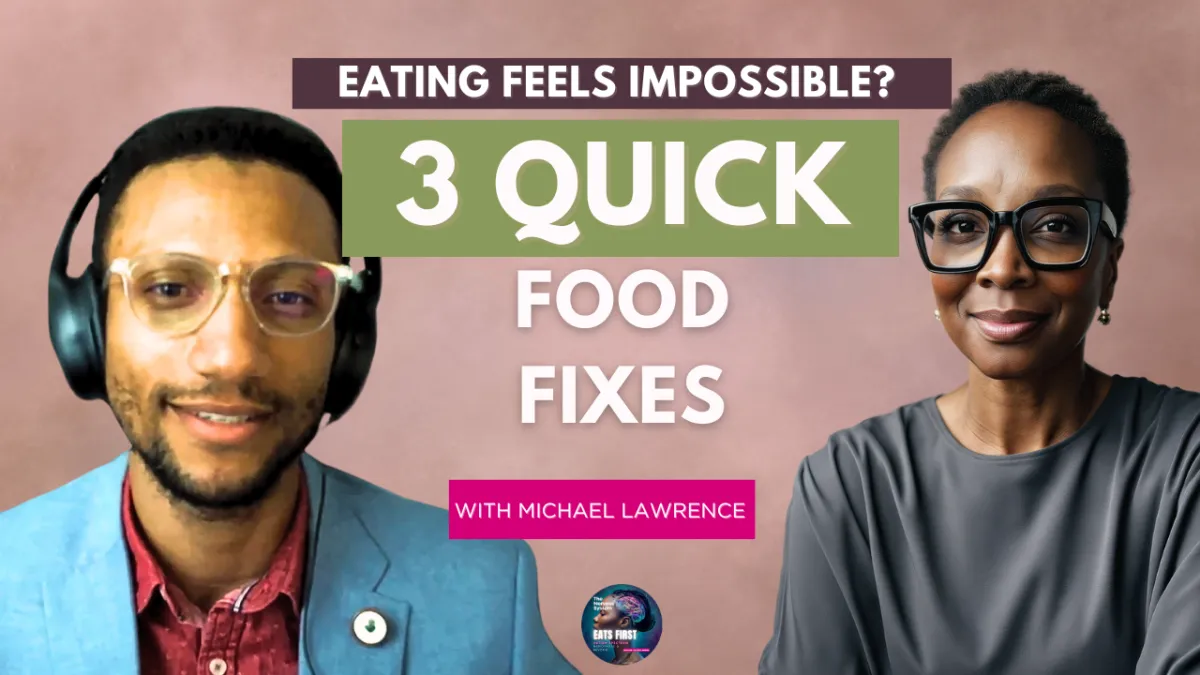
How Your Eating Environment Affects Your Nervous System
Your Dining Room Is Speaking to Your Nervous System Before You Take a Single Bite
Have you ever noticed how the same meal can feel completely nourishing in one space — and taste like absolutely nothing in another?
Maybe you eat standing at the counter most mornings, rushing, half-dressed, already mentally three steps ahead of where you are. Maybe you've eaten lunch in your car more times than you'd like to count. Maybe you've sat in a bright, loud restaurant and found yourself barely tasting anything even though the food was technically good.
That's not in your head. That's your nervous system telling you something your fork can't fix.
I came to this conversation already knowing that what we eat matters enormously for a perimenopausal nervous system — the estrobolome, the gut-brain axis, the histamine load, all of it. You follow what I'm saying? But what I hadn't fully sat with until I talked with Michael Lawrence was how much the WHERE and HOW of eating matters just as much as the what.
Sometimes you need a master chef who is also a licensed architect to explain your own nervous system back to you.
The Guest I Didn't Know I Needed
Michael Lawrence isn't your typical chef. He spent 20 years designing spaces where food doesn't just feed bodies — it heals nervous systems. As a World Master Chef certified by the World Master Chef Society, a certified food service professional, and a licensed architect in four states, Michael has designed Michelin star restaurant kitchens, hospital healing gardens, food trucks, and five-star dining experiences.

What makes Michael extraordinary isn't the credentials. It's his understanding that how we eat, where we eat, and what surrounds us while we eat is either regulating or dysregulating our nervous systems before we ever take that first bite.
He calls it sensory first design. I call it neuroaesthetics. Turns out we've been talking about the same thing from different directions.
Your Nervous System Is Already Eating Before You Pick Up Your Fork
You know that feeling when you walk into a restaurant and something just feels right — the lighting, the sound level, the way the furniture sits — and you relax before you've even looked at the menu? That's not ambiance. That's neuroception. Your nervous system scanning the environment for safety signals before your conscious mind has processed a single detail.
And when neuroception reads the space as safe, something happens physiologically. Your parasympathetic nervous system engages. Your vagus nerve — the main highway of your gut-brain axis — activates the rest-and-digest response. Your digestive enzymes start flowing. Your gut is ready to actually receive what you're about to give it.
When neuroception reads threat — harsh overhead lighting, overwhelming noise, a screen in front of you demanding attention, standing at a counter with one hand already reaching for your keys — your sympathetic nervous system stays in charge. Your body is in survival mode. And a body in survival mode cannot optimally digest, absorb nutrients, or register fullness. It's too busy managing the perceived emergency.
For a neurodivergent woman in perimenopause — whose sensory threshold has already dropped as estrogen declines, whose nervous system is running more reactively than it used to, whose interoceptive signals are less reliable — the eating environment isn't a nice-to-have. It's a biological prerequisite for the food to actually do its job.
What Michael Said That Stopped Me
We were talking about what he calls the invisible sensory dimensions of eating — the things that speak to your nervous system that you don't consciously register. And he named something I'd been circling around clinically for a long time without quite landing on it directly.
The texture of the surface you're eating from. The quality of light. Whether you're sitting or standing. The temperature of the room. The colors surrounding you. All of it is being processed as sensory data that your nervous system is using to determine: is this safe enough to receive?
And for women who have been eating on survival mode for years — grabbing whatever, whenever, standing over the sink, eating in the car, finishing the kids' leftovers at 10pm standing in the kitchen — the nervous system hasn't been asked to receive in a long time. It's been asked to fuel. There's a difference. A significant one.

Fueling is utilitarian. Receiving is relational. Your body knows which one it's being asked to do based on signals that have nothing to do with the food itself.
The Questions We Went Through Together
In this episode I asked Michael the things I think about when I'm sitting with a patient whose gut-brain axis is dysregulated and whose eating has become mechanical, joyless, and disconnected from any real sense of hunger or satisfaction:
How do the invisible sensory dimensions of our eating spaces — sound, light, temperature, texture — impact our ability to feel safe and nourished?
Why do some environments make us eat on autopilot while others help us actually taste and digest our food?
What does a truly therapeutic food environment look and feel like — not just beautiful, but actually healing for a nervous system that's been under load for years?
And how can we create simple rituals and environmental shifts that signal safety to our nervous systems before we ever pick up our forks?
His answers were specific, practical, and clinically grounded in ways I didn't expect from a chef. This man understands the polyvagal theory better than most clinicians I've talked to.
The Part That Hit Closest to Home
When Michael talked about women who have been eating in disconnect — not tasting, not feeling satisfied, not registering fullness — he described it as the nervous system running a threat response that makes genuine nourishment physiologically impossible. You can eat a nutritionally perfect meal in a dysregulated state and absorb a fraction of what you would have absorbed in a regulated one.
I've been saying for years that you can't out-supplement a dysregulated nervous system. You also, it turns out, can't out-nutrient a dysregulated eating environment.

The Nourish or Numb segment at the end of our conversation is worth listening to for this alone. We went through specific scenarios: eating in your car while checking emails, dinner by candlelight with music, a colorful bowl with varied textures. What each one does to your nervous system. What it signals. Whether it's medicine or static.
What This Means for You Tonight
You don't have to redesign your dining room. You don't need candles and linen napkins every night. But there are three things you can do tonight, right now, that cost nothing and start shifting the signal your environment is sending to your nervous system:
Sit down. Both feet on the floor. Not at the counter. Not in your car. At a surface that is designated, even temporarily, as the place where you eat. The act of sitting sends a parasympathetic signal before the first bite.
Change one thing about the light. Overhead fluorescents are the enemy of nervous system regulation at mealtimes. A lamp, a dimmer, a candle — anything that shifts the light quality toward warm and low signals safety to your nervous system faster than almost any other environmental change.
Put your phone face down. Not in another room necessarily. Just face down, out of your sightline. The visual presence of a screen keeps your threat-detection system partially engaged even when you're not actively using it. Face down removes the visual cue.
Three things. One meal. See what your body does differently.
Where to Listen
This full conversation is one of my favorites — and I think it will change how you set your table tonight, how you think about the light in your kitchen, and why eating in your car is costing you more than just the distraction.
Listen on Spotify → The Nervous System Eats First | Michael Lawrence Episode
Watch on YouTube → The Nervous System Eats First | Michael Lawrence Episode
Michael's work → ml-design-studio.webno.page
And One More Thing
The eating environment is the external piece. Your nervous system's internal architecture — the way it processes sensory input, what it reads as safe or threatening, what colors and textures and sounds regulate it rather than dysregulate it — that's your color archetype.
When your eating environment matches your archetype, your nervous system exhales before the first bite. Which means your estrobolome gets a regulated gut to work in. Your serotonin production gets the conditions it needs. Your skin barrier gets the nutrients you actually absorbed rather than the ones you swallowed under stress.
The quiz takes five minutes. It gives you your nervous system map — including what your eating environment needs to feel like for your body to actually receive what you're giving it.
Take the Color Archetype Quiz →
This episode of The Nervous System Eats First is available on Spotify and YouTube. Show notes, transcripts, and all resources mentioned are at drstaceydenise.com.
Published: April 2026