What Dopamine Decor Gets Wrong About the Neurodivergent Perimenopausal Brain — And What to Do Instead
In 2022, I wrote a post explaining dopamine decor to an audience that was just beginning to understand what neurodivergence even meant.
I was a physician observing something from the outside — describing how vivid colors and bold patterns trigger dopamine, how ADHD brains process stimulation differently, how designers needed to account for neurodiversity in ways they had never been trained to. I wrote it carefully, clinically, and with the distance of someone who understood the science without yet understanding that I was describing my own nervous system.
I did not know I was autistic when I wrote that post. I knew I had alexithymia. I knew I had C-PTSD. I knew I had spent my entire career — and much of my life — performing a version of myself that fit into spaces that were not built for how my brain actually works. But the word autistic had not yet landed for me as mine, and so I wrote about neurodivergence the way you write about something you understand intellectually but have not yet claimed personally.
That post is still live, and you can read it here →. It reflects an honest moment in the conversation, and I am not editing it. What I am doing is going somewhere it could not go, because I did not have the vantage point yet.
That vantage point is this: what happens to the dopamine-seeking neurodivergent brain when perimenopause is also happening? And why is the design trend that is supposed to bring you joy possibly the worst thing you could put in your home during the hormonal transition nobody warned you about?
Why I Was Quoted in Motley Bloom — and Why That Conversation Needed to Go Further
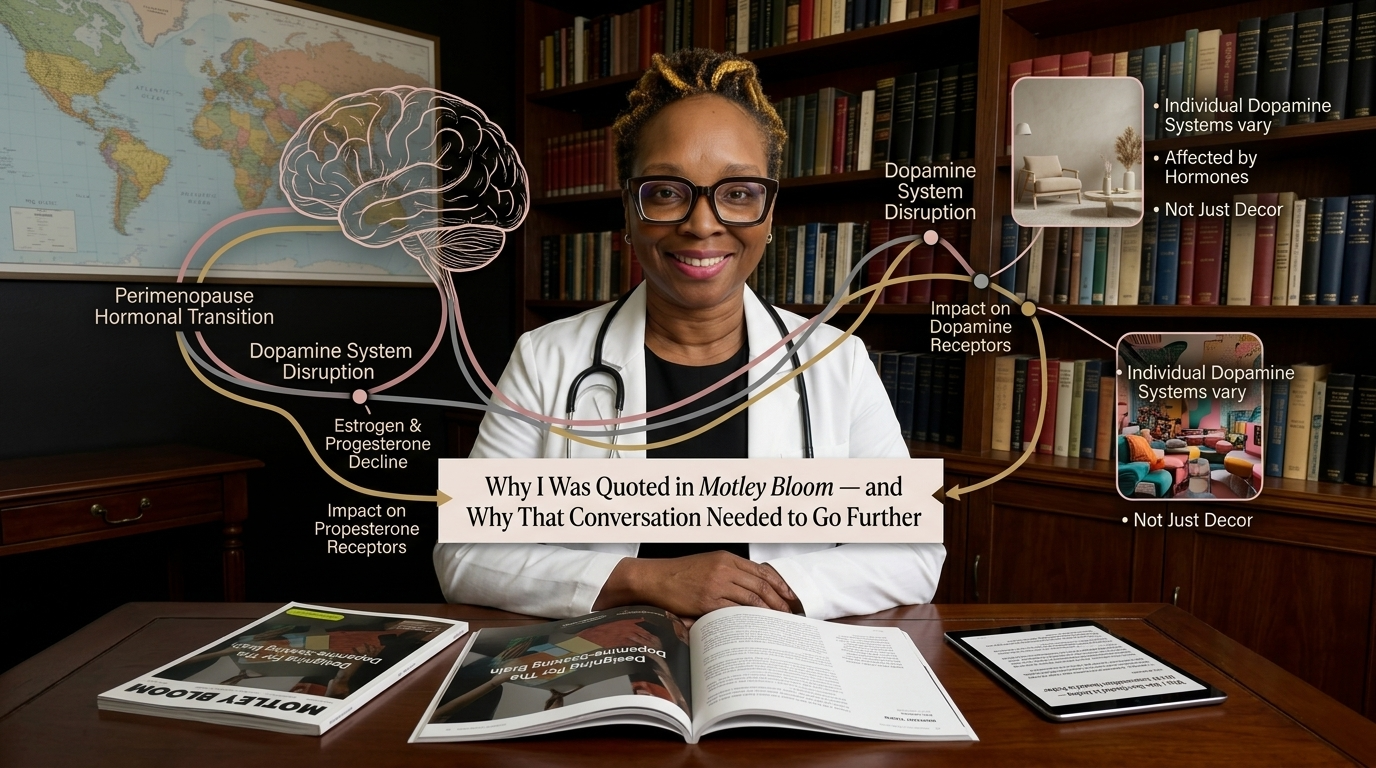
In 2025, a publication called Motley Bloom ran a feature on designing for the dopamine-seeking brain, and they quoted me alongside an interior designer specializing in neurodivergent-friendly spaces. The piece was good and the conversation it opened was important — that not everyone's brain responds the same way to bold, stimulating environments, and that dopamine decor is not a universal prescription for joy.
But even that conversation, as nuanced as it was, did not go where I needed it to go, which is into the body of a woman in perimenopause whose dopamine system is not just different because of neurodivergence, but is being actively disrupted by the hormonal transition she is in the middle of.
That is the conversation I want to have today.
The Dopamine System Is Not Static — And Estrogen Is Why
Here is what I want you to understand before we talk about design at all, because the design piece only makes sense if you understand the biology underneath it.
Dopamine is not just the "feel-good" neurotransmitter. It is the neurotransmitter of motivation, of anticipation, of the reward system that tells your brain something is worth pursuing, something is worth getting out of bed for, something means something. When your dopamine system is well-regulated, you experience pleasure in proportion to experience — the bright living room actually does feel energizing, the bold pattern actually does feel joyful, the stimulating environment actually does give your brain what it is seeking.
And estrogen — which I will keep saying until it becomes part of the clinical vocabulary of every menopause conversation — estrogen modulates your dopamine system directly. It regulates dopamine receptor sensitivity and influences dopaminergic pathways throughout the brain. This has been confirmed in peer-reviewed literature. A 2021 review in Psychological Medicine established that estrogens increase dopamine sensitivity — meaning when estrogen is present and functional, your brain's dopamine system is more responsive, more calibrated, better able to receive and process reward signals. (DOI: 10.1017/S0033291721004591)
And when estrogen declines in perimenopause, that calibration shifts.
Researchers at the University of North Carolina launched a clinical trial in 2023 — published in the journal Trials — specifically to study what estrogen fluctuations do to the mesolimbic reward system in perimenopausal women, because they had been observing something in their clinical work that the literature had not yet caught up to: that perimenopausal psychiatric symptoms including anhedonia — the inability to feel pleasure or anticipate reward — were connected not just to mood but to measurable changes in how the dopamine system was functioning in the brain's reward centers. (DOI: 10.1186/s13063-023-07166-7)
Anhedonia. The inability to feel pleasure. The flatness. The "nothing feels good anymore and I don't know why." That is not a character flaw and it is not just stress and it is not just your hormones being off in some vague general way. In some women, what is happening is a disruption in the mesolimbic dopamine reward system driven by the hormonal changes of perimenopause.
And for neurodivergent women who were already managing a dopamine system that worked differently — the ADHD brain seeking stimulation to regulate, the autistic brain needing precise sensory calibration to feel safe — this is not a gradual drift. It is a collision.
What Perimenopause Does to the ADHD Brain's Relationship With Stimulation
A 2025 review in Frontiers in Global Women's Health, produced by the Eunethydis Special Interest Group on Female ADHD and involving more than 30 researchers across multiple countries, examined what happens to women with ADHD across their lifespan — and what they found about the perimenopause window is something I want every clinician and every ADHD woman in midlife to read. (DOI: 10.3389/fgwh.2025.1613628)
The review confirmed that hormonal transitions including perimenopause exacerbate ADHD symptoms through dopaminergic pathways, and that periods of lower estrogen directly affect cognition and dopamine function in women with ADHD, and that undiagnosed women — the ones who spent their entire lives being told they were too much, too scattered, too sensitive, not trying hard enough — are at significantly increased vulnerability during this transition.
Think about what that means for the woman who has been using environmental stimulation as a self-regulation strategy her entire adult life — the bright office, the vibrant wardrobe, the bold home decor that gave her dopamine-seeking brain just enough input to feel organized and alive and like herself — and then perimenopause arrives and the very system she has been feeding with all of that stimulation starts responding differently.
The bright environment that used to energize her now exhausts her.
The bold pattern that used to feel joyful now feels jarring.
The stimulating space that used to help her focus now makes her feel like she cannot think.
And because nobody told her this was coming, and because the medical system has not connected these dots for her, she does not understand why her coping strategies have stopped working. She just knows she does not feel like herself anymore.
And for the Autistic Woman Who Was Never Diagnosed
I want to speak directly to the woman who came to this post because something in the title recognized her before her brain caught up to why.
The research on autistic masking — the conscious and unconscious suppression of natural autistic responses in order to survive in environments that were not designed for you — has confirmed what many autistic people already knew from lived experience: that masking leads to late and missed diagnosis, mental health crises, burnout, and for some, suicidality. A 2021 conceptual analysis in Autism in Adulthood established that masking is not a female autism phenotype, it is a social survival response driven by stigma, exclusion, and the decades-long message that who you are naturally is too much, too strange, too inconvenient for the rooms you need to be in. (DOI: 10.1089/aut.2020.0043)
I masked for most of my life without knowing I was doing it. I understood it intellectually as something that happened to other people. And then perimenopause came, and estrogen started pulling back, and the hormonal buffer that had been helping me sustain the mask began to thin — and what was left was a nervous system that had been in a state of managed crisis for so long that it had forgotten what unmanaged actually felt like.
For autistic women in perimenopause, this thinning of the hormonal buffer does not just change how we experience symptoms. It changes our capacity to maintain the environments we have spent a lifetime curating to keep ourselves functional. The sensory calibration that worked before — the specific textures, the particular lighting, the careful arrangement of a space that told our nervous system it was safe to unmask here — can shift in perimenopause in ways that feel inexplicable and disorienting, because nobody ever told us that our sensory experience of the world was tied to our estrogen levels, and nobody ever taught us to listen to what our bodies were telling us, because we had been taught from childhood that our bodies' signals were not reliable.
That is interoception failing. That is masking costing its final bill. And that is the woman who walks into her vibrant, dopamine-decorated living room and feels nothing, or worse, feels assaulted by everything she spent years deliberately choosing to surround herself with.
What The Color Reset Method™ Offers Instead
What I built after my own late diagnosis, and after years of watching my patients navigate this intersection without language for it, is a framework that takes the dopamine decor conversation and grounds it in nervous system science rather than trend.
The Color Reset Method™ does not ask what color makes you happy. It asks what nervous system state you are currently operating from, and what color signal would provide the most effective opposite input to move you toward regulation.
Because the answer to "what color is most calming" is not blue or green or lavender in the abstract — it is the color that provides the specific corrective signal for the specific pattern of dysregulation you are currently in, and that answer changes as your hormonal landscape changes, which is exactly why the palette that worked for you at 35 may not be working at 48.
The Color Archetype Quiz maps your current nervous system state across nine profiles — each one describing a different pattern of dopamine, autonomic, and sensory dysregulation — and gives you a personalized reset prescription that includes color, texture, scent, movement, and sound cues calibrated to where you actually are, not where design trends say you should be.
For the ADHD woman whose stimulation-seeking strategies have stopped working in perimenopause, the quiz is likely to show her that she needs grounding and containment right now, not more activation — and it will give her the specific visual language for that through her archetype, so she can start making deliberate environmental choices rather than cycling through design trends hoping one of them will make her feel like herself again.
For the autistic woman who is only now understanding why certain environments have always felt wrong to her, the quiz is often the first time a tool has asked the right question — not how do you like to decorate, but what does your nervous system actually need to feel safe.
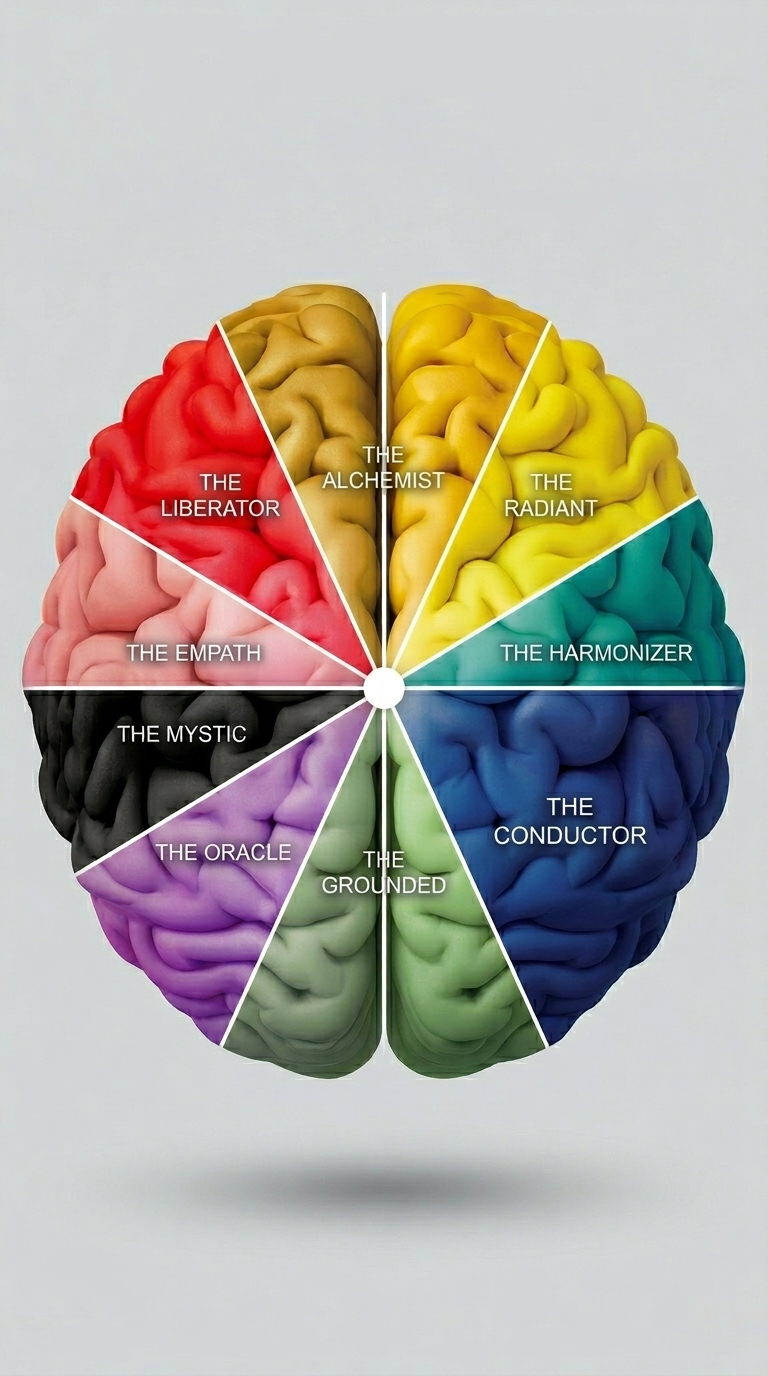
And for the woman who does not have a diagnosis and is not sure which of these describes her, but who knows that something in her relationship to her own environment has shifted during perimenopause and she cannot explain why — the quiz meets her where she is and gives her a starting point.
Take the Color Archetype Quiz →
I'm Just Saying
The dopamine decor trend was never wrong — it was incomplete.
It was designed for a generalized brain without accounting for the neurodivergent brain. And it was designed for a static nervous system without accounting for what happens to that brain when estrogen starts pulling back and the dopamine system it was regulating begins to shift.
The women who are reading this are living in that gap, and most of them have been there long enough to know that nobody in mainstream medicine or mainstream design is asking the right questions about them.
I am asking those questions. I am asking them as a physician. I am asking them as a late-diagnosed autistic woman who built her clinical methodology out of the gaps in her own self-understanding. And I am asking them because the research is starting to catch up to what I have been seeing in my practice for years, and it is time to name it out loud.
Your environment is medicine. Not dopamine decor's version of medicine — your nervous system's version, calibrated to who you are right now, in this transition, with everything you now know about yourself.
Read the original 2022 dopamine decor post here: Dopamine Decor: Understanding the Neurodivergent Brain →
Start with the science underneath all of this: What Is Neuroaesthetics? The Gentle Science of How Beauty Heals Your Brain →
For how color connects to your nervous system profile: Color Is Not Decoration: What the Color Reset Method™ Reveals About Your Nervous System →
And for the interoception piece that lives underneath all of it: The Missing Sense: What Interoception Explains About Why You Feel Everything But Can't Find the Words →
Sources
Walsh MJM et al. Perimenopausal Effects of Estradiol on Anhedonia and Psychosis Study (PEEPs): study protocol for a neural and molecular mechanistic clinical trial. Trials. 2023. DOI: 10.1186/s13063-023-07166-7
Brand BA et al. Antipsychotic medication for women with schizophrenia spectrum disorders. Psychological Medicine. 2021. DOI: 10.1017/S0033291721004591
Kooij JJS et al. Research advances and future directions in female ADHD: the lifelong interplay of hormonal fluctuations with mood, cognition, and disease. Frontiers in Global Women's Health. 2025. DOI: 10.3389/fgwh.2025.1613628
Pearson A, Rose K. A Conceptual Analysis of Autistic Masking: Understanding the Narrative of Stigma and the Illusion of Choice. Autism in Adulthood. 2021. DOI: 10.1089/aut.2020.0043