Your Brain Was Built for Nature — And Your Office Is Running on Fumes
Updated: April 2026
Most of us have felt it — the instant relief of stepping outside after a long day indoors. The air shifts. Your shoulders drop. Something in the body that was clenched releases without you having to decide to let it go.
You did not decide that. Your nervous system did. And it happened because your nervous system was built for this — for green, for sky, for the sound of water and wind and the particular quality of light that comes through leaves rather than through a fluorescent panel.
Your brain is not struggling because you are weak. It is struggling because it was built for nature and you are spending eight hours a day — sometimes ten, sometimes twelve — inside a building designed without a single living thing in it.
For the woman navigating perimenopause, this is not a minor inconvenience. It is a clinical gap with measurable consequences. And closing it does not require a forest outside your window. It requires understanding what your nervous system is actually asking for, and bringing enough of it into your daily environment to stop the low-grade alarm from running continuously in the background.
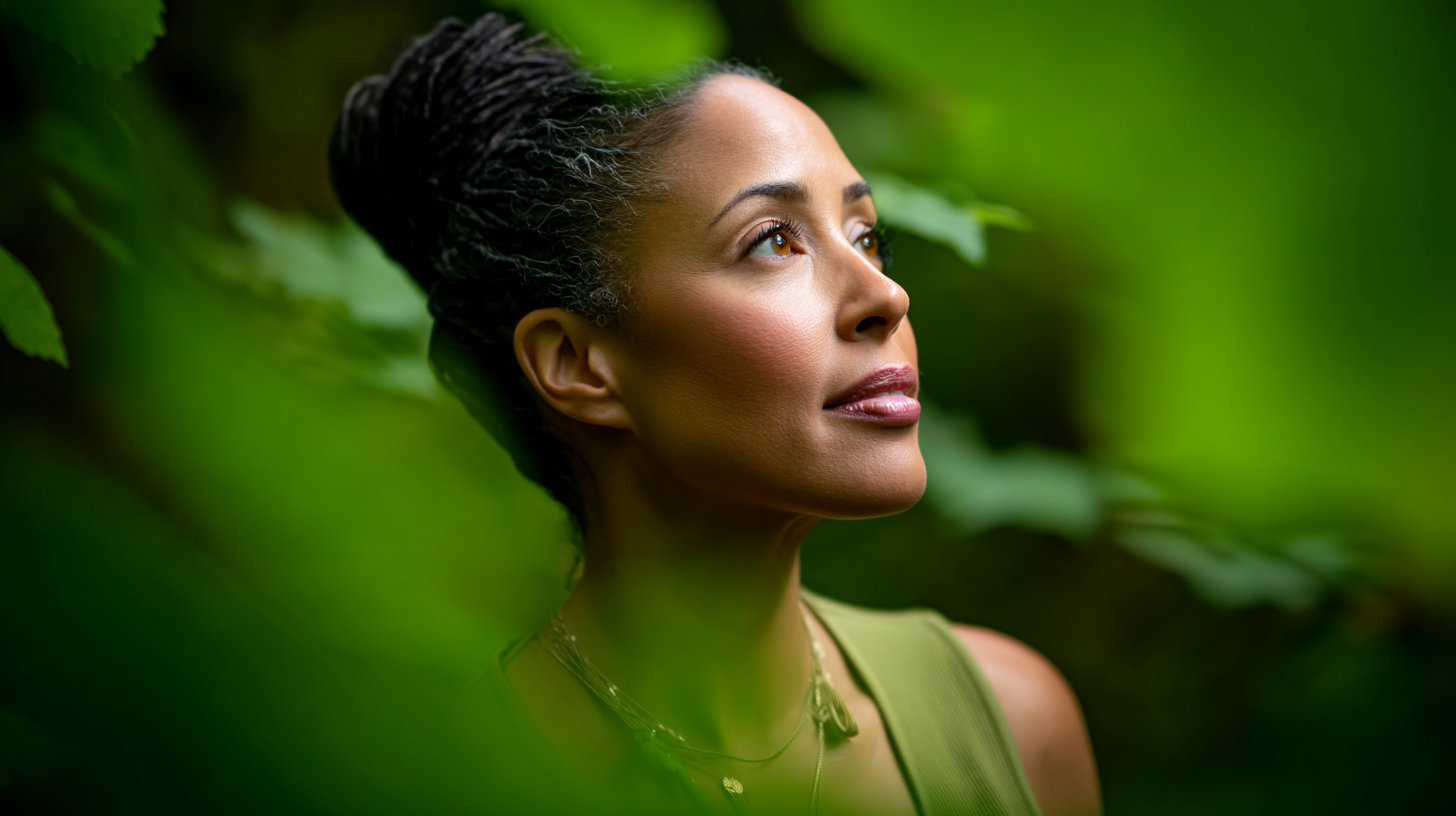
What Your Brain Is Looking For
The biophilia hypothesis — the idea that humans have an evolved, wired-in connection to natural environments — is not a philosophical concept. It is a biological reality that has been studied, replicated, and increasingly quantified.
A 2022 review establishing the science of Forest Medicine — the formal medical study of Shinrin-yoku, or forest bathing — summarized the documented effects of time in natural environments on the human body and found them to include reduced cortisol, reduced blood pressure and heart rate, increased natural killer cell activity, improved sleep, decreased anxiety and depression scores, and a shift from sympathetic toward parasympathetic autonomic dominance. (DOI: 10.1265/ehpm.22-00160)
Read that list again as a clinician. Every single item on it is a symptom cluster for the perimenopausal woman in burnout. Elevated cortisol. Elevated blood pressure. Disrupted sleep. Anxiety. Depression. Autonomic dysregulation. The very symptoms the medical system reaches for prescriptions to address are the symptoms that time in nature measurably resolves — not because nature is magic, but because the human nervous system co-evolved with natural environments over hundreds of thousands of years and is still running on that operating system.
The office building your body spends most of its waking hours inside was designed in the last fifty years for a different set of priorities.
You Do Not Need a Forest
Here is the part that matters most practically, because I know most of you are not working next to a national park.
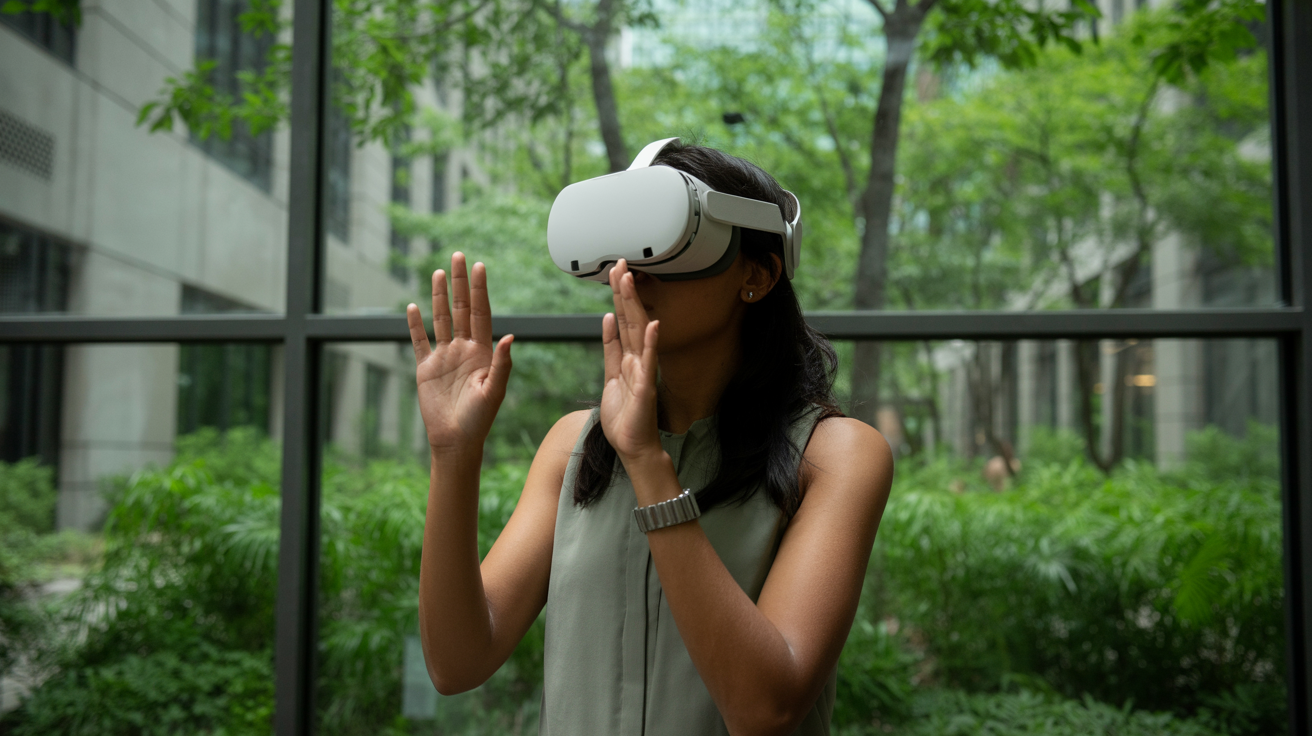
A 2022 randomized controlled trial published in Environmental Research studied the effects of green space exposure on stress recovery — and they did it using virtual reality. Participants were exposed to VR videos of urban scenes with varying levels of greenery immediately after a laboratory stress task, and what the researchers found was that even simulated green space exposure measurably reduced cortisol, lowered systolic blood pressure, decreased salivary stress markers, and improved both positive affect and anxiety scores compared to non-green environments. The park-like setting with high green content had the strongest effects, but any green exposure produced measurable stress recovery. (DOI: 10.1016/j.envres.2022.114499)
Virtual green space. Measurable cortisol reduction.
What that tells us clinically is that the nervous system does not require actual forest immersion to begin shifting toward regulation. It responds to nature cues — visual, auditory, olfactory — because those cues are the signal language it has been reading for its entire evolutionary history. A window with a tree outside it. A plant on the desk that moves when the air conditioning comes on. The sound of water from a small fountain. The color green in the visual field. These are not decorations. They are nervous system instructions.
And for the woman in perimenopause whose nervous system has lost significant hormonal buffering and is running with a lower sensory threshold and a higher cortisol baseline — those instructions matter more than they ever did when estrogen was absorbing the slack.
What the Workplace Research Shows
I went looking for peer-reviewed research specifically on nature in work environments because the biophilic design conversation often stays in the architectural world and I wanted to see what the occupational health science said.
A 2023 systematic review in the International Journal of Environmental Research and Public Health synthesized 16 studies on the restorative effects of nature exposure during work time — both outdoor and indoor nature exposure — and found consistent evidence of positive effects on wellbeing, motivation, job satisfaction, and work performance. The review also flagged that the research is still limited and scattered, which tells me this is a field where the science is catching up to what practitioners and patients have known for years. (DOI: 10.3390/ijerph20216986)
A 2025 study published in Work took this further by comparing four office environments with different levels of biophilic integration and measuring employee health outcomes directly. The offices with both indoor and outdoor greenery — the highest biophilic integration — showed the most significant positive effects, with employees demonstrating greater emotional stability, better sleep quality, lower stress levels, and improved work efficiency compared to environments with no greenery. (DOI: 10.1177/10519815251345816)
Greater emotional stability. Better sleep quality. Lower stress levels. Improved work efficiency.
That is the symptom cluster you are trying to manage in perimenopause — and a plant, a window view, and an acoustic water feature might be doing more for it than anyone in the building has thought to measure.
Why Burnout and Perimenopause Are Running on the Same Fuel
I want to name something that does not get said clearly enough in either the menopause conversation or the burnout conversation.
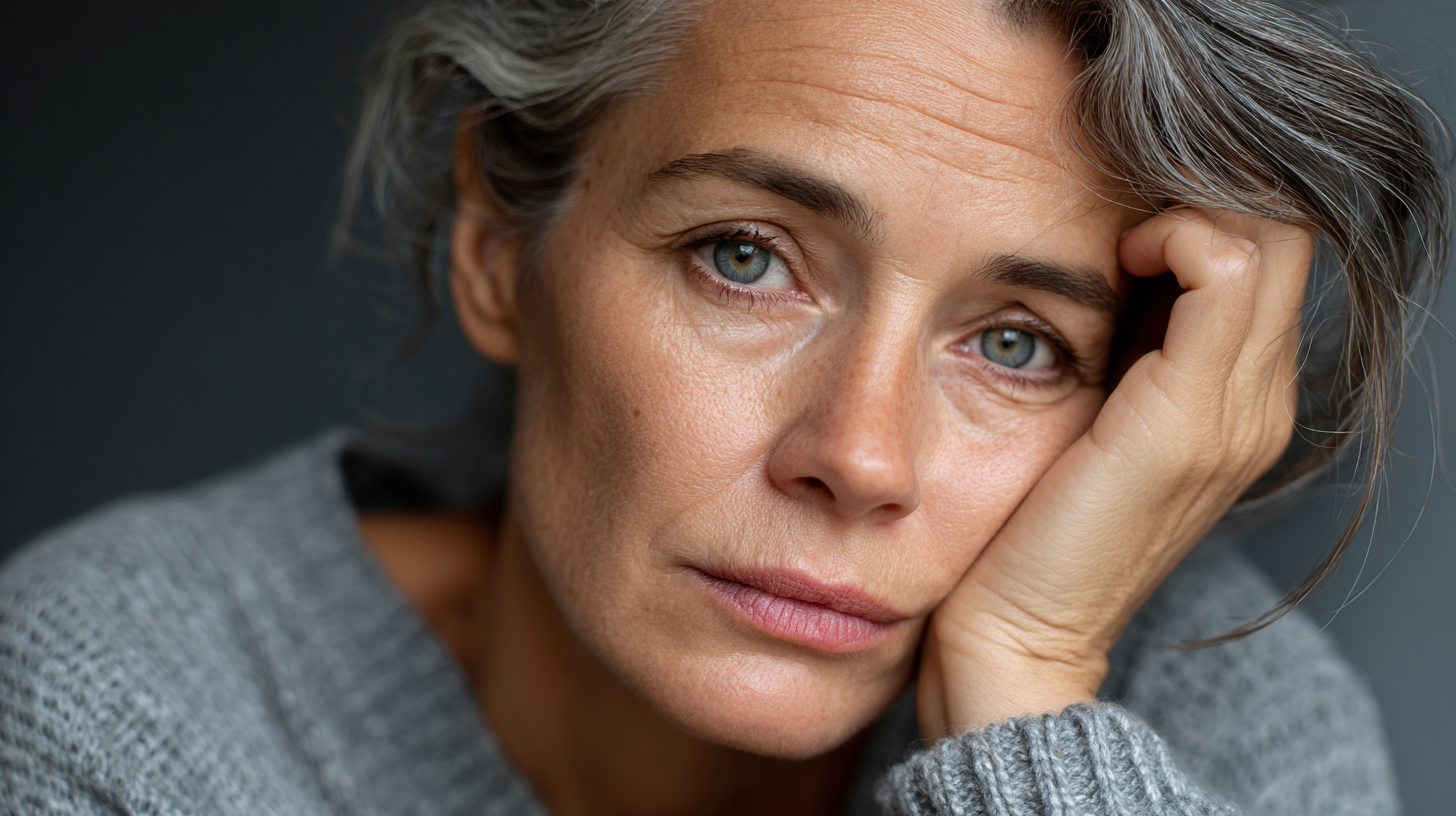
Burnout is a chronic stress state characterized by emotional exhaustion, cognitive depletion, reduced sense of efficacy, and physical deregulation. Perimenopause is a hormonal transition that removes the estrogen-mediated buffering that was helping your nervous system manage stress, regulate cortisol, and recover from activation.
When these two things happen simultaneously — which they frequently do, because the average age of perimenopause onset overlaps directly with the peak years of professional achievement and institutional responsibility — the result is a nervous system that is managing a double load with half the resources it had five years ago.
Nature is not a cure for either. But nature exposure is one of the most evidence-based, lowest-cost, immediately accessible interventions for the underlying biology of both. Cortisol regulation. Autonomic balance. Sleep quality. Immune resilience. Every one of those physiological levers responds to natural environments, and every one of them is relevant to the perimenopausal woman whose body is asking for exactly this kind of biological reset.
This is not an invitation to go outside more — although please, do that too. This is a clinical argument for deliberately bringing nature into the environments where you spend the most hours of your life.
Biophilic Design — What It Actually Means for Your Space
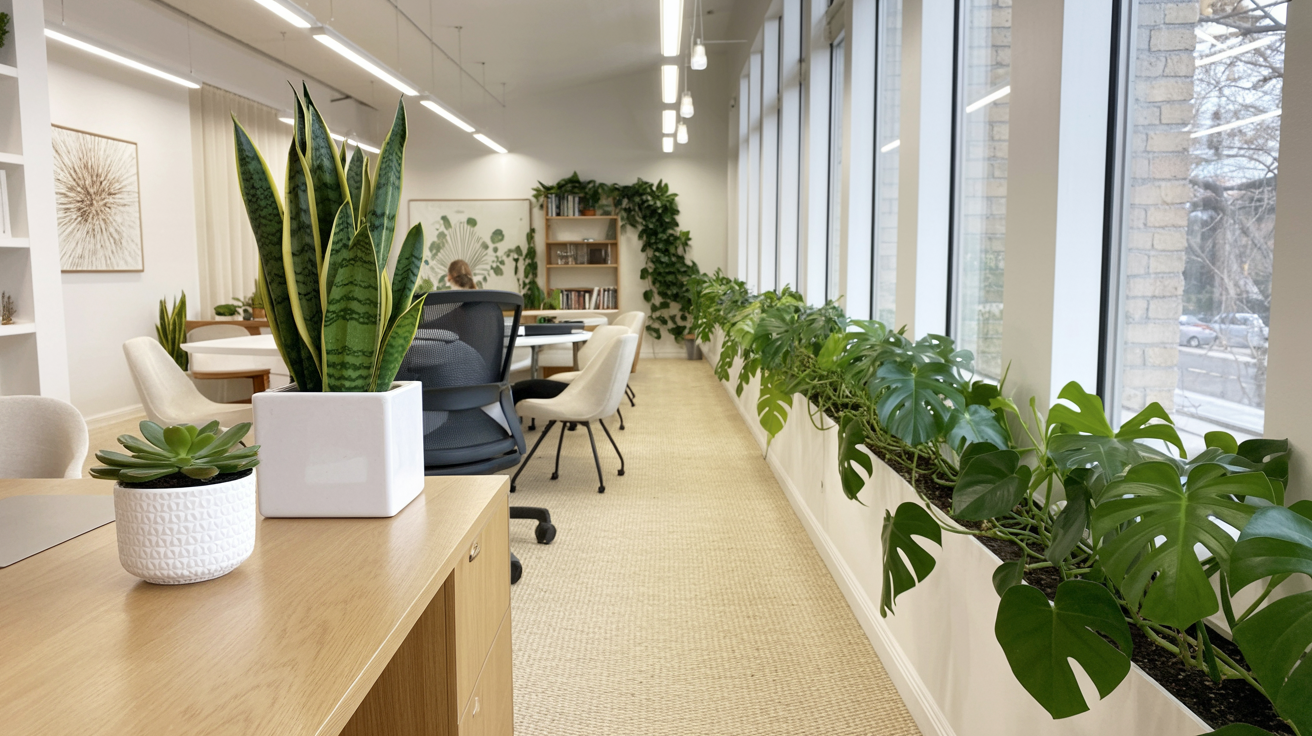
Biophilic design is not putting a succulent on your windowsill and calling it a day. It is the deliberate integration of natural elements, patterns, and sensory experiences into built environments in ways that support the nervous system's need for biological cues it recognizes as safe and restorative.
Here is what that looks like in practice across the environments where you spend your time.
At your desk:
A live plant in your direct visual field is not decorative. It is a cortisol regulation tool. The movement of leaves in airflow, the organic irregular edge of a leaf, the specific frequency range of green in the visual spectrum — all of these register as calming inputs to a nervous system that is scanning its environment continuously. A snake plant, a pothos, a peace lily — all low-maintenance, all effective. Put it where you can see it without turning your head.
Natural light is the second element. If you have a window, face it. If you do not, warm-toned lighting that mimics the 3000-4000K range of natural daylight is the closest substitute. Overhead fluorescent lighting in the 5000K+ range is activating, not calming, and for the woman whose sensory threshold has shifted in perimenopause, it is often genuinely dysregulating rather than merely unpleasant.
In the meeting room:
The most underused meeting room intervention is a small tabletop water feature or a nature sound ambient track running quietly in the background. The rhythmic, unpredictable-within-a-pattern quality of water sound is specifically processed by the brain as non-threatening and tonically calming — unlike the unpredictable sounds of a busy office environment, which keep the threat detection system lightly engaged. A three-minute walk outside before a high-stakes meeting is also a legitimate performance strategy, not a procrastination behavior.
At the organizational level:
Walking meetings. Green spaces in break areas. Windows in conference rooms rather than interior rooms for the longest meetings. A deliberate ten-minute outdoor break mid-morning rather than a third coffee. These are not wellness perks. They are nervous system infrastructure decisions that have measurable return on cognitive performance, and the woman in perimenopause is the person in your building who will benefit most visibly because her nervous system is the one most in need of the corrective input.
For the neurodivergent woman specifically:
I want to hold something that the general biophilic design conversation often misses. For autistic women and women with ADHD, the relationship with nature is not always straightforward. Sensory preferences vary significantly — the woman who finds birdsong calming may also find it distracting at the wrong moment. The woman who loves the texture of natural materials may be overwhelmed by the smell of certain plants. The principle is not "add more nature" without qualification. The principle is "understand which nature cues your specific nervous system reads as safe rather than stimulating, and prioritize those." Your Color Archetype — your nervous system's specific regulatory profile — shapes which natural inputs are most restorative for you personally, which is exactly why the NRM approach starts with the individual rather than with a universal prescription.
The Practice of Natural Reset
Let me give you something practical you can do before the end of this week with no budget and no employer permission required.
Find one window you can stand near for five minutes in the morning before the first meeting, before the email, before the day's demands arrive. Stand facing natural light. Let your eyes rest on whatever is outside the window — sky, a parking lot tree, a neighbor's yard — rather than on a screen. Five minutes. That is the Shinrin-yoku principle applied to the built environment. You are not replacing the forest. You are giving your nervous system the minimum viable nature dose before the day's demands begin stacking.
The research on forest bathing consistently shows effects from exposures of twenty minutes or more in genuinely natural environments. But the VR green space study showed measurable cortisol effects from five minutes of simulated nature. The direction of the intervention is clear. The dose matters less than the consistency.
And if you can add one plant to your visual field at work this week — one — you have begun the environmental adjustment. The body responds to direction, not perfection.
The Bigger Picture
Your nervous system came with a nature prescription. It has always had one. The question is whether the environments you spend your time inside are filling it or depleting it further.
For the neurodivergent woman in perimenopause who is navigating burnout, cognitive fog, sensory dysregulation, and a hormonal transition that medicine is only beginning to address with the nuance it deserves — nature is not a supplement to clinical care. It is part of the clinical picture.
The Color Archetype Quiz is where I start with every patient before we talk about any environmental intervention, because your archetype tells us which natural inputs your specific nervous system will respond to most readily. Some archetypes need green and water. Others need open sky and warmth. Some need the forest. Some need the coast. The prescription is specific, not generic, and it changes as your hormonal landscape changes.
Take the Color Archetype Quiz →
And join the Auntie Menopause Circle and tell us what nature reset is working for you right now. The collective wisdom in that room is clinical data waiting to be organized.
Join the Auntie Menopause Circle →
The workplace neuroaesthetics framework lives here: Your Office Is Either Working With Your Nervous System or Against It →
For the home environment version of this work: From Space to Mind: How Your Home Environment Is Either Wiring You Up or Winding You Down →
The clinical foundation: What Is Neuroaesthetics? The Gentle Science of How Beauty Heals Your Brain →
Sources
Li Q. Effects of forest environment (Shinrin-yoku/Forest bathing) on health promotion and disease prevention — the Establishment of Forest Medicine. Environmental Health and Preventive Medicine. 2022. DOI: 10.1265/ehpm.22-00160
Sun Y et al. Physiological and affective responses to green space virtual reality among pregnant women. Environmental Research. 2022. DOI: 10.1016/j.envres.2022.114499
Gonçalves G et al. Restorative Effects of Biophilic Workplace and Nature Exposure during Working Time: A Systematic Review. International Journal of Environmental Research and Public Health. 2023. DOI: 10.3390/ijerph20216986
Zhao M, Jiao D, Tang J. Research on the impact of biophilic office space environments on employee health promotion. Work. 2025. DOI: 10.1177/10519815251345816
NOTE: This post was originally published on Ceyise Studios, my design and neuroaesthetics platform, and has been brought here to drstaceydenise.com because it is foundational to the clinical work I now do with neurodivergent women navigating perimenopause and menopause. Some of those original posts have been retired. Others have been expanded into updated companion pieces that go further than the original could. Where a newer version exists, you will find a link to it at the top or bottom of this post.
Originally published on Ceyise Studios. Updated: April 2026.