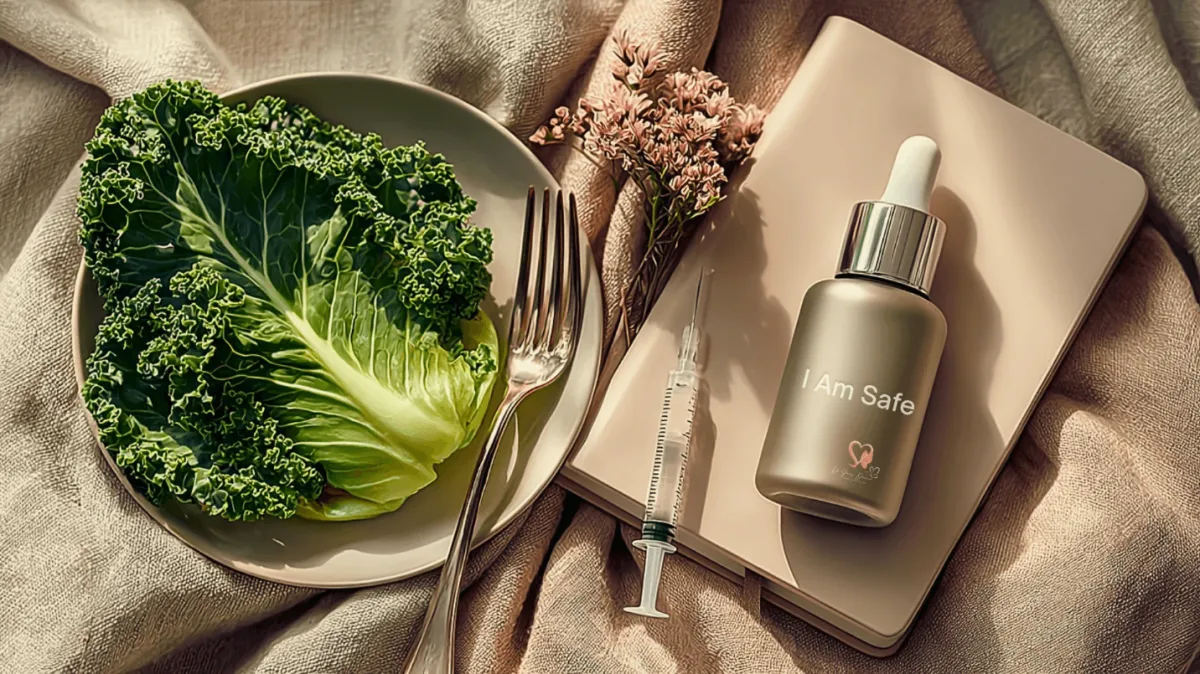
What Good Is Kale If You’re Numb Inside?

June 30, 20254 min read

On GLP-1s, Beauty Culture, and What We’ve Forgotten About Health

We’ve been taught that health is something you measure on a scale.
But what if the real weight we need to lose isn’t on our bodies—but in the stress our nervous systems carry?

The Shot That Silenced the Noise—But at What Cost?

There’s a new kind of hush in the world. GLP-1 shots—Ozempic, Wegovy, Mounjaro—promise miracles: weight loss, steadier blood sugar, even better sleep. For many, especially those living with diabetes, these are real, measurable wins.

But lately, I notice something quieter. People tell me, “I’m smaller, but I feel less alive.” Food doesn’t sing the way it used to. Joy feels muted, like the colors in a favorite painting left in the sun too long.

I hear these stories more and more. And I can’t help but wonder: What good is kale if your nervous system is stuck in survival mode? What good is weight loss if it costs you your joy?

Numbing the Body to Sculpt the Ideal

Let’s talk about this strange paradox. A few years ago, so many refused a vaccine meant to protect life. Now, millions line up for an injectable meant to shrink their bodies. Same route. Different reasons.

One shot was about collective safety. The other? About fitting in. We’re told thinness is beauty, and beauty is safety. But for so many of us—especially those who’ve never felt truly safe—this is a trade-off that cuts deep.

So we medicate, not just for health, but for belonging.

GLP-1s and the Quieting of Joy

GLP-1s and the Quieting of Joy

Here’s what I see, and what early science whispers: These medications don’t just quiet hunger—they can quiet pleasure, too. Some women tell me, “I used to love cooking. Now, I just don’t care.” Others say, “I’m thin, but I don’t feel healthy. I feel flat.”

It’s as if the music of life gets turned down. For those of us who’ve lived through trauma, or who feel the world more intensely, this isn’t peace—it’s emptiness. It’s like living in a house where the colors have faded and every room echoes.

In our rush to find relief, have we traded away the very things that make us feel at home in ourselves?

Beauty, Safety, and the Stories We Inherit

Beauty isn’t just what we see. It’s what we feel. Our brains are wired to trust certain shapes, colors, and faces. But the stories we inherit—about thinness, about worth—run deeper than any diet plan.

Marginalized bodies—fat, disabled, neurodivergent, Black—are often left out of these stories. We’re not obsessed with thinness. We’re addicted to the feeling of safety we hope it will buy us. But safety that demands we shrink ourselves isn’t safety at all.

The Aesthetic Myth of “Health”

We’ve confused looking well with being well. We count calories, track steps, chase smaller jeans. But we forget to ask: Am I emotionally full? We shrink our waists, but ignore the tension in our shoulders, the tightness in our chests.

GLP-1s are powerful tools. But sometimes, they become emotional bypasses.
They cut off cravings—but also ritual.
They flatten appetite—but also identity.
They shrink the body—but not the wound.

A thinner body in a dysregulated nervous system is still a body in crisis.

A Return to the Real Roots of Health

In my work, I teach that true health isn’t about subtraction—it’s about coherence.
It’s not how little you eat.
It’s how deeply you feel.
It’s not how fit you look.
It’s how safe your body feels in your own presence.

So I ask my clients: Can your body move from fight-or-flight into rest-and-receive? Are you sleeping in a way that lets your soul reset? Do you know what you’re truly hungry for?

This is lifestyle medicine from the inside out—not from the mirror in.

Beauty That Doesn’t Betray You

I’m not anti-medication. I’m not anti-weight loss. I’m not anti-beauty. But I am radically for wholeness.

Because when beauty becomes a numbing strategy, it stops being beautiful. When hunger becomes the enemy, you forget what it feels like to receive. And when health is divorced from emotion, it becomes another form of harm.

So if you’ve been chasing kale but still feel hollow—pause. The question isn’t what you’re eating. It’s whether you’re emotionally allowed to digest your own life.

Want to Reconnect to the Body Behind the Goal?

Let’s find your rhythm again—through emotional safety, sensory design, and narrative repair.

Begin Your Neuroaesthetic Reset™ Journey

Experience the beta cohort of the Neuroaesthetic Reset Program—a gentle, sensory-based invitation to decode your emotional health blueprint and rediscover food peace and inner repair.

Reserve Your Spot in the Beta Cohort

This isn’t a reset for your body.
It’s a reclamation of self.

Art is the Medicine. Design is the Therapy. Healing is the Evolution.
— Dr. Stacey Denise

Dr. Stacey Denise Moore is a board-certified surgeon, lifestyle medicine physician, and the founder of Ceyise Studios®. Known as The Neuroaesthetic MD™, she specializes in helping women in midlife optimize their metabolic health, sleep, and environments. By blending clinical neuroscience with sensory design, she teaches patients and organizations how to create spaces and habits that support nervous system regulation and hormonal balance.

Dr. Stacey Denise

Dr. Stacey Denise Moore is a board-certified surgeon, lifestyle medicine physician, and the founder of Ceyise Studios®. Known as The Neuroaesthetic MD™, she specializes in helping women in midlife optimize their metabolic health, sleep, and environments. By blending clinical neuroscience with sensory design, she teaches patients and organizations how to create spaces and habits that support nervous system regulation and hormonal balance.

LinkedIn logo icon
Instagram logo icon
Youtube logo icon
Back to Blog