Teach Her — What Breaking the Cycle Actually Looks Like
Updated: April 2026
Let me tell you something about this piece that the formal artist statement doesn't quite capture.
Teach Her is personal in a way that goes deeper than mentorship language or legacy language or any of the tidy frameworks we use to talk about paying it forward. It's about a little Black girl from Ohio who — by every metric society uses to predict outcomes — was not supposed to be here.
Not in the way I'm here. Not building a clinical practice. Not publishing research. Not releasing ambient music albums or writing a book or standing in a Houston gallery having read a spoken word poem about her own healing journey to a room full of people who needed to hear it.
The data said otherwise. The environment said otherwise. The voices in my earliest years said otherwise.
And I made it anyway. And now I have something to say about what that means for the girls who come after me.
That's Teach Her.
The Girl Who Loved Science and Math
Before everything else — before the trauma, before the survival strategies, before the masks and the running and the decades of managing what I couldn't name — there was a child who loved patterns. Who loved numbers. Who was fascinated by how things worked, how systems fit together, what lived beneath the visible surface of things.
That child wasn't just heading toward medicine. She was heading toward understanding. Science, math, technology, design — these weren't subjects to me. They were languages. Ways of seeing the world that made it feel less chaotic, more navigable, more full of possibility than the immediate environment I was living in.
STEM wasn't a career path. It was a lifeline.
And here's what I know now that I couldn't have articulated then: for children growing up in environments of chaos and instability, the precision of science and math can be one of the first places the nervous system finds something reliable. Something that follows rules. Something that produces the same result every time you apply the same process. In a world where so much is unpredictable, two plus two always equals four.
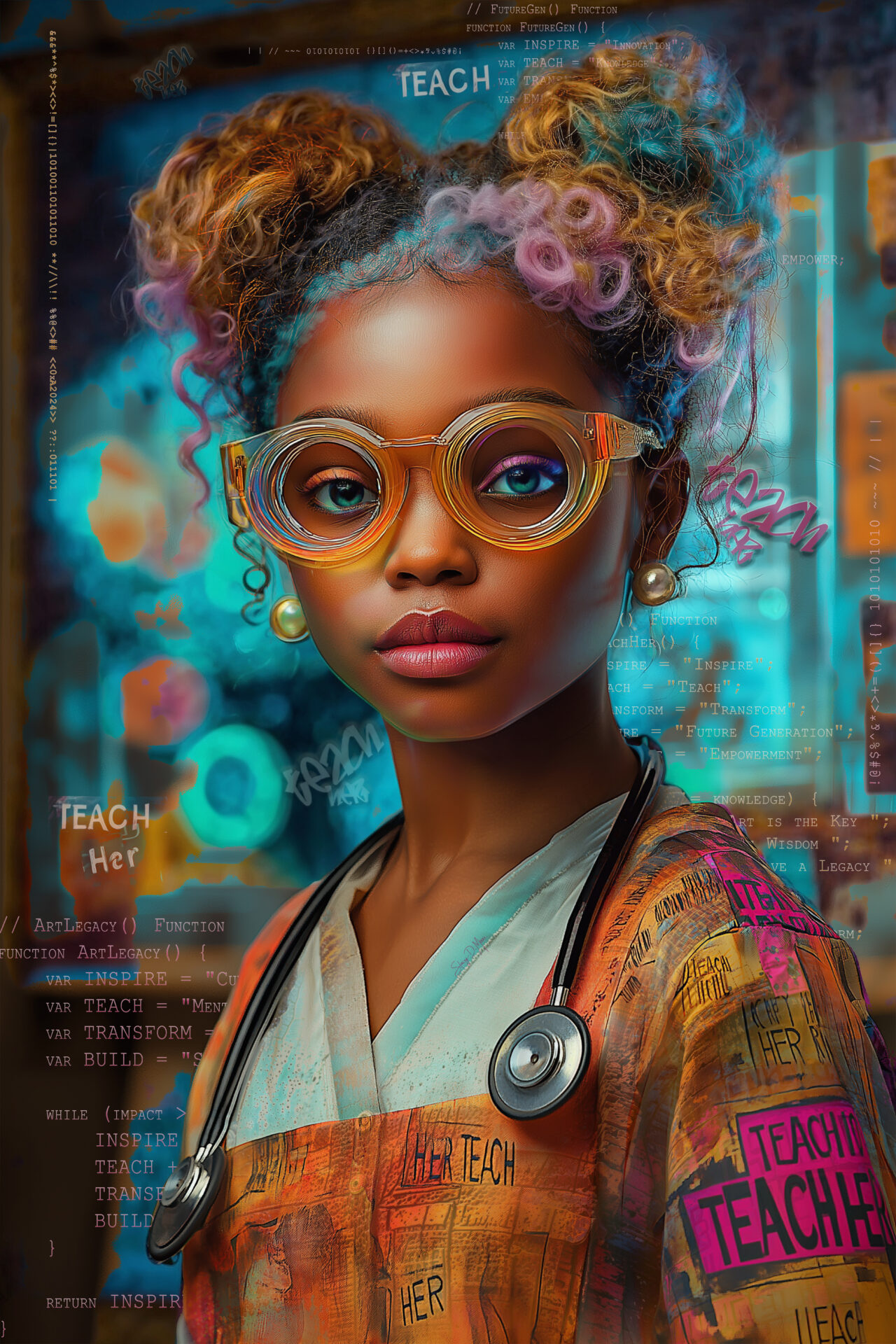
That child who loved patterns — she's in this painting. She's the figure in Teach Her, wearing surgical loupes as a nod to the path that love of precision eventually led me down. Seeing clearly. Seeing past what's obvious. Seeing what others might miss.
What the Loupes Hold
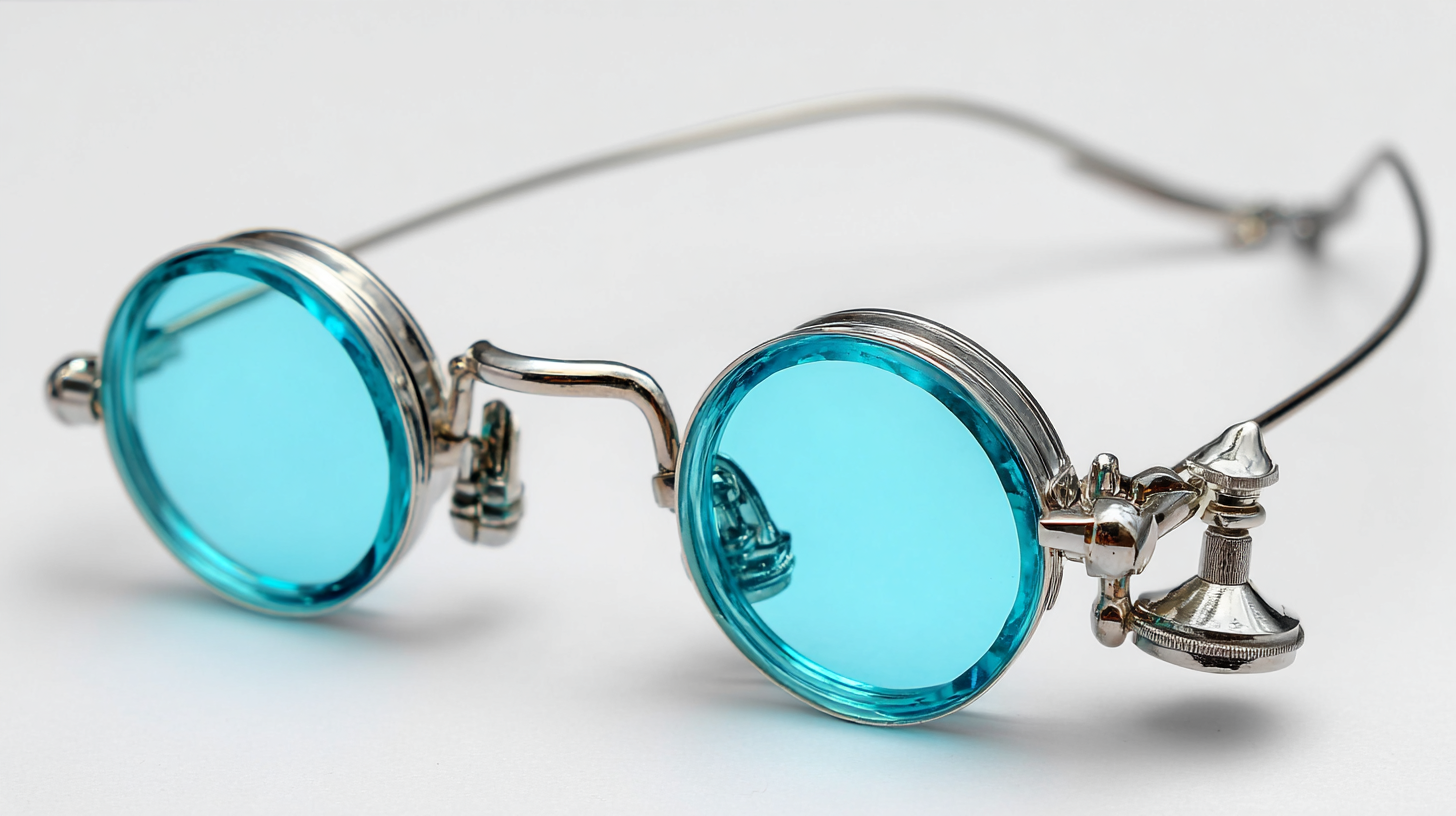
The surgical loupes worn by the figure in Teach Her are a specific and intentional choice. In surgery, loupes are magnification lenses — they allow the surgeon to see at a level of detail that the naked eye can't access. They're precision tools. They're also a symbol of the particular kind of vision that surgery cultivated in me: the capacity to look directly at something difficult, to see it clearly and completely, and to act with intention rather than flinching.
That capacity — the willingness to look, to see, to not look away — is exactly what healing requires. And it's exactly what I want to pass to the next generation.
Not the clinical skill. The quality of seeing. The willingness to look at what's actually there — in your body, in your history, in the systems that shaped you — and to trust yourself to work with what you find.
The figure in Teach Her holds that vision forward. She's not looking back. She's looking at what's coming — and she's equipped to meet it.
The Code and What It Means
Threaded through the design of this piece is code — the visual language of technology and innovation, of programming and digital possibility. It's not decorative. It's a statement about what the future holds for girls who are given access to it.
I grew up loving math and patterns and the logic of how systems work. I also grew up in a world that didn't have a clear picture of what that could become for a Black girl from Ohio without resources, without a roadmap, without the visible representation that makes the possible feel real.
STEAM education — science, technology, engineering, arts, and mathematics — is how we change that for the next generation. Not just because the jobs are there. Because the capacity to understand and build systems, to think in patterns, to move comfortably in the space where creativity and logic meet — that capacity is protective. It creates agency. It gives young people a relationship with their own intelligence that no one can take from them.
The code in Teach Her is both a tribute to that love in me and a vision of what becomes possible when we stop letting society decide which children deserve access to those tools.
The Generational Turn
Here is the truth that makes this piece more than a mentorship statement.
I passed down a dysregulated nervous system to my daughters without meaning to. I passed down the patterns I hadn't healed, the emotional unavailability of a woman who had survived by not feeling, the chaos that felt like home because home had always been chaotic. I did my absolute best — materially, practically, professionally — and in the dimension that mattered most, I was still running.
When my daughters sat me down and told me what they had witnessed, that was the moment Teach Her became necessary. Not as an aspiration. As an obligation.
Because breaking the cycle of generational trauma isn't something you do for yourself. You do it for yourself AND for every person who will live downstream of you. Your children. Their children. The students you mentor. The patients you treat. The women who find your blog at 2am because they can't sleep and they're starting to understand that something is wrong and they don't know what it is.
Research we've referenced throughout this series — Rachel Yehuda's work on intergenerational stress transmission, the Journal of Affective Disorders study on children of trauma survivors — confirms what my daughters confirmed in that conversation: the unhealed self transmits. Not through intention. Through nervous system, through attachment pattern, through the way you respond to threat, through what you model about how a woman moves through the world.
Teach Her is the commitment that the transmission changes here. With me. With this generation. Forward.
By Society's Standards I Shouldn't Be Here
I want to say this plainly because I think it matters for every woman reading this who has a version of this sentence in her own history.
By the metrics society uses to predict who makes it — family stability, economic resources, emotional safety in childhood, the absence of trauma, the presence of visible role models who look like you — I was not supposed to be a physician. I was not supposed to build a clinical practice. I was not supposed to stand in a gallery and speak my healing story aloud.
And yet.
That yet is not luck. It's not exceptional individual will. It's a combination of things: the people who showed up for me at the right moments, the programs that gave me access to science education when I needed it, the stubbornness of a nervous system that kept moving even when it didn't know where it was going, and eventually — the decision to stop running and do the work.
The little girl who loved math and patterns made it here because somebody invested. A teacher. A program. A moment where a door opened that could have stayed closed.
Teach Her is the promise that I will be that for the next generation. That the girls who look like me — who come from what I came from, who society has already written off before they've had a chance to write their own story — will find a door open.
That they won't have to be exceptional to deserve it. They just have to show up.
The Ambient Album and What It Proves
On May 15, 2026, I'm releasing my first 10-track ambient music album.
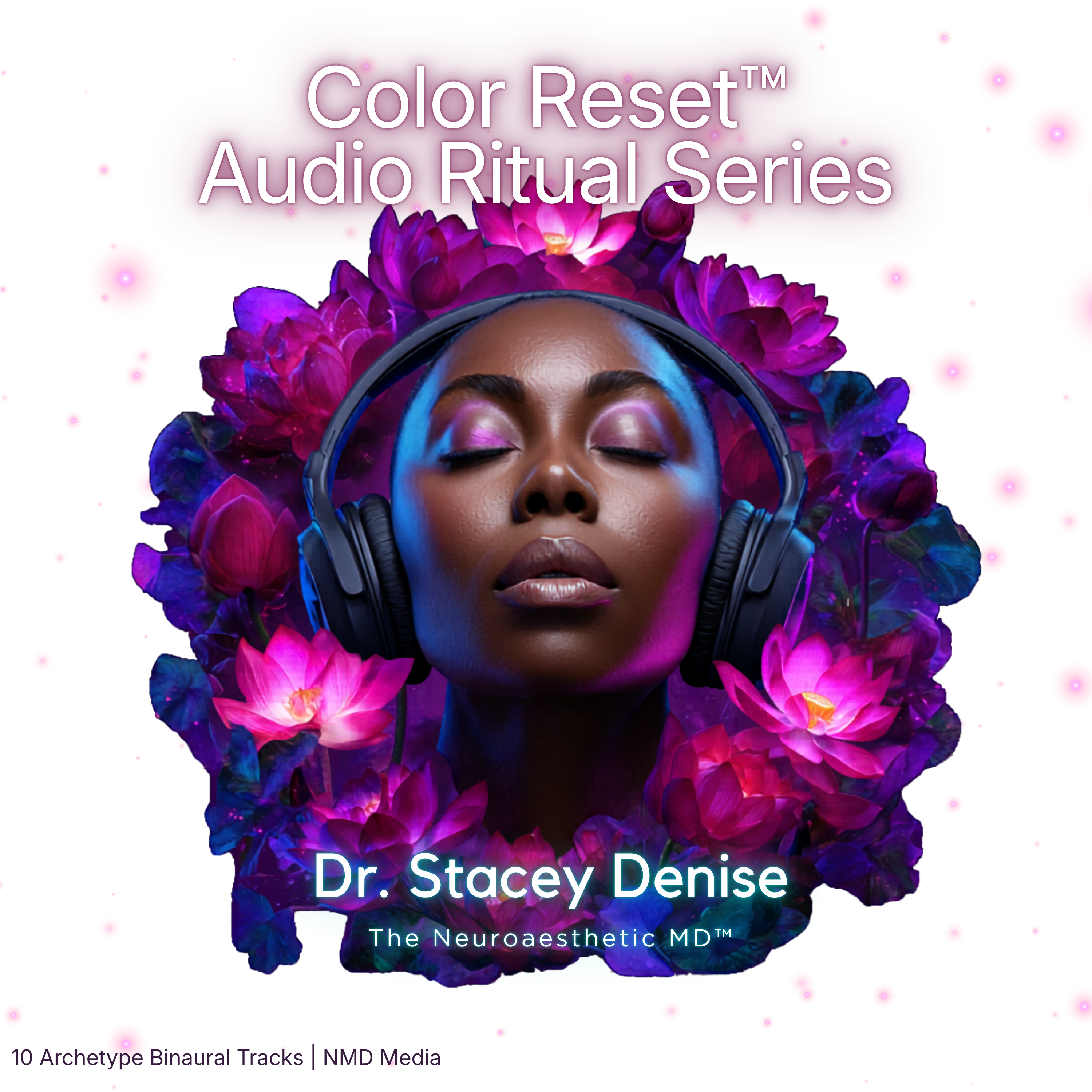
I'm saying that here, in the Teach Her post, because it belongs here. Because Allante — the girl with the stage name inspired by a red Cadillac, the girl who wrote raps and felt most alive in bold colors and early hip-hop energy, the girl who was told to go to medical school instead — didn't disappear.
She waited. She went underground. And in May, through the specific and beautiful mechanism of healing, she came back — not as she was, but as what the years between then and now have made possible. Ambient music. The nervous system's language. Slow, intentional, therapeutic by design.
That's what Teach Her is about. Not just the next generation of young girls in STEAM programs. Also the creative self that got suppressed along the way — and what becomes possible when you finally give her room.
Full circle isn't a metaphor. It's a documented outcome.
What I Want for You
Teach Her asks three questions that I want to leave with you:
What legacy will you leave for those who follow?
How can you inspire the next generation to see the world — and themselves — more clearly?
What steps can you take to ensure your community thrives?
These aren't rhetorical. They're clinical. They're the questions I ask myself when I think about why this practice exists, why this blog exists, why I stood in a gallery and read a poem about my own healing in front of strangers who became witnesses.
Because the nervous system heals in community. Because the cycle breaks when someone decides it breaks here. Because the little girl who loved math and patterns and shouldn't have made it by society's standards is now a physician, an artist, a musician, a mentor, and a woman who finally knows her own name.
And she's not done teaching.
The piece that came before this one: Be Her — The Coming Out Party Nobody Sent Me an Invitation To →
The beginning of this arc: See Her — A Declaration of Visibility →
The full origin story: Art Is Medicine — And I Know This Because It Saved Me →
Join the Auntie Menopause Circle →
If this resonated with you, you are not alone in this journey. The Auntie Menopause Circle is where women who are done being dismissed come to learn, heal, and find each other.
NOTE: This post originated as a reflection on the Teach Her artwork and legacy on Ceyise Studios. It has been fully rewritten here on drstaceydenise.com — grounded in the exhibition booklet description of the piece, Dr. Stacey's own words about the little girl who loved science and math and by society's standards shouldn't have made it, the surgical loupes as precision vision passed forward, the code threaded through the design as a commitment to STEAM access for girls who look like her, and the release of her first ambient music album the day this post was completed — Allante completing the full circle in real time.
Originally published on Ceyise Studios. Updated: April 2026.