
Why Talk Therapy Fails High-Masking Women in Perimenopause
Why Talk Therapy Fails High-Masking Women in Perimenopause
You are sitting in your therapist's office.
The white noise machine hums in the corner. The couch fabric scratches the back of your legs.
They look at you with kind eyes and ask, "How does that make you feel?"
And your mind goes blank.
Not blank like you don't care. Blank like the file cabinet in your brain where emotions live has no labels. You know something is there—you can feel the weight of it sitting on your chest—but you cannot name it. You cannot describe it. And the harder you try, the more your throat closes up.
You aren't resisting. You aren't being difficult. You literally cannot speak because the answer doesn't exist in words.
Why Your Nervous System Can't Talk Its Way to Safety
For high-performing, neurodivergent women—especially those of us navigating the sensory shifts of perimenopause—talk therapy often becomes just another form of masking. We intellectualize our pain to make it palatable for the therapist. We explain our "stress" with perfect logic while our nervous system remains locked in a silent scream.
Listen.
This is alexithymia in action. It’s not just "no words for emotions." It’s a disconnect between your story (cortex) and your safety (brainstem).
And here's what most therapists don't understand: when your nervous system is in a survival state, your cortex—the part of your brain that makes sentences—goes offline. You cannot "talk it out" when the threat alarm is still ringing. Your body needs proof of safety first, language second.
Until we bridge that gap, sleep will remain a hostage situation.
"We intellectualize our pain to make it palatable for the therapist while our nervous system remains locked in a silent scream."
The Science: Why Art Is Neural Surgery (and Not Just a Hobby)
We used to think art was just a distraction. New research confirms it is a biological necessity for a nervous system stuck in "on."
Science confirms what your nervous system already knows: We cannot repair what we cannot see.
When you create a symbol, a scribble, a mask, a collage, you are building a bridge between your amygdala (fear) and your prefrontal cortex (meaning). This isn't "arts and crafts." This is neural surgery.
Here is what is actually happening in your brain when you bypass words:
1. You Turn Down the Noise (DMN Regulation)
Research published in Frontiers in Psychology (2025) shows that engaging in art therapy actively rewires the Default Mode Network (DMN). The DMN is that "voice in your head" that ruminates on past mistakes and future fears—the exact network that keeps you awake at night. Art therapy quiets this loop, allowing your brain to shift from "analyzing" to "sensing."
2. You Activate Your "Safety" Center
When you look at something you’ve created that holds personal meaning, you activate the medial orbitofrontal cortex (Zeki, 2003). This is the brain’s reward center. It signals safety. For a neurodivergent woman whose nervous system is constantly scanning for threats, this visual signal is a biological "permission slip" to rest.
3. You Move Trauma Without Reliving It
Studies on mask-making for PTSD show something fascinating: when you create a visual representation of "healing," you strengthen the connection between your memory centers and your speech centers (Broca’s area) (Payano Sosa et al., 2023).
You don’t have to retell the story to fix it. The image does the heavy lifting, metabolizing the emotion so your body doesn't have to hold it while you try to sleep.
You follow what I'm saying?
"You don't need to retell the trauma story to fix it. The image does the heavy lifting so your body doesn't have to hold it while you try to sleep."
Three Ways to Speak Your Body's Language Tonight
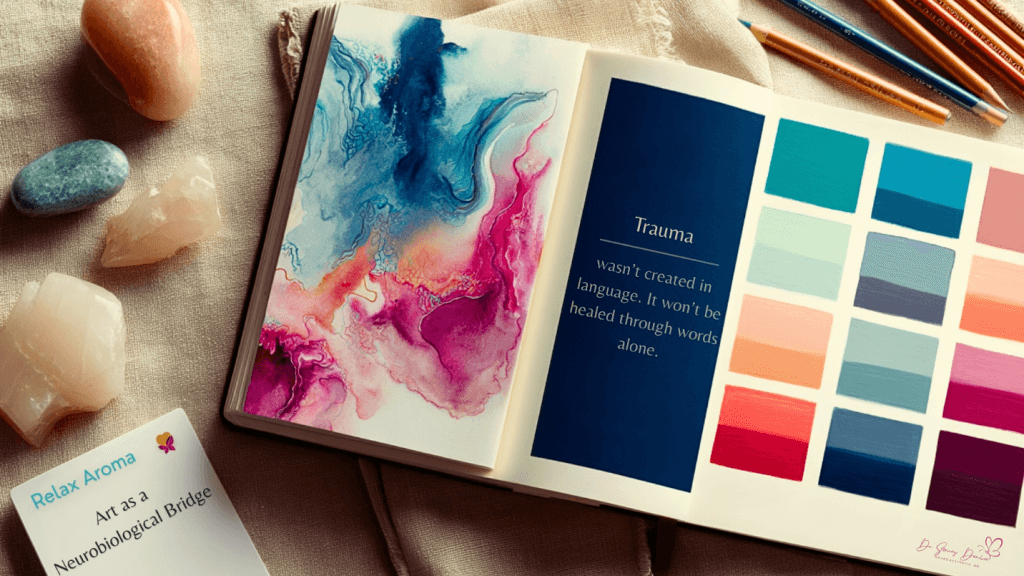
You don't need to be an artist. You just need to be willing to let your hands say what your mouth cannot.
1. The "Safety" Altar
What it is: Externalizing your nervous system's vigilance.
Why it works: Visual proof of safety allows your brain to stop scanning for threats.
How to do it tonight: Clear a small space on your nightstand. Place one object there that feels like an anchor—a smooth stone, a photo of a calm place, or a fabric swatch in a color like Healing Aqua or Magenta Flame. Before bed, look at this object and tell your brain, "This is here. I am here. We are safe."
2. Drawing the Shadow (The Monster Journal)
What it is: A containment vessel for your worry.
Why it works: Giving form to a feeling traps it on paper so it doesn't live in your body.
How to do it tonight: Keep a sketchbook by your bed. If you feel "overwhelm," draw a tangle of black yarn. If you feel "grief," draw a heavy blue shape. Once it is on the paper, close the book. You have trapped the monster. It doesn’t need to sleep in your bed.
3. Pocket Anchors (Tactile Grounding)
What it is: A physical tether to the present moment.
Why it works: Tactile input overrides the amygdala's danger signal.
How to do it tonight: Keep a small, textured token in your pajama pocket or under your pillow. When the 3 a.m. anxiety hits, touch it. Focus entirely on the texture. This pulls you out of the feedback loop and back into your body.
"Art therapy isn't 'arts and crafts.' It's neural surgery—building a bridge between your amygdala and your prefrontal cortex."
When Your Sleep Problem Isn't Just About Sleep
If you are reading this and thinking, “Dr. Stacey, I have optimized my sleep hygiene and I still cannot rest,” I hear you.
You aren’t broken. You are a woman in transition. Your hormones are shifting, your sensory filters are thinning, and your trauma is asking to be seen, not just discussed.
We need to look at the whole picture—your labs, your sleep architecture, and your nervous system.
If you are in Texas, Caifornia or Ohio, I can be your doctor. We will look at the metabolic data and thyroid function that standard screenings often miss. But healing starts before the appointment.
It starts tonight, with a piece of paper and a permission slip to stop talking.
I'm just saying.
If you are ready to stop guessing and start sleeping, take the first step:
- Identify your pattern: Take the Sleep Quiz to find out which Sleep Saboteur is keeping you awake.
Go Deeper: When Words Fail, Art Speaks
If this resonates, you need to hear the conversation I had with Ann Yakimovicz. We go deep into why the nervous system doesn't need words to heal—it needs color, texture, and ritual.
🎧 Listen to Episode 6: Paint to Remember
Watch on YouTube
References
- Quinn, M. (2025). Art therapy's engagement of brain networks for enduring recovery from addiction. Frontiers in Psychiatry.
- Zeki, S. (2003). The neural determinants of abstract beauty. Journal of Consciousness Studies.
- Payano Sosa, J. et al. (2023). Mask-making for PTSD facilitates narrative reintegration. Neuroaesthetics Journal.