See Her — A Declaration of Visibility
Updated: April 2026
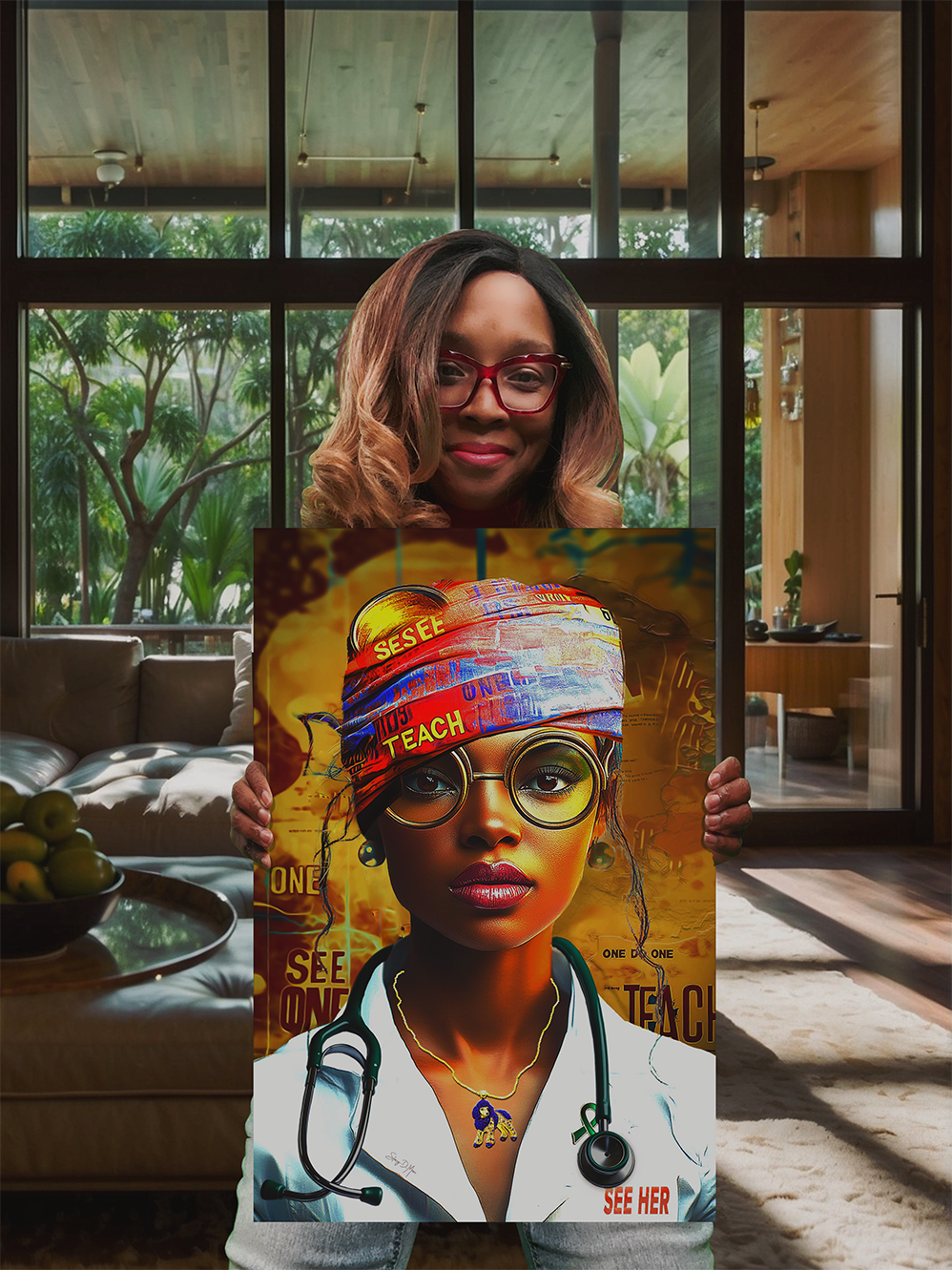
She stands here, hidden behind the armor of her profession. A healer, yet unseen, bearing the weight of expectations that silenced her voice and denied her humanity.
That's the description I wrote for this piece when I made it. And every word of it was true.
See Her is the first piece in the Her Series — the third and final section of the Fragments to Fusion collection. By the time you reach this piece, you've already moved through the Inner Child Series, through Quiet Before the Storm and Dysregulated, through Fiery Orange Chicken and Panda's Storytime and the Frog Prince sitting alone at the bayou. You've moved through the shadow work — Am I Looking in the Mirror, Piercing My Soul, The What Ifs. You've done the excavation.
See Her is what comes after the excavation. It's the moment you stand up and say: I'm here. And I'm done being invisible.

The Bandana and What It Held
At the center of this piece is a bandana inscribed with the words See One, Do One, Teach One.
If you've never been through surgical training, you might not fully understand what those six words cost. They represent the operating logic of medical residency: watch a procedure once, perform it the next time, teach it after that. The assumption buried in that mantra is that one exposure is sufficient. That human beings can absorb complexity, trauma, high-stakes decision-making, and technical precision in a single pass — and then be expected to replicate it flawlessly, and then pass it forward.
The bandana in this piece is both a shield and a scar. It's a psychological bandage covering wounds left by a system that demanded perfection and offered no space for the humanity required to sustain it. It's what I wore — not literally, but in every other sense — for years in that environment. The armor that let me function. The covering that let me survive.
But a bandana can only hold so much. And underneath it, something was always pressing against the fabric, waiting.
What the System Couldn't See
A 12-year retrospective study of American academic surgery faculty published in the Journal of Surgical Research documented what many of us lived without needing a study to confirm: racial and gender disparities in surgical medicine remain most severe at the highest ranks of leadership and academic achievement, with Black surgeons named specifically as among the most underrepresented. (DOI: 10.1016/j.jss.2020.08.069)
I was in that data. I was one of the few. And every day in that environment carried an unspoken demand: prove you belong here. Again. And again. And again.
As a young Black woman navigating a field that was predominantly white and predominantly male, my identity was the first thing people registered — often before my intellect, before my skills, before my clinical judgment. I learned what many Black women in medicine learn: that survival required a particular kind of management. Not just of patients and procedures, but of perceptions. Of how much you showed. Of how much you felt. Of what you let land visibly on your face when something happened that had no business happening.

In this environment, like in Full Metal Jacket, every step was regimented, rehearsed. The relentless cycle of See One, Do One, Teach One. And yet — no one ever paused to see her. The woman inside the white coat. The child who had grown up in a home organized around chaos and violence and was now channeling all of that practiced emotional management into a profession that rewarded exactly that capacity without ever asking what it had cost to develop it.
She wore resilience as a shield but craved acknowledgment. Validation for her struggle, her strength. The recognition that she was not just a function — a set of hands, a set of skills, a set of credentials — but a person. With history. With wounds. With something to say that the clinical environment had no category for.
The Sorority Emblem and What It Meant
Also in this piece is the poodle emblem of Sigma Gamma Rho — my sorority. I want to be clear about what that symbol holds and why it belongs in this artwork alongside the surgical mantra.
Sigma Gamma Rho was founded in 1922 by seven young women educators who believed that education, advocacy, and service were the foundations of a life well-lived and a community well-served. The poodle emblem represents exactly what I was fighting to preserve in myself during those years of training: the commitment to education as liberation, to health advocacy as calling, to leadership as responsibility rather than as status.
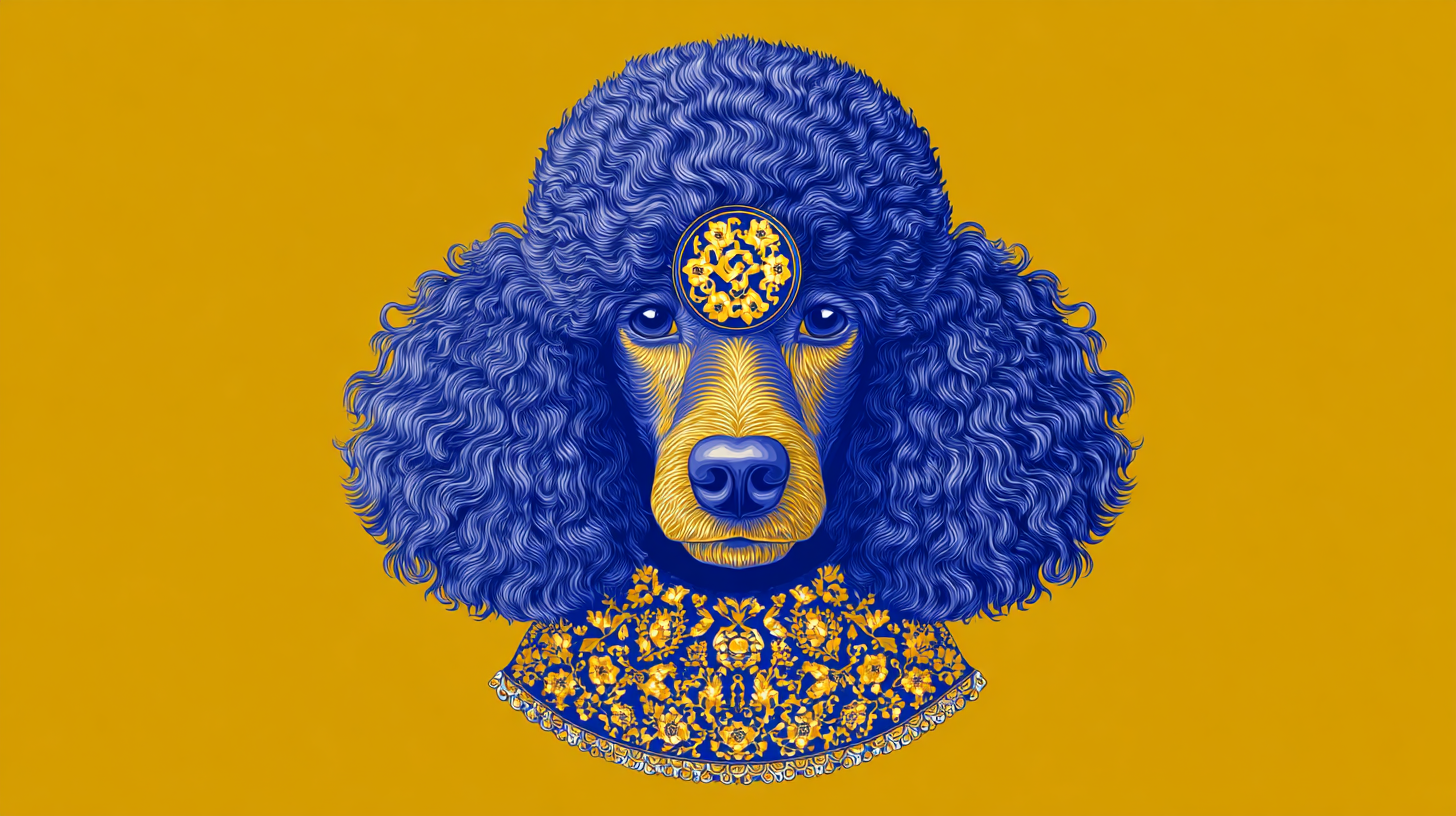
When the system was telling me to become impenetrable, the sorority's values were reminding me why I had entered medicine in the first place. Not to perform perfection for an audience that would never fully accept me. But to keep doors open for the women who would come behind me. To show my daughters and others like them that they, too, deserved to be seen and valued.
That emblem in the painting is a thread back to purpose when the environment was doing its best to sever it.
The Declaration
See Her is my declaration: no longer invisible, no longer just a cog in the wheel. It's time to be seen.
I want to say plainly what that declaration required — because declaring visibility isn't a feeling, it's a decision. And it's one that many of us don't get to make until we've survived what made us invisible in the first place.
It required surviving training. It required making it to the other side of a system designed to break people — and specifically designed to break people who looked like me — and deciding that what I found on the other side was worth saying out loud.
It required the shadow work. The Inner Child Series. The reckoning with what
I had been carrying and what it had cost me and my daughters. The decision to heal — not because healing was easy or comfortable, but because the alternative was continuing to transmit the wound.
And it required art. The particular gift of figurative expressionism — the ability to put something on a surface that holds a truth your clinical training never taught you to name, in colors that communicate what language alone can't carry. The intense palette of this piece, the bold strokes, the emotional storm made visible — that's not aesthetics. That's what it felt like inside when I finally stopped hiding it.
Who This Is For
This piece — and this post — is for every woman who has been so busy performing competence that nobody, including herself, knew she was doing it.
For every Black woman who has learned to become impenetrable in a system that made that the only available option for survival, and who carries the weight of that impenetrability in her body long after the training is over.
For every physician, surgeon, healthcare worker who was trained to See One, Do One, Teach One — and never once had someone pause long enough to see them.
For the women in perimenopause who are watching the performance structures they built in their twenties and thirties start to crumble — not because something is wrong with them, but because the estrogen buffer that was helping them maintain the armor is thinning, and the body underneath it is finally insisting on being acknowledged.
The body has always known what the system refused to see. That underneath the armor is a person. That the person has a story. That the story matters.
See her.
The next chapter: Be Her: Stepping Into Empowerment →
The shadow work that made this declaration possible: Meeting the Shadow — Carl Jung, the Dark Night of the Soul →
The origin of the framework: Art Is Medicine — And I Know This Because It Saved Me →
Join the Auntie Menopause Circle → facebook.com/groups/theauntiemenopausecircle
If this resonated with you, you are not alone in this journey. The Auntie Menopause Circle is where women who are done being dismissed come to learn, heal, and find each other.
Sources
Zhu K, et al. Equity, diversity, and inclusion in academic American surgery faculty: an elusive dream. Journal of Surgical Research. 2020. DOI: 10.1016/j.jss.2020.08.069
NOTE: This post originated as a reflection on the See Her artwork and its connection to medical training, race, and identity on Ceyise Studios. It has been fully rewritten here on drstaceydenise.com — grounded in the exhibition booklet description of the piece, the artist statement, and the specific visual elements: the bandana inscribed with See One, Do One, Teach One as both shield and scar; the Sigma Gamma Rho poodle emblem as thread back to purpose; the declaration of visibility as the culmination of everything the Inner Child Series excavated.
Originally published on Ceyise Studios. Updated: April 2026.