Rituals for Clearing Space: Why Your Neurodivergent Brain in Perimenopause Needs This More Than You Know
Updated: April 19, 2026
Someone probably told you space clearing was woo-woo.
Maybe it was a colleague. Maybe it was a doctor. Maybe it was the part of your own brain that has been trained to dismiss anything that doesn't come with a clinical trial and a prescription pad attached.
And I want to talk to that part of you today. Because here is the truth.
The woman who is burning sage in her living room on a Sunday morning is not being irrational. The woman who is ringing a bell in the corners of her room, or opening every window to move air through the house, or carefully placing objects that carry meaning back into order—she is not performing mysticism.
She is doing something her nervous system has been asking for. She just didn't have the clinical language to explain why.
I'm going to give you that language today.

Architecture and the Brain
Someone once said that architecture is 99% invisible.
The structure and durability of a building are the result of a carefully planned set of supports and construction methods. You cannot see them. But without them, the building gives way. It does not matter how beautiful the exterior is. Without the internal architecture—the load-bearing walls, the foundation, the hidden infrastructure—everything collapses.
A stressed mind works the same way.
And here is what I have observed in my practice and in my own life as a late-diagnosed autistic physician navigating this exact intersection of neurodivergence and midlife transition: when the external environment is chaotic, disorganized, visually overloaded, or energetically heavy—the internal architecture of the nervous system buckles under the weight.
You can feel it in your body. You walk into a cluttered room and your shoulders go up. You sit in a space where something feels off—where the energy of something difficult happened and nobody cleared it—and your nervous system registers that before your conscious mind does.
That is not imagination. That is your threat detection system doing exactly what it was designed to do.
Having our energy and inspiration drained by a chaotic environment is not a personal weakness. It is a documented physiological response. And for neurodivergent women in perimenopause, it is amplified in ways that conventional medicine has completely failed to address.
The ADHD and AuDHD Brain in a Chaotic Environment
Listen. I need you to understand what is actually happening in your brain before we talk about how to fix it.
If you have ADHD or AuDHD, the co-occurrence of autism and ADHD that many of us are only now learning describes us—your executive function system is working differently than a neurotypical brain. Your working memory is more limited. Your ability to filter irrelevant sensory information is more effortful. Your brain is constantly scanning the environment for input it needs to process, and a cluttered, disorganized, visually noisy environment gives it an enormous amount of input to process before you have done anything else.
Every pile of unfolded laundry. Every counter covered in objects. Every surface that holds something that belongs somewhere else. Your ADHD brain registers all of it. It does not filter it out the way a neurotypical brain might. It keeps processing it. In the background. Constantly.
This is not a character flaw. This is neuroanatomy.
And the cognitive load of that constant background processing—that perpetual low-grade sensory and executive drain—leaves you with less capacity for everything else. Less capacity for emotional regulation. Less capacity for decision-making. Less capacity for the masking that keeps you functional in the world. Less capacity for rest.
For autistic women who have been masking—performing neurotypicality in every space they enter, managing every sensory input, modulating every response—the home is supposed to be the one place where masking can come down. Where the nervous system can exhale.
But if your home is chaotic—if it is carrying visual noise, sensory overload, or the energetic weight of unprocessed events and difficult memories—it is not a place where the mask can come down. It is just another environment to manage.
You follow me?

What Perimenopause Does to All of This
Here is where it gets urgent.
Estrogen is not just a reproductive hormone. I say this in every context because it bears repeating until every woman in midlife understands it in her bones. Estrogen supports your nervous system. It modulates your sensory threshold. It buffers your stress response. It helps your brain filter, process, and manage the constant incoming stream of environmental information.
When estrogen starts declining during perimenopause -- the sensory inputs that your hormonal system was helping you manage become harder to filter. The visual clutter that was annoying before becomes genuinely overwhelming. The environment that felt manageable at 38 can feel like an assault at 48.
This is not you becoming more sensitive. This is your biology asking for more precise environmental support at exactly the moment when most of your life's accumulated stuff is surrounding you in every room.
And here is the part that nobody talks about: for women who have been masking their neurodivergent nervous systems for decades, perimenopause does not just change the hormonal landscape. It removes the last remaining buffer between who you have been pretending to be and what your nervous system actually needs.
The space clearing that felt optional before perimenopause becomes clinically urgent after it.
Why Ritual Is Not Woo
Let me address this directly. Because I know some of you are still in that part of your brain that is waiting for me to tell you why this is real medicine.
Here is the truth about ritual in medicine.
Ritual is the brain's mechanism for creating predictability in an unpredictable world. When you engage in a deliberate, sequential, sensory-rich act—lighting a candle, burning sage, ringing a bell, opening the windows in a particular order—you are giving your prefrontal cortex a structured task to focus on and your amygdala a clear signal: this sequence means something specific. This sequence means we are transitioning. This sequence means this space is becoming different from what it was.
The placebo literature—which is not the dismissive word most people think it is—has established that the expectation of healing, the ritual of treatment, the structured ceremonial context of a clinical encounter all produce measurable neurobiological changes. Dopamine release. Endorphin activation. Reduced amygdala firing. These are real changes in real brain chemistry, produced not by a pill but by meaning.
Your brain cannot tell the difference between a ritual that a scientist designed in a lab and a ritual that a healer designed 3,000 years ago—as long as both are performed with intention, repetition, and sensory engagement. The mechanism is the same. The brain responds to pattern, to predictability, and to the clear signal that this deliberate sequence of actions means something is shifting.
For ADHD and AuDHD brains that are strongly pattern-driven—that actually need the repetition and predictability of ritual in ways neurotypical brains often don't—space clearing rituals are not supplementary. They are precisely the kind of structured, sensory, intentional act that the neurodivergent nervous system uses to self-regulate.
This is not woo. This is neuroscience wearing ancient clothing.
The Pandemic Proved It
When the pandemic hit and the entire world was quarantined inside their homes, something became painfully obvious.
The environment was inescapable.
The chaos you could outrun before—the pile of papers you told yourself you'd deal with later, the room that held difficult memories, the spaces in your home that had never been intentionally cleared or organized or made yours—you were now living inside them 24 hours a day. There was nowhere to go. The external reset that used to compensate for the internal environment was gone.
And gradually, for millions of people -- the enthusiasm leaked out. The motivation flattened. The nervous system, with nowhere else to be, had to metabolize the energetic weight of the space it was trapped in.
Some people redecorated. Some people deep-cleaned every surface. Some people burned through sage like it was going out of style. And many of them reported the same thing: something lifted. Something shifted. The space felt different. And because the space felt different, they felt different.
That is the data. It may not be in a randomized controlled trial. But it is in the lived experience of millions of people who discovered in the hardest possible way that their environment was either medicine or it was making them sick.
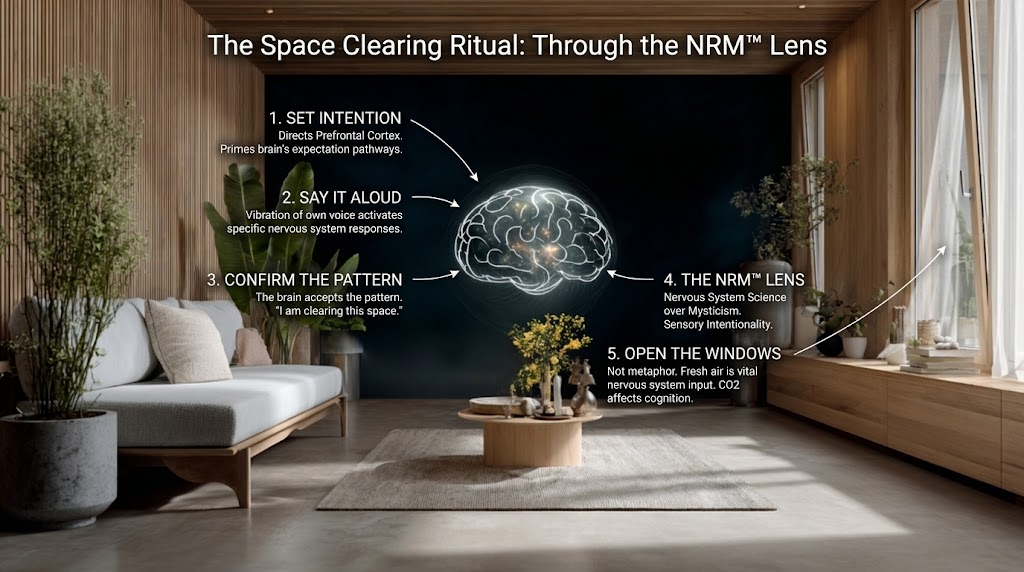
The Space Clearing Ritual Through the NRM™ Lens
Here is how to clear space in a way that is grounded in The Neuroaesthetic Reset Method™—not feng shui, not New Age religion, but nervous system science with sensory intentionality.
Before you begin -- set the intention.
This is not optional and it is not mystical. Setting an intention before you begin a clearing ritual gives your prefrontal cortex a clear directive and primes your brain's expectation pathways. You are not wishing something into existence. You are telling your nervous system what this sequence of actions means.
Say it out loud if you can. Your nervous system responds to the vibration of your own voice in a way that silent thought does not activate. Say: "I am clearing this space. I am making room. What has been heavy here is released. What comes next is lighter."
You don't have to believe it fully yet. Your brain just needs the pattern.
Open the windows first.
Before anything else, open the windows. Move air through the space. This is not a metaphor. Air quality directly affects nervous system function, mood, and cognitive clarity. The stale, recycled air of a closed space carries higher CO2 levels that are measurably associated with cognitive fatigue and lower mood. Fresh air is a nervous system input. Use it.
Clear the visual clutter first - before the ritual elements.
For ADHD and AuDHD brains, visual clutter is the first sensory assault. You cannot receive the benefit of a clearing ritual in a visually overloaded space. Your nervous system will keep scanning the clutter instead of settling into the ritual.
Before you light the sage, before you ring the bell—clear one surface. One. Not the whole house. One surface that your eyes will naturally land on. A clear surface is a signal to the nervous system: here is a space that is intentional. Here is a space that was tended to.
The sage or palo santo - clinical aromatherapy, not mysticism.
Both sage and palo santo have been used in healing traditions across cultures for thousands of years. And both have clinical rationale that goes beyond spiritual belief.
Burning sage—specifically white sage or common sage—releases volatile organic compounds including 1,8-cineole, which has documented antimicrobial properties and has been studied for neuroprotective and anti-inflammatory effects. The act of slowly moving smoke through a space, at your own pace, in your own sequence, is also a structured, sensory, rhythmic act—which is exactly the kind of input that regulates neurodivergent nervous systems.
The scent itself activates the olfactory system, which has a direct pathway to the limbic system—your emotional and memory processing center. Scent reaches your nervous system faster than any other sensory input. The scent of sage or palo santo, associated with clearing and transition through repeated use, becomes a conditioned cue. Your brain learns: when I smell this, something is changing. When I smell this, I am clearing what was heavy.
That is not magic. That is classical conditioning applied to your own nervous system.
For women with sensory sensitivities—and in perimenopause, sensory sensitivity increases as estrogen declines—use smoke minimally and at low concentration, or substitute with a diffuser using sage essential oil, palo santo essential oil, or frankincense. The scent cue works without the smoke. Do not override your sensory system in the name of ritual. The ritual serves you, not the other way around.
Sound - the bell, the bowl, the voice.
Sound is vibration. And vibration registers in the body before the conscious mind processes it.
A bell, a singing bowl, or even a gentle clap in the corners of a room produces sound waves that travel through the air and through your body simultaneously. For neurodivergent women who process the world through sensation first - this is not nothing. This is physical information that tells the nervous system: this space is being actively engaged with. Something deliberate is happening here.
Ring a bell or bowl in each corner of the room you are clearing. Start at the door and move clockwise. The pattern matters—not because of spiritual law, but because pattern is regulating. Your ADHD brain will track the sequence. Your autistic nervous system will find the predictability grounding. The act itself is the medicine.
The closing - set the new frequency.
End the ritual by placing one object in the cleared space that represents what you are calling in. Not decorating. Not filling space. One intentional object.
A candle you light only during this ritual. A crystal or stone that you hold only in this context. A photograph that represents who you are becoming. A flower from your garden.
This object becomes the anchor. Every time you see it, your nervous system receives the same signal: this space was cleared. This space is intentional. This space belongs to me.
For the Silver Goddess navigating perimenopause—the woman who grew up in spaces that were never hers, who has been tending to everyone else's environments her entire adult life—the act of placing one intentional object in a cleared space is not interior design.
It is a declaration.

I'm Just Saying
Your environment is not neutral.
It is either working with your nervous system or it is working against it. Every day. Whether you are conscious of it or not.
For ADHD and AuDHD women in perimenopause whose nervous systems are running without the hormonal scaffolding that was helping them cope -- the environment becomes more clinical, not less. The clutter that was annoying before becomes a genuine physiological stressor. The chaotic space that you could manage at 35 becomes a drain on the executive function and emotional regulation capacity that perimenopause is already taxing.
Space clearing is not about removing negative energy in the abstract.
It is about reducing sensory load. Creating predictability. Establishing ritual anchors that tell your nervous system this space is intentional, tended, and safe. Removing the accumulated weight of what was difficult and making room for what is coming next.
That is medicine. It has always been medicine. The ancient traditions that developed these rituals understood something about the nervous system that Western medicine is still catching up to.
You don't have to choose between the science and the ritual. They are telling you the same thing.
Listen.
If you want to go deeper on how your home environment is affecting your nervous system during perimenopause -- the Auntie Menopause Circle is where we have these conversations every week.
Come join us.
Join the Auntie Menopause Circle →
And if you want to understand which patterns are keeping your nervous system stuck in the first place --
Take the Sleep Saboteur Quiz →
Understand the full science of how your environment shapes your nervous system: What Is Neuroaesthetics? The Gentle Science of How Beauty Heals Your Brain →
And read this next -- because trauma, neurodivergence, and perimenopause are all part of the same collision: Why Trauma, Neurodivergence, and Menopause Collide -- And Why Your Doctor Keeps Missing It →
For the bedroom version of this work: Bedroom Color Ideas Every Woman in Perimenopause Should Know →
NOTE: This post was originally published on Ceyise Studios, my design and neuroaesthetics platform, and has been brought here to drstaceydenise.com because it is foundational to the clinical work I now do with neurodivergent women navigating perimenopause and menopause. Some of those original posts have been retired. Others have been expanded into updated companion pieces that go further than the original could. Where a newer version exists, you will find a link to it at the top or bottom of this post.