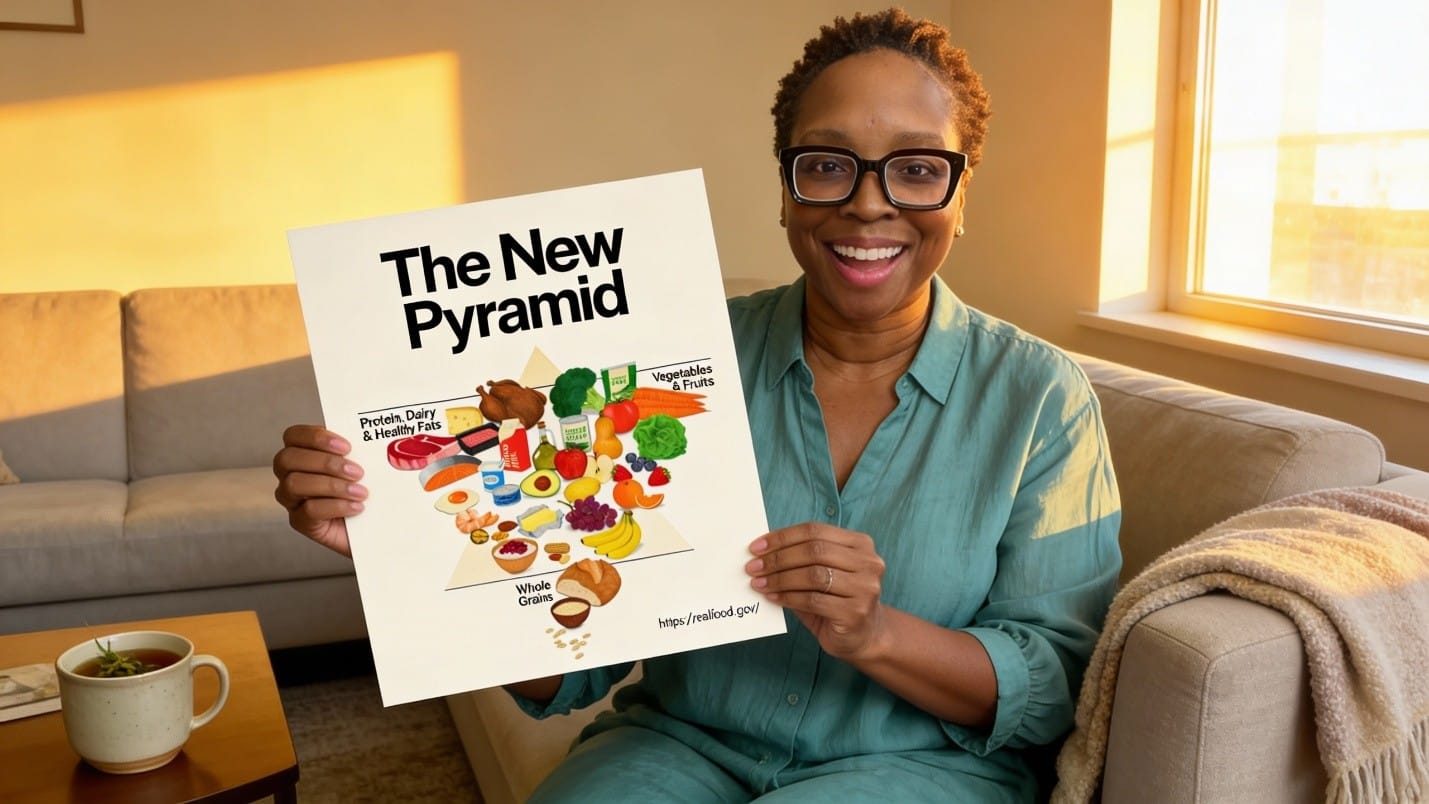
Can the New “Real Food” Pyramid Actually Help You Sleep in Menopause?
From Headlines to 2 a.m. Wakeups
By now you’ve probably seen the headlines.
“New upside‑down food pyramid.”
“War on sugar and ultra‑processed foods.”
“Eat real food.”
You scroll past it at midnight with one eye half‑closed, because honestly, you’re just trying to make it through another night without waking up at 2 a.m. drenched, starving, or wired.
Here’s the part nobody is explaining to you.
Listen.
Whatever you think about politics, the new 'real food' pyramid guidelines actually matter for menopause sleep. They matter for one very specific thing in your life right now: how stable your blood sugar, hormones, and nervous system are when you're trying to sleep through perimenopause.
So let’s take this out of the press conference and into your bedroom. Let me translate what changed, what it means for your metabolism and sleep, and what to do if you’re already eating mostly “real food” and still exhausted.
What Actually Changed in the New Food Pyramid (No Drama)
The 2025–2030 federal dietary guidelines just went through a major reset. Under all the noise, here’s the essence:
- Protein and whole‑food fats moved to the center.
The pyramid now prioritizes “high‑quality, nutrient‑dense protein” at most meals—meat, poultry, eggs, seafood, dairy, beans, lentils, nuts, and seeds—paired with healthy fats like olive oil, avocados, and full‑fat dairy. - Ultra‑processed foods and sugary drinks are finally called out.
For the first time, the guidelines explicitly say to avoid “highly processed packaged, prepared, ready‑to‑eat foods that are salty or sweet” and sugar‑sweetened beverages. - Whole fruits, vegetables, and fiber‑rich grains are emphasized.
There is strong language around real produce, whole grains, and fiber for cardiometabolic and gut health, not just calories.
In other words: more real food, more protein, more fiber, less sugar, less fake food.
If you’ve ever noticed that a protein‑rich dinner helps you sleep better than pizza and soda, your body got this memo long before the government did.
Are you following what I’m saying?
Why This Matters for Perimenopause Metabolism and Sleep
Let’s talk about what all of this means for a 45‑year‑old woman who is hot, wired, exhausted, and watching her weight shift to her midsection even though nothing about her eating feels that different.
1. More Protein → Steadier Blood Sugar, Fewer 3 a.m. Crashes
Perimenopause is not just about estrogen. It’s about insulin. As estrogen fluctuates and eventually declines, your cells become more insulin‑resistant. That means:
- Higher and more prolonged blood sugar spikes after meals
- More reactive hypoglycemia later (the 2–4 a.m. “I woke up starving or anxious” pattern)
- Easier midsection weight gain even at the same calorie intake
Higher‑protein meals (especially 25–30 grams per meal) slow the absorption of carbohydrate, blunt glucose spikes, and help you feel full longer. Stable blood sugar means:
- Fewer cortisol surges in the middle of the night
- Less nocturnal adrenaline (the heart‑racing, wide‑awake feeling)
- A lower chance of waking up shaking, hungry, or drenched in sweat
Protein is also where you get amino acids like tryptophan, which are precursors for serotonin and melatonin—the brain chemistry that allows your body to feel sleepy and stay asleep. When the pyramid centers protein, it quietly supports the neurotransmitters that help you rest.
2. Whole‑Food Fats → Calmer Nervous System, More Stable Hormones
For decades, women were told to fear fat. Low‑fat yogurt, low‑fat crackers, low‑fat everything. Now the guidelines are finally softening on saturated fat and emphasizing quality over simple restriction.
Healthy fats matter in menopause because they:
- Support hormone production and hormone metabolism
- Slow gastric emptying and stabilize blood sugar
- Provide omega‑3s that reduce neuroinflammation and support mood and sleep quality
A plate with salmon, olive oil, avocado, or full‑fat yogurt will hit your nervous system very differently than a plate built from low‑fat processed products.
3. Less Sugar and Ultra‑Processed Food → Fewer Sleep Saboteurs
The guidelines explicitly target sugar‑sweetened beverages and ultra‑processed foods because of their role in obesity, diabetes, and cardiovascular disease. For your sleep, here’s what those foods do:
- Spike blood sugar quickly and crash it hard a few hours later
- Increase nighttime reflux and digestive discomfort
- Drive inflammation that can worsen hot flashes and pain
- Disrupt the gut microbiome, which talks directly to your brain and circadian system
If you notice that evenings with soda, candy, or “just a few chips” lead to more restless nights, that’s not lack of willpower. That’s physiology.
4. More Fiber and Real Plants → Gut + Estrobolome → Sleep
The new guidelines lean heavily into “eat real plants,” not just “take fiber supplements.” That matters because:
- Fiber feeds your gut microbiome, which in turn influences inflammation, mood, and sleep.
- A healthy estrobolome (the part of the microbiome that processes estrogen) helps clear used estrogen and can moderate the intensity of hot flashes and mood swings.
Better estrogen handling + lower inflammation + more stable gut‑brain signaling = fewer sleep‑disrupting symptoms for many women.
Where the Pyramid Still Fails Women in Midlife
All of this is helpful. But it’s not enough.
The pyramid can tell you what to eat in broad strokes. It does not tell you:
- When to eat for a nervous system that gets a second wind at 10 p.m.
- How to adjust for night shifts, caregiving, or “revenge bedtime procrastination.”
- What to do if you’re autistic or ADHD and certain textures, smells, or routines are non‑negotiable.
- How to factor in HRT, thyroid problems, insulin resistance, iron deficiency, or trauma.
It is written for “the average American adult.” You are not an average anything.
You are a neurodivergent, sleep‑deprived, midlife woman whose hormones are recalibrating while she carries a career, a family, and a lifetime of weathering. The guidelines don’t see that. Your body still needs something more specific.
Tiny Trials: How to Use the New Pyramid for Sleep This Week
You don’t need to overhaul everything. You need a few strategic experiments that speak directly to your metabolism and sleep.
Try any of these for 5 nights in a row and watch what changes.
Trial 1 – The “Real‑Food Evening Plate”
For dinner, build your plate like this:
- Protein: palm‑sized portion (fish, chicken, tofu, lentils, eggs)
- Non‑starchy vegetables: two fists (broccoli, greens, peppers, salad)
- Real fat: one thumb (olive oil, avocado, nuts, butter or ghee if tolerated)
- Slow carb (optional): cupped‑hand of beans, quinoa, or roasted sweet potato
What to notice:
- Do you still get “snack panic” at 9–10 p.m.?
- Do you wake up as hungry or shaky at 2–3 a.m.?
- Does your sleep feel less “jagged” even if total hours are the same?
Trial 2 – Front‑Load Carbs, Move Dinner Earlier
For 5 days:
- Move your main starch (rice, pasta, bread, dessert) into breakfast or lunch.
- Keep dinner mostly protein, vegetables, and fat.
- Aim to finish eating 3 hours before bed when possible.
What to notice:
- How long it takes to fall asleep
- Night sweats, reflux, or bathroom trips after midnight
- Whether your 4–5 a.m. awakenings soften or shorten
Trial 3 – One Ultra‑Processed Swap at Night
For 5 nights:
- Replace your usual evening UPF (chips, crackers, cookies, candy, soda) with one of these:
- Greek yogurt with berries and a few nuts
- Apple slices with nut butter
- Leftover protein + a handful of veggies and herbal tea
What to notice:
- Does your heart race less when you’re lying in bed?
- Are your dreams less chaotic?
- Do you feel less puffy or inflamed when you wake up?
Trial 4 – Fiber + Protein Breakfast to Anchor the Day
Most women do not realize how much breakfast sets up their entire 24‑hour cortisol and blood sugar curve.
For 5 mornings, try:
- Option A: Eggs scrambled with spinach + side of oats with berries
- Option B: Greek yogurt, chia seeds, and fruit
- Option C: Leftover salmon or chicken + roasted vegetables and a small portion of sweet potato
What to notice:
- Mid‑morning crashes and cravings
- Afternoon energy dip
- Ease of falling asleep at night when your day started more stable
None of these trials are about perfection. They are about data. Your body is always giving you feedback. These trials make that feedback easier to read.
When the Guidelines Aren’t Enough
Here’s the truth: if you’re already eating 70–80% “real food” and you’re still waking up at 2 a.m., this is no longer just a food pyramid problem.
It might be:
- Perimenopausal estrogen and progesterone swings
- Thyroid function on the low side of “normal”
- Cortisol rhythm flipped from years of stress or shift work
- Iron, B12, or vitamin D depletion
- A nervous system stuck in hypervigilance
The guidelines can’t sort that out. That’s where individualized care comes in.
The 60‑Minute Clarity Call is where we map your symptoms, your current eating pattern, your sleep story, and your labs (if you have them) into a picture that makes sense for your body.
We look at:
- How closely your real life can or already does match these guidelines
- Where hormones, thyroid, cortisol, or iron might be sabotaging your efforts
- Which one or two next steps will give you the most sleep return for your energy investment
If you’re already doing “most of the things” and still feel wrecked, you don’t need another generic rule. You need clarity.
Your Next Step
If this new “real food” pyramid feels like confirmation that your body was never overreacting to sugar, low‑fat everything, or ultra‑processed snacks, you’re not imagining it.
Your insomnia, your weight shift, your 2 a.m. wakeups—they are physiology, not a lack of willpower.
Start here:
- Take the Sleep Pattern Decoder Quiz to identify which Sleep Saboteur is most active for you right now.
- Run one or two of the Tiny Trials for 5 nights.
- If your sleep is still fragmented, schedule a 60‑Minute Clarity Call so we can see what the pyramid can’t: your hormones, your nervous system, your lived reality.
Your body has been telling this story for years. The guidelines are finally catching up. Now it is time to build a plan that fits you.