Melatonin Gummies and Menopause: The Hidden Reason We’re Overdosed and Still Awake at 2 A.M.
The bottle on the nightstand
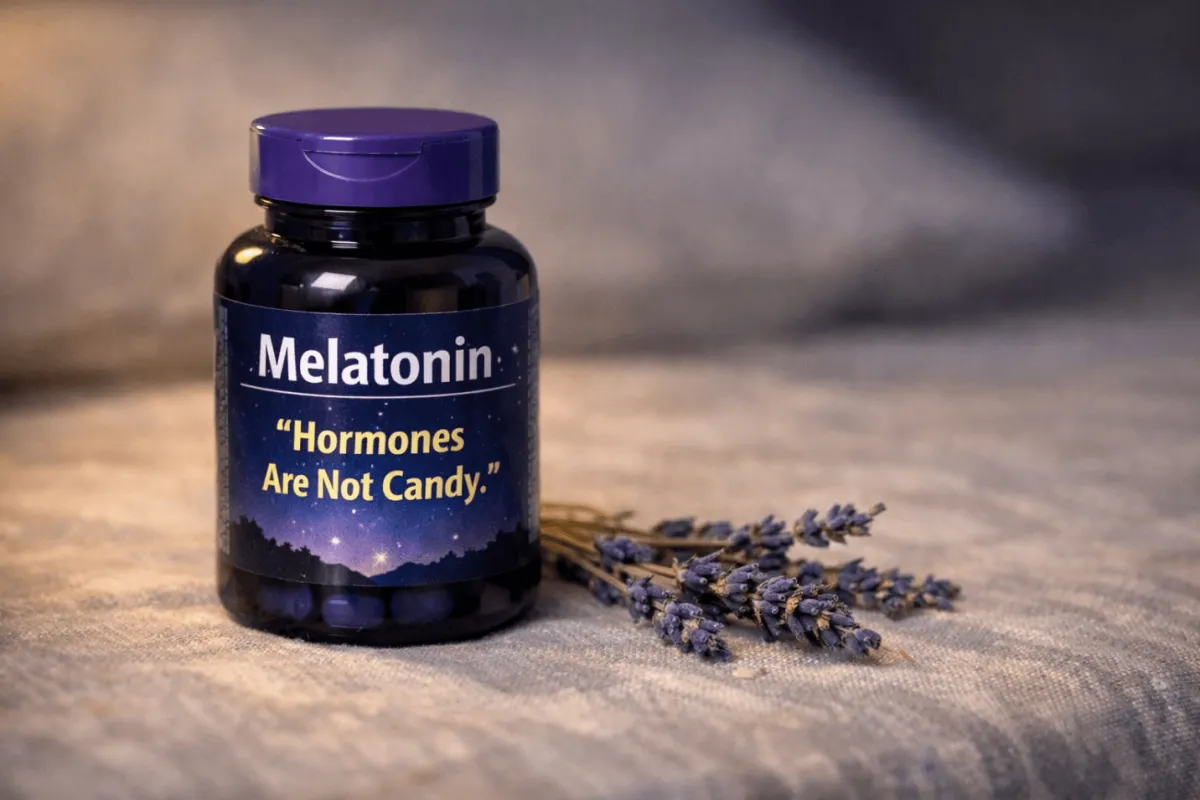
Melatonin Gummies and Menopause often look like an easy fix, but for many women they backfire and still leave you awake at 2 a.m. If I walked into your bedroom right now, I’d probably find it. The purple bottle. Or maybe the red one. The gummies that taste like berries and promise to knock you out when your brain refuses to shut down.
You take one. Nothing happens. You take two. Maybe you drift off, but three hours later, you are wide awake. Staring at the ceiling. The clock says 2:13 a.m. Your chest feels tight, your mind is racing through a to-do list for 2027, and you are exhausted.
You think, “I just need a higher dose.”
But, listen to me. The problem isn’t that you haven’t found the right gummy. The problem is that we are treating a complex hormonal transition like a candy store visit.
And while we’ve been busy buying the "extra strength" version, the data has shifted. We are overdosing our kids, risking our own heart health, and completely missing the conversation your body is actually trying to have with you.
In Melatonin Gummies and Menopause, the problem is rarely willpower. It’s dosing, timing, and a nervous system that needs a different signal.
Let’s translate what your physiology is screaming while you’re lying there awake.
Melatonin Gummies and Menopause: The Candy Aisle Crisis
We need to talk about how casual we’ve become with neurohormones.
Melatonin is not a vitamin. It is a hormone. It is a chemical messenger that tells your body it is night. And yet, we have normalized handing it out like snacks.
The numbers are terrifying.
Between 2012 and 2021, pediatric melatonin poisonings increased by 530%. Calls to poison control centers skyrocketed from roughly 8,000 to over 52,000. We have kids under five finding these "gummies" that look and taste exactly like fruit snacks, and they are ingesting doses massive enough to land them in the ER.
We have normalized the idea that if a little is good, a lot is better.
And you—tired, overwhelmed, sensory-overloaded you—have internalized this too. If the label says 5mg, maybe 10mg will finally stop the racing thoughts. But biology doesn’t work like math. More is not better. Often, more is just noise.
The Heart Failure Signal: Why "Natural" Doesn’t Mean "Benign"
I need to put my Clinician hat on for a moment. I need you to hear this, not to scare you, but to empower you with informed consent.
We used to think melatonin was completely harmless. You could take it forever, no consequences. But new data from the American Heart Association’s 2025 cohort is forcing us to pause.
In adults with insomnia, long-term use of melatonin (taken for a year or more) was associated with a nearly 90% higher risk of incident heart failure over five years compared to non-users.
Hospitalizations for heart failure in this group more than tripled.
Now, pause. Breathe.
This is observational data. It doesn’t mean the gummy in your stomach right now is a heart attack waiting to happen. It means correlation, not necessarily causation. It is possible that people who take melatonin every night have worse sleep to begin with, and that sleep deprivation is stressing the heart.
But it tells us something critical: Long-term reliance on high-dose synthetic melatonin is not a free pass. It is not just "background noise" for your body.
If you are a Black woman, or a woman with metabolic concerns, your cardiovascular risk is already something we need to protect fiercely. We cannot afford to be casual about anything that might strain your heart.
Why You’re Losing Your Natural Melatonin (And Why 10mg Won’t Fix It)
So, why are you awake?
It’s not your fault. It’s your physiology.
As you navigate perimenopause, your endogenous (natural) melatonin production drops. It falls significantly during the menopausal transition. This decline is intimately linked to that classic "midlife insomnia cluster"—the trouble falling asleep, and the maddening ability to wake up fully alert at 3 a.m.
But here is the nuance the gummy bottles miss:
Your body produces melatonin in picograms and nanograms. Tiny, whisper-soft amounts.
When you take a 5mg or 10mg gummy, you are hitting your brain with a sledgehammer. You are flooding the receptors. This can cause down-regulation, meaning your body stops listening to the signal because it’s being shouted at.
You end up with a "melatonin hangover" the next day—foggy, groggy, heavy. Or worse, you experience vivid, terrifying dreams because your REM cycle was forced, not invited.
You don’t need a sledgehammer. You need a signal.
The Neuroaesthetic Fix: Lighting the Pathway to Sleep
If we take the gummy off the pedestal, what replaces it?
We go back to the nervous system. We go back to the senses.
Your body knows how to make melatonin. It just needs the right cues. In my practice, we don’t start with supplements. We start with light.
1. Morning Lux is your ignition key.
You need bright light in your eyes within 30 minutes of waking. This sets the timer for melatonin release 12-14 hours later. If you wake up and stay in the dark, your timer never starts.
2. The Sunset Signal.
In the evening, your house should look like a cave, not a stadium. Blue light from screens suppresses melatonin twice as fast in children and significantly in midlife women. Dim the lights. Turn your phone screen red.
3. Temperature as a trigger.
Your core body temperature must drop for sleep to initiate. Perimenopause messes with this thermostat (hello, night sweats). A cool room (65-67 degrees) is not a luxury; it is a medical necessity for you.
Tiny Trials: A Safer Protocol for the Weary
If you are reading this with gritty eyes and thinking, "Stacey, that sounds lovely, but I need to sleep tonight," I hear you.
We don’t do big overhauls. We do tiny trials.
If you are going to use support, let’s do it safely.
- The Tart Cherry Switch: Instead of synthetic hormones, try tart cherry juice. It contains small, bioavailable amounts of melatonin precursors that nudge your body rather than shoving it.
- Magnesium Glycinate: This is your nervous system’s best friend. It doesn’t sedate you; it relaxes the physical tension that keeps you wired.
- Micro-Dosing: If you must use melatonin, look for 0.3mg to 1mg. Yes, that small. It mimics your body’s natural rhythm without the receptor overload.
- The Progesterone Conversation: Sometimes, the insomnia isn’t a melatonin issue. It’s a progesterone issue. Progesterone is your body’s natural Valium. It drops safely and steadily in perimenopause. Restoring that—under a doctor’s care—can often do what no gummy ever could.
You’re Not Fragmented. You’re Just Over-Stimulated.
You are not failing at sleep. You are navigating a world that wasn't built for a sensory-sensitive, menopausal nervous system.
The answer isn't in the candy aisle. It’s in listening to the language your body is speaking. She wants to sleep. Let’s help her remember how.
Ready to decode your nights?
If this speaks to your nervous system, you don’t have to guess anymore. Take my Sleep Pattern Decoder Quiz to find out exactly which chronotype you are and what your 2 a.m. waking is actually trying to tell you.
Quick safety note
This article is for education and storytelling. It is not personal medical advice and it does not replace a conversation with your own health care professional. Melatonin, tart cherry, magnesium, and progesterone can all interact with medications and health conditions, especially if you have cardiovascular disease, mood disorders, seizures, or are pregnant or breastfeeding. Please check in with your clinician before changing your regimen.