
5 Ways to Bring Nature Indoors for the Neurodivergent Perimenopausal Brain — A Los Angeles Guide
Updated: April 13, 2026
My patients don't need me to tell them that being outside feels different from being inside.
They already know. The woman who drives an hour to El Matador beach in Malibu because something about the Pacific resets her in a way she can't explain. The one who walks the trails at Griffith Park before work because it's the only thing that makes the day feel manageable. The one who keeps a single peace lily on her desk at her West Hollywood office because she doesn't know why it helps; it just does.
They know. They've always known.
What I want to give them is the science behind what their bodies have been telling them all along. Because when you're a neurodivergent woman in perimenopause—when your nervous system is more reactive, your sensory threshold is lower, and your hormonal buffer is thinning—understanding WHY something works matters. It helps you stop dismissing your own needs as preferences and start treating them as what they actually are: clinical requirements.
Most of us spend about 90% of our time indoors. And while that statistic applies to everyone, the consequences are not equal. For autistic women, women with ADHD, and sensory-sensitive women who have spent decades managing environments that were never built for their nervous systems, the absence of nature contact accumulates. It compounds.
So let's talk about what we can actually do about it—especially if you're in Los Angeles, where the Pacific is close but traffic is real and your Silver Lake apartment or Marina del Rey condo may be the only nature-adjacent space you reliably control.
What the Research Is Confirming
I want to share what I've been reading because I think you deserve to see the data, not just take my word for it.
I pulled four studies from PubMed that I keep coming back to because together they build a picture that is hard to argue with.
A 2021 review out of Harvard T.H. Chan School of Public Health looked across a decade of studies and found nature exposure linked to improved cognitive function, reduced blood pressure, better mental health outcomes, and improved sleep. Those four things. Together. Which is basically the entire symptom cluster I see in neurodivergent women in perimenopause. (DOI: 10.3390/ijerph18094790)
A large cohort study published in JAMA Network Open followed nearly 47,000 adults over six years and found that living near 30% or more tree canopy was associated with significantly lower odds of psychological distress and better self-rated general health. Tree canopy. Not a prescription. Not a supplement. Trees. (DOI: 10.1001/jamanetworkopen.2019.8209)
Here's the one I find most useful for women who can't always get outside: a cross-sectional study published in Environment International found that contact with indoor plants specifically was associated with a statistically significant reduction in stress scores. Which means the plant on your desk is not decoration. It is doing something measurable to your nervous system. (DOI: 10.1016/j.envint.2021.106664)
And a 2023 study in IJERPH found something I think about a lot: it wasn't just proximity to nature that predicted lower depression and stress. It was feeling connected to nature. Connection. Not just presence. That distinction matters for women whose relationship with outdoor spaces has been complicated by sensory barriers, safety concerns, or simply the pace of life in a city like Los Angeles. (DOI: 10.3390/ijerph20065083)
This is the clinical foundation. Now here are five ways to bring it inside.
A Note Before We Start
For neurodivergent women, "bring nature inside" can land wrong.
Some of you love plants but have no bandwidth to keep them alive during autistic burnout. Some of you are drawn to natural textures but find certain ones intolerable. Some of you want the calming effect of nature but the visual complexity of too many elements is overwhelming in itself.
I hear you. Every suggestion below includes a neurodivergent adaptation. Because the goal is nervous system regulation—not an aesthetically perfect room.
1. Houseplants—with a Sensory-Safe Approach
The research is clear: contact with indoor plants reduces stress. But not every plant works for every nervous system.
For low-maintenance, high-impact options in a Los Angeles home where the Mediterranean climate supports year-round growth: peace lilies thrive in low light and purify indoor air. Snake plants are nearly indestructible and visually clean—no overwhelming leaf complexity. Pothos can hang from ceiling hooks out of reach if tactile aversions make touching soil or leaves dysregulating.
The neurodivergent adaptation: If keeping plants alive during perimenopause burnout feels like one more thing to fail at, a preserved or dried botanical arrangement gives you the visual and tactile benefit of nature without the maintenance demand. This is not cheating. This is accommodating your actual nervous system.
The perimenopause connection: Declining estrogen affects the mucosal lining of your airways and makes you more sensitive to indoor air quality. Peace lilies and snake plants have both been studied for volatile organic compound removal. Better air, calmer nervous system, better sleep. It connects.
Want to understand how color in your environment connects to your nervous system regulation? Read this: Get in Touch with Your Inner Hue: The Ayurvedic Approach to Color Therapy →

2. Nature Art and Visual Scenes—with Intentional Placement
The Harvard-led review confirmed that viewing nature scenes supports mental health outcomes. The mechanism is partly amygdala calming—the same structure that becomes more reactive as estrogen declines during perimenopause.
A painting of the ocean, a photograph of eucalyptus groves at Elysian Park, or a high-resolution print of the Santa Monica mountains can provide measurable benefit. Not because it's pretty. Because your brain processes visual nature scenes as partial safety cues, downregulating your threat response.
What to choose: Scenes with soft edges and organic curves are more regulating than sharp geometric images. Blues and greens have consistently shown calming associations. The warm amber tones of a California golden hour tend to feel grounding—especially if you grew up here and have body memories of that light.
The neurodivergent adaptation: One large calming nature print is more regulating than a gallery wall of multiple images. Less visual complexity, more nervous system signal.
Placement: Put it somewhere your eyes naturally land when you're at rest—across from your bed, at eye level when seated at your desk, or in your reset corner.
3. Natural Textures—the Tactile Nervous System Reset
Your nervous system doesn't just process nature through sight and sound. Texture is a direct nervous system input—and for sensory-sensitive women, the wrong texture is dysregulating and the right texture is genuinely therapeutic.
Natural fibers—cotton, linen, wool, and bamboo—have different tactile qualities than synthetics. Many neurodivergent women report that natural fibers feel "right" in a way that synthetics don't, even if they can't articulate why. This is not a sensory preference being fussy. This is your nervous system accurately reading material quality and signaling either safety or alert.
What to incorporate: A cotton or linen throw you actually want to reach for. A jute or wool rug under your feet in your reset space. A smooth river stone or polished crystal you can hold during stress—the weight and temperature of natural stone is a sensory grounding tool backed by occupational therapy research.
The neurodivergent adaptation: Texture needs are highly individual. Some of you find wool intolerable. Some of you need weight—deep pressure is a regulating sensory input, which is why weighted blankets work so well for neurodivergent women in perimenopause. The goal is finding natural textures that your nervous system reads as safe. These will be yours and nobody else's.
The perimenopause connection: Tactile sensitivity often increases during perimenopause as estrogen affects skin receptor sensitivity. This means textures that didn't bother you before may now feel wrong. This is not you becoming more difficult. This is your body asking for more precise environmental support.
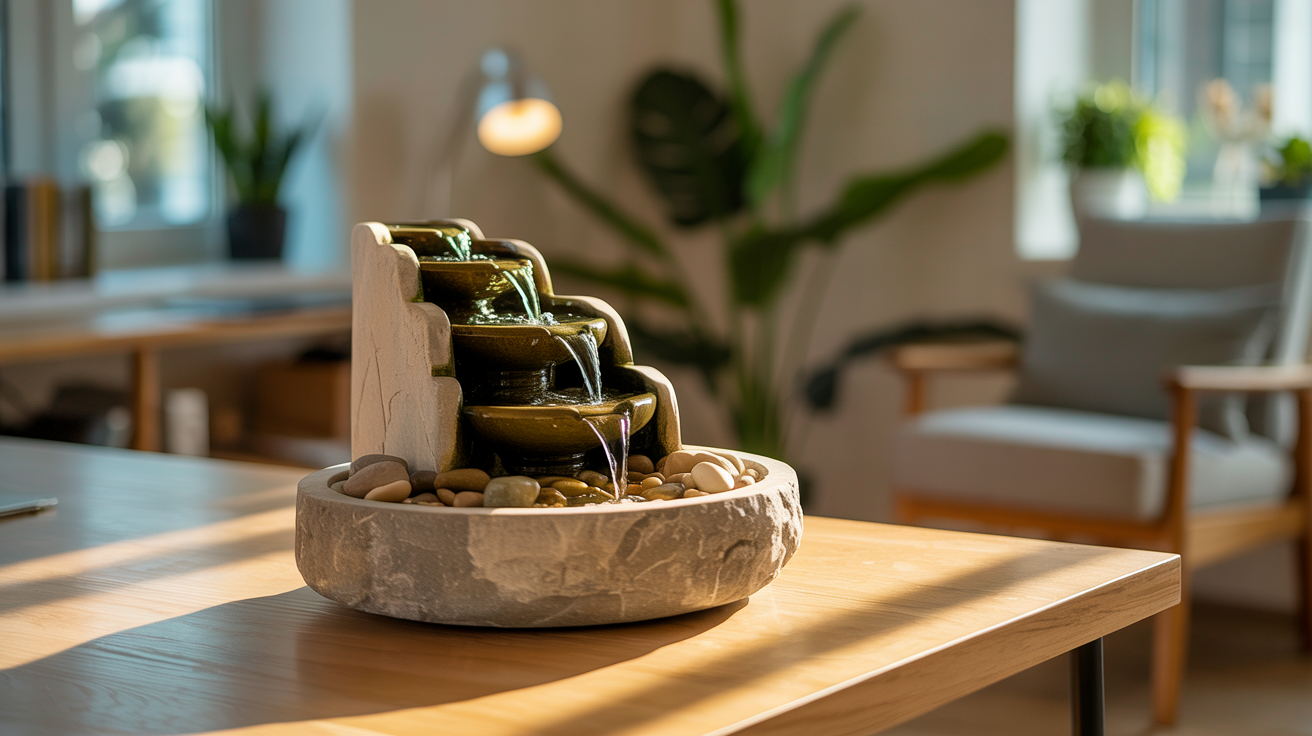
4. Water Elements -- Sound as a Parasympathetic Cue
The sound of flowing water is one of the most documented auditory regulators of the autonomic nervous system. It activates the parasympathetic branch—the "rest and digest" system—and has been associated with reduced cortisol and heart rate.
A small tabletop fountain in your reset space or bedroom can provide this cue continuously without requiring your attention. Your nervous system hears it and begins to downshift in the background—even while you're doing other things.
In Los Angeles you have something most cities don't—the Pacific Ocean is never more than an hour away. If you can get to the water, do it. The Huntington Botanical Gardens in Pasadena, the eucalyptus groves at Elysian Park, or simply sitting near the koi pond at Descanso Gardens are all accessible nervous system resets hiding in plain sight across the city.
But on the days traffic wins, the tabletop fountain is your proxy.
The neurodivergent adaptation: If moving water sounds are irritating rather than calming, try nature soundscapes through a speaker instead—forest sounds, rain on leaves, ocean waves from your phone. Choose the version your nervous system finds regulating rather than alerting.
The perimenopause connection: Night sweats and sleep disruption are driven partly by the sympathetic nervous system staying activated when it should be downshifting. A soft water sound or white noise in your bedroom can help provide the parasympathetic cue your body needs to make that transition. I recommend this before supplements for most of my patients.
5. Biophilic Design Principles - Bringing the Whole System Together
Biophilic design is the intentional integration of nature into built environments based on our biological affinity for natural systems. It goes beyond one plant or one painting—it's about creating a sensory environment that speaks the language your nervous system already knows.
For neurodivergent women in perimenopause, biophilic design is not an aesthetic choice. It is a clinical strategy.
The principles are simple: natural light over artificial when possible, organic curves over hard angles, living elements over purely manufactured ones, views of nature from rest positions, and natural materials in the things you touch most.
In a Los Angeles home this means:
Position your most-used chair near a window with a view of trees, sky, or the Hollywood Hills if you have them
In smaller Silver Lake or Echo Park apartments where space is tight, a single well-placed plant near a window does the work of a whole garden
Use the California morning light as your primary daytime light source and transition to warm artificial light in the evening
Keep one corner of your home intentionally simple, nature-informed, and free of screens
The neurodivergent adaptation: More is not always more. A single carefully chosen natural element in a visually quiet space is more regulating than a richly layered environment that overstimulates. Start with one change. Let your nervous system tell you what it needs next.
The Bigger Picture
You are spending most of your waking hours in environments that were designed without your nervous system in mind. This was true before perimenopause. During the hormonal transition—when your sensory threshold is lower and your stress response is more reactive—the mismatch between your nervous system's needs and your built environment becomes a clinical issue.
Bringing nature inside is not about decoration. It is about creating one environment in your life that speaks the language your nervous system already knows.
Start with one thing. A plant. A photograph of the Pacific. A smooth stone you can hold. A sound that makes your shoulders drop.
Your nervous system knows what it's been missing. You're just giving it permission to remember.
If you want to go deeper on how your environment is affecting your hormones, sleep, and nervous system during perimenopause -- the Auntie Menopause Circle is where we have these conversations every week.
Come join us.
Join the Auntie Menopause Circle →
Want to understand the science behind why your environment matters so much during menopause? Start here: What Is Neuroaesthetics? The Gentle Science of How Beauty Heals Your Brain →
Sources
Jimenez MP et al. Associations between Nature Exposure and Health: A Review of the Evidence. Int J Environ Res Public Health. 2021. DOI: 10.3390/ijerph18094790
Astell-Burt T, Feng X. Association of Urban Green Space With Mental Health and General Health Among Adults in Australia. JAMA Netw Open. 2019. DOI: 10.1001/jamanetworkopen.2019.8209
Ribeiro AI et al. Exposure to nature and mental health outcomes during COVID-19 lockdown. Environ Int. 2021. DOI: 10.1016/j.envint.2021.106664
Wicks CL et al. The Impact of the Coronavirus Pandemic on the Contribution of Local Green Space and Nature Connection to Mental Health. Int J Environ Res Public Health. 2023. DOI: 10.3390/ijerph20065083
NOTE: This post was originally published on Ceyise Studios, my design and neuroaesthetics platform, and has been brought here to drstaceydenise.com because it is foundational to the clinical work I now do with neurodivergent women navigating perimenopause and menopause. Some of those original posts have been retired. Others have been expanded into updated companion pieces that go further than the original could. Where a newer version exists, you will find a link to it at the top or bottom of this post.