Reclaiming the Inner Child — When Art Becomes the Ritual That Brings You Home
Updated: April 2026
Here's something about C-PTSD that most people don't fully understand — including many clinicians.
It doesn't just wound the emotions. It fragments the self.
When trauma is prolonged, repeated, and inescapable — the kind that happens in childhood, in the years when identity is still being built — the psyche doesn't just carry a scar from a specific event. It develops around the wound. The sense of who you are, what you feel, what you deserve, what's possible for you — all of it gets organized around the threat rather than around your authentic nature. And the version of yourself that existed before the fragmenting, the child who had needs and feelings and a right to take up space — she gets buried under layers of adaptation, performance, and survival.
Reclaiming that child isn't sentimental work. It's clinical work. It's identity reconstruction. And for those of us with alexithymia — where the bridge between feeling and naming is unreliable — it requires tools that work below the level of language.
Art is one of those tools. And when it's practiced with intention and repetition, it becomes something even more powerful: ritual medicine.
What C-PTSD Does to the Self
A comprehensive review published in World Psychiatry confirmed that complex PTSD involves not just the classic trauma symptoms — hypervigilance, avoidance, intrusion — but specific disturbances to both memory and identity. The review noted that identity-based approaches are among the emerging treatments showing promise for complex trauma, precisely because they address what standard PTSD protocols often miss: the fragmented sense of self that sustained early trauma produces. (DOI: 10.1002/wps.21269)
What does identity fragmentation actually feel like from the inside?
It feels like not knowing who you are when nobody is watching. It feels like performing so many different versions of yourself for so many different audiences that the original — the one underneath all the performances — has become someone you can no longer find. It feels like imposter syndrome that never fully resolves, because the imposter feeling isn't irrational. It's the nervous system's accurate read on a self that was built more around adaptation than authenticity.
For me, growing up in a home where violence was ordinary and the message "you come into this world alone and die alone" arrived before I had the capacity to evaluate it critically — the self that emerged was one organized around survival. Smart, capable, driven, accomplished. And quietly disconnected from the interior life that should have been the foundation of all of it.
Reclaiming the inner child — the version of me that existed before the fragmenting — required going back into the territory where she had been buried. Not with words, which the survival self had learned to weaponize in the service of performance. But with color. With image. With the rhythmic, repetitive, nonverbal practice of making something that held what language could not.
Two Pieces That Held What Couldn't Be Said
Quiet Before the Storm is a piece about the moment before dissociation fully takes hold. You know the moment — when you can feel something enormous building underneath the surface but you're still holding it back, still performing composure, still managing. Storm-cloud hair with electric blue lightning. An Evil Eye pendant. Pearls. The imagery of protection and resilience sitting right on the edge of the internal weather that's about to break.
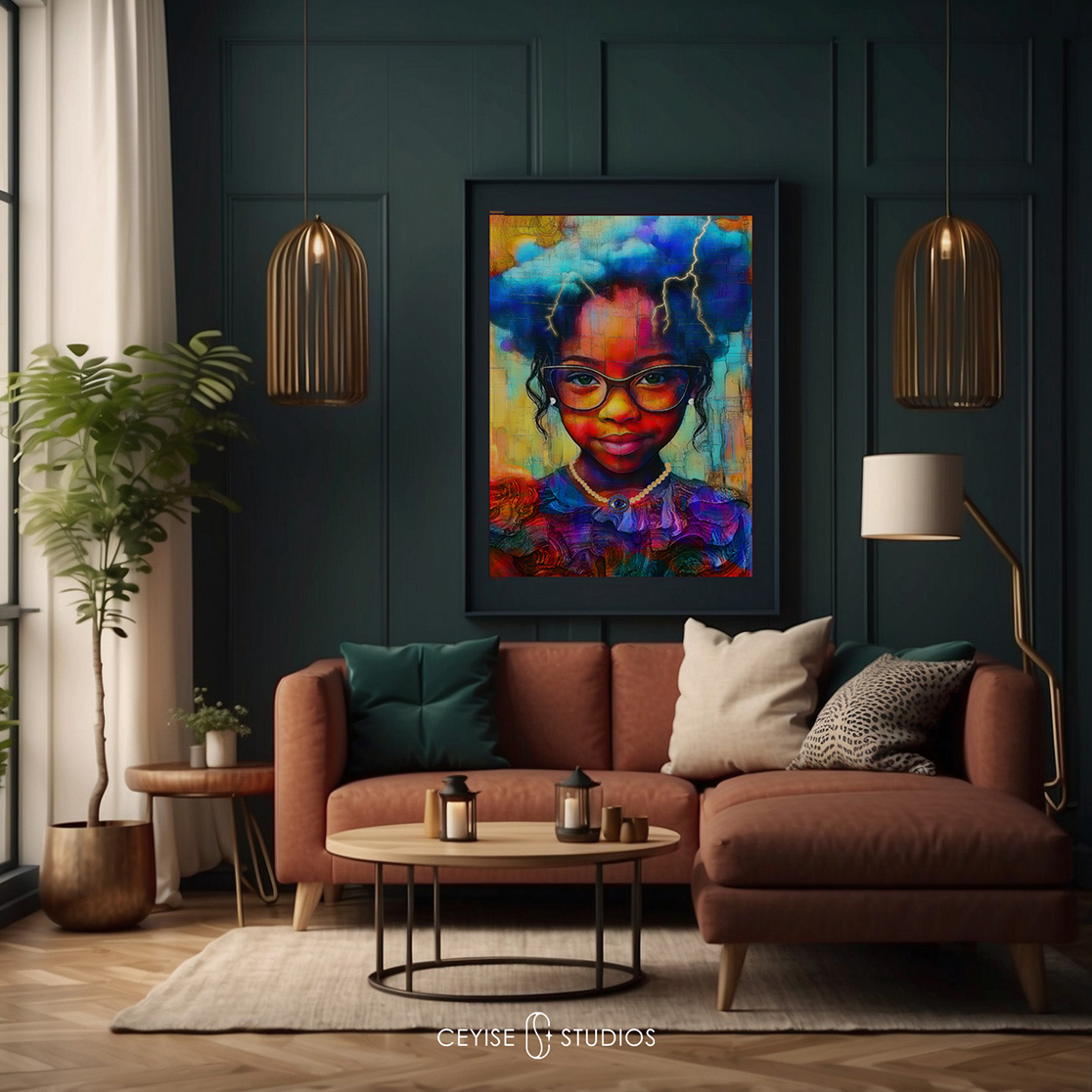
When I made this piece, I wasn't consciously describing my relationship with dissociation. I was following what the image wanted to be. And when I stepped back and looked at what I had made, I recognized it immediately: the self that shows up for everyone else, perfectly composed, while the internal storm has nowhere to go.
That's alexithymia in its most visual form. And making the piece — giving it color and form and visibility — was the first step in acknowledging that the storm was real, that it deserved to be seen, that I didn't have to keep holding it at the surface level of calm while everything churned underneath.
Dysregulated is what happens after. The chaos that comes when the holding fails — when the dissociation can't be maintained and the emotional material that's been suppressed makes its way to the surface all at once, without language, without order, without any of the management tools that usually keep it contained. Intense reds and cool blues. Raw energy and moments of strange stillness occurring simultaneously. The experience of feeling too much and nothing at the same time.
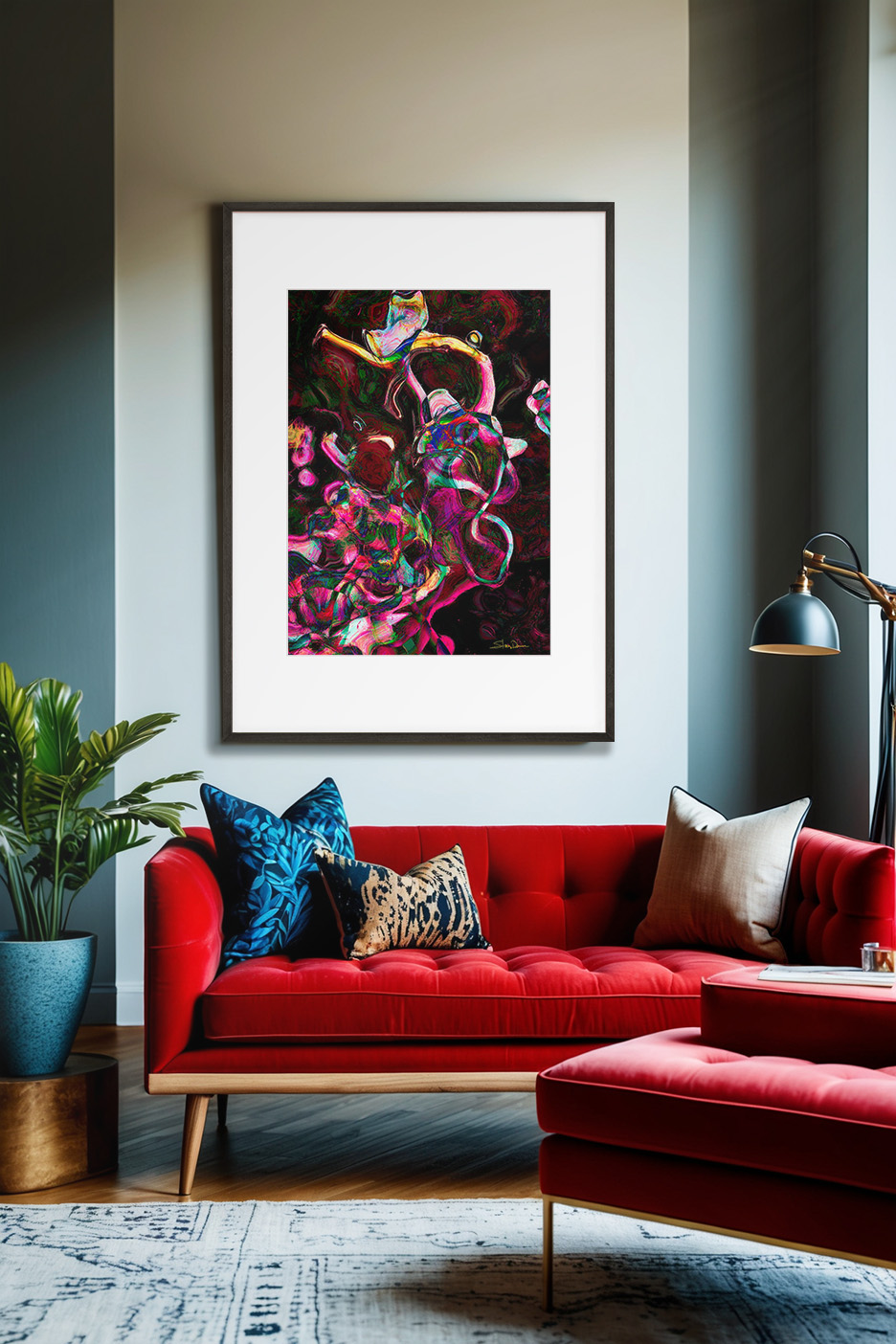
This piece was my way of saying: this is what it looks like inside. Not the polished external version. The actual internal weather of a nervous system that has been managing emotional material it was never given the tools to process.
Making Dysregulated was itself a regulation. The act of externalizing the chaos — putting it on a surface, giving it form, stepping back and looking at it as something outside myself rather than as something I was drowning inside — created just enough distance to breathe.
Art as Ritual Medicine — The Rhythmicity That Heals
Here's where the clinical argument for ritual comes in. And this is the piece I most want you to sit with, because it changes the way you understand why art works for the kind of healing we're talking about.
The nervous system doesn't respond to inspiration. It responds to rhythm. To predictable, repeated, safe patterns that teach the RAS — the reticular activating system, your brain's focus filter — what to categorize as safe and what to filter as threat. Every time you engage in a ritual, you're sending your nervous system a signal: this is familiar. This is mine. This is safe. (Read more: Your Brain's Focus Filter: How the RAS Learns to Feel Safe →)
And what does dopamine — the neurotransmitter we're taught is about reward and achievement — actually respond to in a dysregulated nervous system? Not just accomplishment. Familiarity. Safety. The recognition of a pattern that has been experienced as good before. Dopamine isn't about hustle. It's about home. (Read more: Dopamine Isn't About Hustle. It's About Home →)
This is why making art as a consistent, intentional, repeated practice — not once, not as a special occasion, but as a daily or weekly ritual — works differently than making art occasionally when you feel inspired. The nervous system needs the repetition to reclassify the creative act as safe. As belonging to you. As a place you can return to without threat.
For a woman whose earliest experiences taught her that she wasn't safe anywhere — that the environment was unpredictable, that her needs were inconvenient, that her authentic self was too much — teaching the nervous system that there is a place that belongs to her, a practice that is only hers, a rhythm that she can count on — is not supplementary to healing. It is the healing.
The ritual of making art — the same corner of the room, the same materials, the same quality of attention — becomes what your dopamine system recognizes as home. And home, for a nervous system that grew up without one, is the entire clinical goal.
From Fragments to Fusion — The Arc of Reclaiming
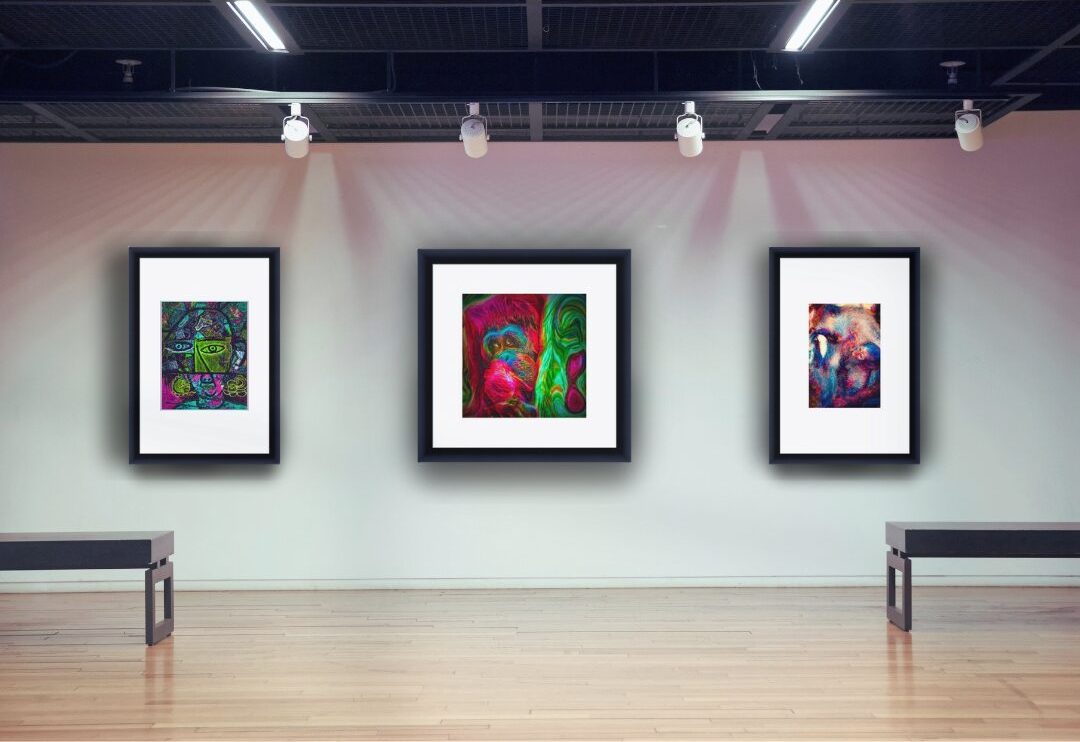
The title of this collection — Fragments to Fusion — is not just aesthetic language. It's the clinical arc.
Fragments: the self that was organized around survival. The parts that were suppressed, hidden, managed, denied access. The inner child who got buried under the competence and the performance and the masks.
Fusion: not the erasure of the difficult parts. Not the pretense that the wound didn't happen. The integration of all of it — the shadow and the light, the survival self and the authentic self, the storms and the quiet — into something whole. Something that can stand in the world without performing its wholeness.
Every piece in the Inner Child Series is a step in that arc. Not a linear progression from damaged to healed. A spiral — the same territory revisited from different angles, with different tools, with growing capacity to look at what's there.
That's how healing from complex trauma actually works. You don't move through it once and arrive on the other side. You move through it again and again, each time with a little more capacity, a little more light, a little more of yourself reclaimed from the dark where it was waiting.
The art holds the record of that movement. And in holding it, it makes it real.
You don't have to be an artist to use art as ritual medicine. You don't have to produce anything worth showing anyone. You just have to be willing to show up to the practice — consistently, rhythmically, with intention — and let the making carry what your words are still learning to hold.
If you want to understand which sensory and creative channels your nervous system responds to most directly, the Color Archetype quiz is where we start.
Take the Color Archetype Quiz → quiz.drstaceydenise.com/color-archetype-quiz
The chapter before this one — the survival masks: The Masks We Wore — Survival, Addiction, and the Stories We Carried Into Adulthood →
The shadow work chapter: Healing Trauma Through Art: Carl Jung's Shadow Self and the Inner Child Series →
The science of ritual and the nervous system: Your Brain's Focus Filter: How the RAS Learns to Feel Safe →
Dopamine as return, not reward: Dopamine Isn't About Hustle. It's About Home →
Join the Auntie Menopause Circle → facebook.com/groups/theauntiemenopausecircle
If this resonated with you, you are not alone in this journey. The Auntie Menopause Circle is where women who are done being dismissed come to learn, heal, and find each other.
Sources
Brewin CR, et al. Post-traumatic stress disorder: evolving conceptualization and evidence, and future research directions. World Psychiatry. 2025. DOI: 10.1002/wps.21269
Joschko R, et al. Active visual art therapy and health outcomes: a systematic review and meta-analysis. JAMA Network Open. 2024. DOI: 10.1001/jamanetworkopen.2024.28709
NOTE: This post originated as an exploration of C-PTSD, alexithymia, and the Inner Child Series on Ceyise Studios. It has been fully rewritten here on drstaceydenise.com — centering the identity fragmentation science, the specific pieces Quiet Before the Storm and Dysregulated, and the clinical argument for art as ritual medicine rather than art as occasional expression. The Fragments to Fusion arc is named and claimed as the through-line of this work.
Originally published on Ceyise Studios. Updated: April 2026.