Gut-Brain-Skin Connection in Perimenopause: What to Eat
Your Gut Is Making Your Serotonin, Protecting Your Skin, and Running Your Mood — All at Once
Here's something I came across that I can't stop thinking about — and that I wish every woman in perimenopause knew before she spent years blaming her brain for what her gut is doing.
Approximately 95% of your serotonin is produced in your gut. Not in your brain. In your intestinal tract, by specialized cells that are in constant communication with the bacteria living alongside them.
GABA — the neurotransmitter that determines whether your nervous system can stand down from threat mode — is also produced and influenced by your gut microbiome. So are dopamine precursors. The chemistry that decides whether you feel regulated, anxious, flat, or wired at 2am when you're clearly exhausted — your gut is producing or disrupting all of it.
And then there's your skin. Which is telling you everything your gut hasn't said out loud yet.
Your Gut and Your Skin Are the Same System
I don't want you to dismiss what you're noticing in the mirror as a vanity metric. The sheen that went quiet, the dryness that doesn't respond to anything topical, the reactivity you didn't used to have — that's your largest organ reporting on what's happening inside.
Based on articles retrieved from PubMed, a 2020 review in Dermatology and Therapy established that estrogen decline directly causes loss of collagen, elastin, fibroblast function, and skin barrier integrity in menopause. (DOI: 10.1007/s13555-020-00468-7) And a 2025 review in the Journal of Cosmetic Dermatology confirmed that these changes affect quality of life in measurable, real ways — not cosmetic concerns to brush aside. (DOI: 10.1111/jocd.70393)
Here's the structural connection most skin conversations miss:
When your gut lining is healthy: Tight junctions keep inflammatory signals inside the intestine where they belong. Your skin barrier stays intact. Nutrients absorb properly. Your skin gets what it needs from the inside.
When your gut lining becomes permeable: Those tight junctions loosen. Inflammatory signals cross into the bloodstream. They show up on your skin as rashes, dryness, reactivity, and dullness that no topical treatment can fix — because the problem isn't on the surface.
This is why the most expensive moisturizer in the world can't fix what's happening internally. The skin is the symptom. The gut is the source.
What Your Gut Needs to Run Your Nervous System
A 2025 review in Molecular and Cellular Endocrinology confirmed that the gut microbiota communicates with the brain via serotonin, GABA, and dopamine and that microbial imbalance is directly linked to altered stress responses and mood. (DOI: 10.1016/j.mce.2025.112599)
For a neurodivergent woman in perimenopause — whose nervous system already depends more heavily on these exact neurotransmitters, whose sensory processing is more effortful, whose estrogen buffer is now declining — this isn't background information. It's the clinical center of what's happening to you right now.
Here's what each neurotransmitter needs from your plate:
What Your Gut Needs to Protect Your Skin
Working on your skin and your gut simultaneously is possible because many of the same foods feed both systems at once:
Bone broth — for both gut lining and skin structure Glycine and proline — the collagen precursors — repair your intestinal tight junctions AND support your skin matrix at the same time. Use it where you'd use water or stock. Make rice with it. Start soup with it. Add a splash to roasted vegetables. You don't have to sip it from a mug if that's not appealing.
Fatty fish — for both gut inflammation and skin reactivity Omega-3 fats from wild salmon, sardines, and mackerel reduce the systemic inflammation that drives both gut permeability and skin reactivity simultaneously. Two servings a week. That's the whole protocol.
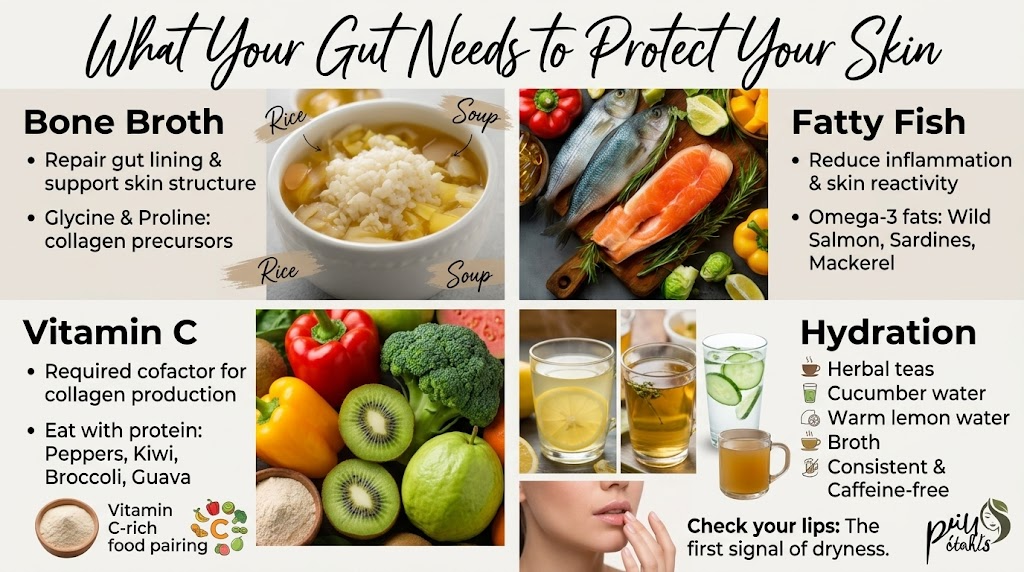
Vitamin C — for collagen you can actually build Your body cannot convert the amino acids you're eating into collagen without vitamin C as the cofactor. Most women in perimenopause are getting far less than they need because vitamin C depletes under stress and most stress responses in perimenopause are chronic. Bell peppers, kiwi, guava, broccoli — pair one of these with your protein at every meal.
Hydration — with intention not with rules Estrogen-deficient skin loses its moisture-binding capacity at the cellular level. Hydration has to come from inside. But "drink eight glasses of water" isn't a useful instruction for a busy woman who doesn't find plain water appealing. So:
Herbal teas count
Cucumber water counts
Warm lemon water counts
Broth counts
Anything consistent and caffeine-free counts
If you track nothing else, track whether your lips are dry. That's usually the first external signal that your hydration is behind where your skin needs it to be.
For the Neurodivergent Woman Who Eats the Same Things on Repeat
I'm going to say something personal here because it's true for me too.
I eat monotropically sometimes. The same things, on repeat, for weeks. Not because I don't know better — because my nervous system found something safe and it's staying there. That's not a discipline failure. That's a neurodivergent nervous system doing exactly what it does.
The problem is that monotropic eating narrows plant diversity over time, which narrows the bacterial diversity that produces serotonin, GABA, and dopamine, which narrows the neurotransmitter range your nervous system has to work with in perimenopause.
The gentlest interruption: add one new plant food alongside the safe rotation. Not instead of. Alongside. One tablespoon of ground flaxseed stirred into the oatmeal you already eat. A handful of pumpkin seeds next to the same lunch you always have. One new thing next to the familiar things.
That's enough. That's how you feed a neurodivergent nervous system in perimenopause. Not all at once. One safe addition at a time.
The Full Picture
This is the third of three gut systems that perimenopause disrupts simultaneously. Post 1 covered the histamine-estrogen loop. Post 2 covered the estrobolome and your hormone recycling. This post covers your gut's role in producing the neurotransmitters that run your nervous system and protecting the skin barrier that's been showing you the symptoms all along.
Together they explain why so much of what you're experiencing right now traces back to your gut — and why feeding it correctly is not optional if you want things to improve.
The complete clinical picture connecting all three is in the hub post. And if the color and sensory environment of how you eat matters to you — because it does, more than most nutrition conversations acknowledge — the quiz below gives you your nervous system map.
Read the Full Story → Histamine Intolerance in Perimenopause: What Your Gut Is Telling You
Know How Your Nervous System Eats → Take the Color Archetype Quiz
Sources
Lephart ED, Naftolin F. Menopause and the Skin. Dermatol Ther (Heidelb). 2020. DOI: 10.1007/s13555-020-00468-7
Viscomi B et al. Managing Menopausal Skin Changes. J Cosmet Dermatol. 2025. DOI: 10.1111/jocd.70393
Khan MT et al. From Gut to Brain. Mol Cell Endocrinol. 2025. DOI: 10.1016/j.mce.2025.112599
Published: April 2026