
FSH, Estradiol & Toxins: What Your Labs Aren't Saying
I Have a Soft Spot for Endocrine Disruptors. Let Me Explain.
I have a soft spot for endocrine disruptors. Not because I want them in my body — trust me, I don't. But because the environment poisons us and we don't even realize it. And I feel like somebody needs to say that out loud in a clinical space, because most doctors just aren't connecting those dots.
Think about what you did this week. Maybe you heated up a Lean Cuisine in that plastic tray. Maybe you poured hot soup into a Styrofoam cup because it was there and you were tired. Maybe you drank out of a plastic bottle that's been sitting in your hot car. None of that felt like a medical decision. It felt like Tuesday.
But here's what I need you to know. Microplastics and BPA have been found in human coronary arteries. In brain tissue. In placentas. And there is a growing body of research — not fringe science, published, peer-reviewed research — connecting these chemicals to disrupted hormone systems, altered reproductive aging, and earlier menopause.
I'm not telling you this to scare you. I'm telling you because I grew up breathing this stuff, I practiced surgery next to people who lived in it, and I think you deserve to have the full picture when your labs come back looking "too old" for your age.

I Know What That Air Smells Like
I grew up in Cincinnati.
And I knew we were getting close to certain parts of the city before I could see them. The air changed first. There was the sharp, chemical smell from Drackett — they made Windex and all kinds of household chemical products. There was the heavy, metallic smell from the Oscar Meyer meat processing plant. And sometimes those cows would actually escape and get out onto the streets. You'd see them just out there. Which would be funny if not for what that facility was doing to the air and the water around it.
Then there was the Ohio River. People dumped everything in that river for decades. You could smell it on certain days — this chemical, industrial tang that sat in the back of your throat. I remember thinking as a kid: this air feels like it's killing me. I didn't have clinical language for that feeling. I just knew something about it felt wrong.
I became a surgeon. I eventually moved to Houston. And in my years operating on patients — women from Baytown, Channelview, Pasadena, right up against the ship channel and the petrochemical plants — I started connecting what I'd smelled in Cincinnati to what I was seeing in people's bodies. Cancers. Hormonal patterns that didn't match age. Reproductive histories that looked accelerated. Women whose labs were telling a story that their birth certificates weren't.
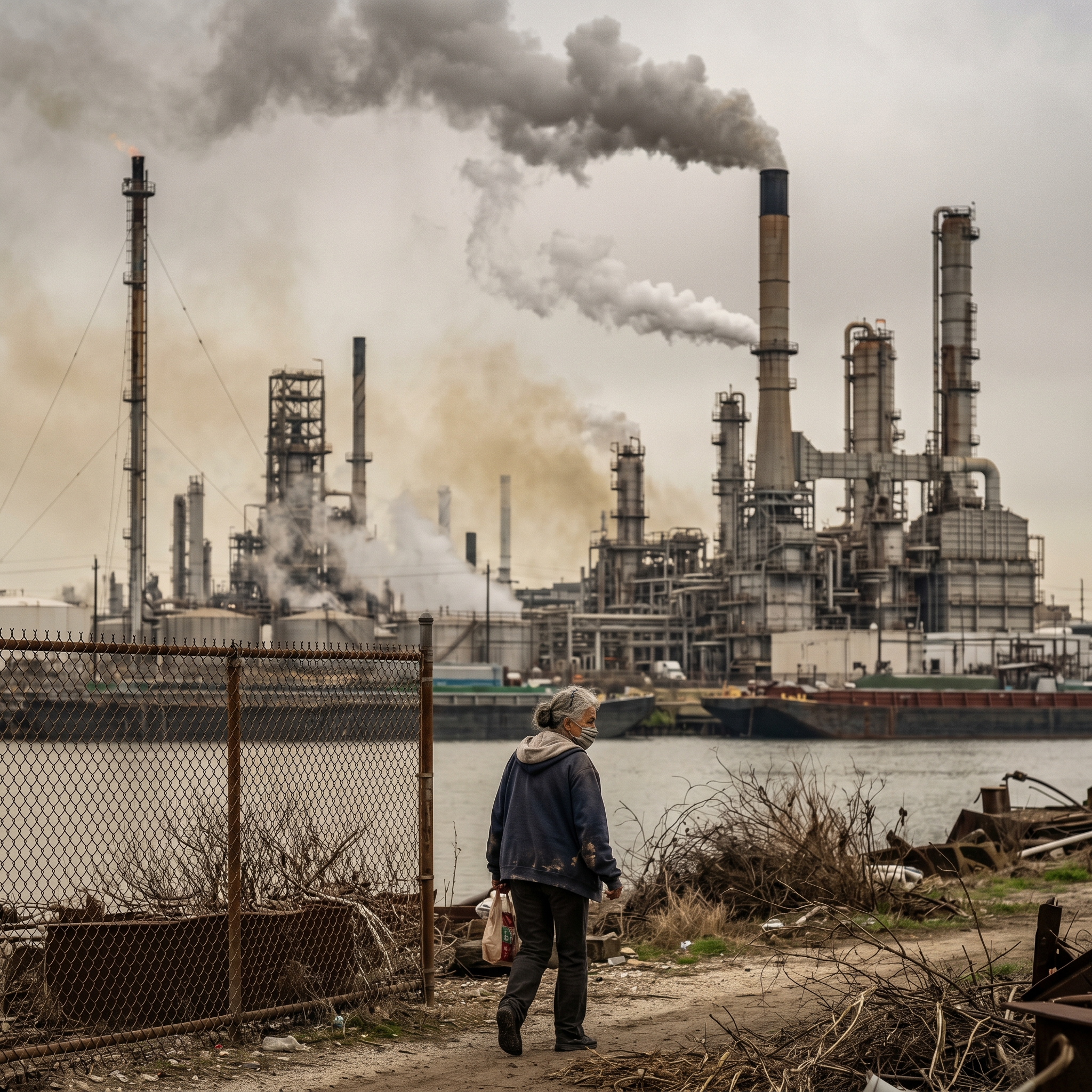
That is not a coincidence. That is chemistry.
What the Research Actually Says
Based on articles retrieved from PubMed, a 2024 umbrella review published in the Annals of Global Health analyzed 52 systematic reviews covering hundreds of meta-analyses on plastic-associated chemicals and human health. The findings are significant — BPA is associated with polycystic ovary syndrome, insulin resistance, type 2 diabetes, and cardiovascular disease. Phthalates — the plasticizers in flexible plastics — are linked to endometriosis, hormone disruption, and reproductive harm in women. (DOI: 10.5334/aogh.4459)
And a Harvard School of Public Health cohort study found that higher urinary levels of propylparaben — a preservative found in personal care products and food packaging — were associated with higher day-3 FSH and lower antral follicle count in women. Both of those are markers of diminished ovarian reserve. (DOI: 10.1289/ehp.1205350)
You follow what I'm saying? The lotion you put on every morning. The preservatives in the food you eat. The packaging your food was stored in. These aren't abstract environmental concerns. They are interacting with your ovarian follicles and your hormone signaling in ways that can show up on a lab panel.
And then a 2023 review published in Maturitas made the connection even more directly — increased environmental pollution and toxin exposure may influence the timing of menopause, and both air pollution and the menopausal transition are associated with worse cardiovascular, bone, and cognitive health outcomes. (DOI: 10.1016/j.maturitas.2023.107825)
For those of you living near the Houston ship channel, near Baytown, Channelview, the East Texas petrochemical corridor, or anywhere with heavy industrial air — this isn't background noise. This is your biology being shaped by your zip code.
What FSH, Estradiol, and Progesterone Are Trying to Do
Before we talk about what disrupts these hormones, let me tell you what they're supposed to do when the environment isn't interfering.
Your hormone system is a conversation. FSH — follicle-stimulating hormone — is your brain talking to your ovaries: time to grow a follicle, time to ovulate. Estradiol is your main estrogen. It does far more than regulate your period — it supports your brain, your bones, your blood vessels, your metabolism, your mood, and your sleep. Progesterone is the stabilizer. It shows up after ovulation, calms your nervous system, balances estradiol, and helps you sleep.
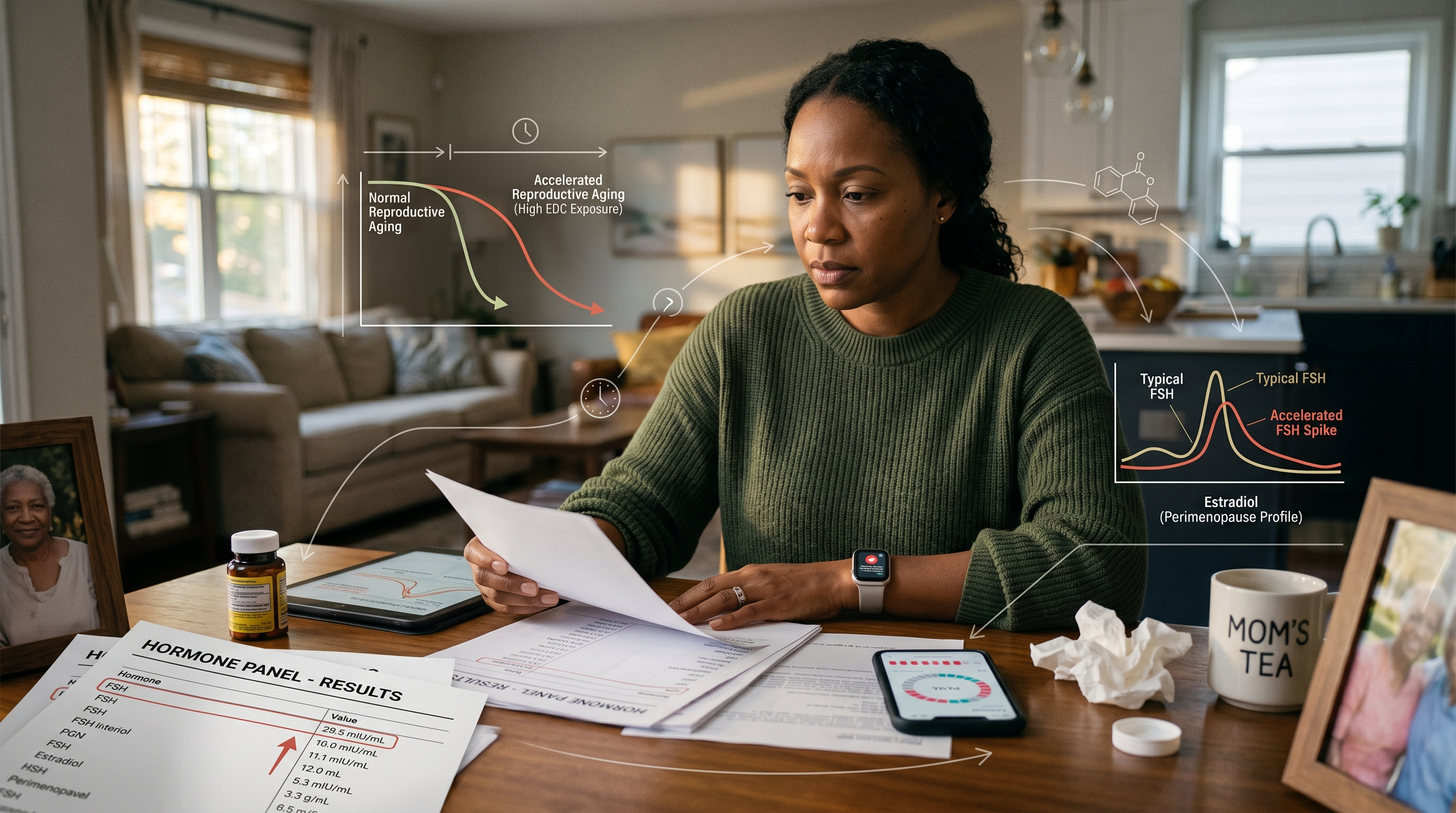
In a world without chemical disruption, the pattern goes like this. In your 20s and 30s, FSH stays relatively low and steady. Estradiol rises and falls in a predictable cycle. Progesterone arrives reliably after ovulation. In early perimenopause, FSH starts to climb, estradiol gets chaotic — some of the highest estradiol levels of your life actually happen in this window — and progesterone starts dropping because you're not ovulating consistently. In late perimenopause, FSH gets persistently high, estradiol and progesterone both fall, and cycles space out until they stop.
That's the textbook. Now layer in a lifetime of chemicals that mimic estrogen, block hormone receptors, and accelerate ovarian aging — and that textbook timeline starts running ahead of schedule.
What This Can Look Like in Your Labs
Let's talk patterns, not single numbers.
The "too-early" high FSH. Your FSH is clearly elevated for your age — maybe high 20s or into the 30s in your early 40s — while estradiol and progesterone look more like late perimenopause than early. Your cycles are shortening or spacing out faster than expected. Your hot flashes started earlier than your mother's did. Your sleep is more disrupted than your friends who are the same age. This is consistent with accelerated reproductive aging — and it's seen more frequently in women with higher lifetime EDC exposure.
Erratic estradiol with low progesterone. Estradiol bouncing high then crashing low. Progesterone consistently low because you're not ovulating reliably. FSH fluctuating between "normal" and "high" depending on which day it was drawn. Symptoms that feel outsized — heavy bleeding, breast tenderness, anxiety spikes, that wired-but-exhausted feeling at night, weight accumulating in your midsection. Chemicals that mimic estrogen or block progesterone signaling can amplify how chaotic this phase feels.
Normal labs, miserable life. FSH, estradiol, and progesterone all technically within reference ranges — and yet you feel wrecked. Brain fog, sleep destroyed, mood flat or swinging. You also live near an industrial corridor or have years of heavy chemical exposure in your history. The research on air pollution and menopause is clear that symptom severity can be significantly worse with higher pollution exposure even when hormone levels stay "in range." The labs don't always capture what your body is living through. Your lived experience is also data.
What Testing Can and Cannot Do Here
Let me be straight with you about the limits.
There's no standard clinical panel that can measure all your lifetime EDC exposure and tell you exactly how many years earlier your menopause started because of it. Commercial "toxin detox" panels are mostly not worth the money. And I'm not going to sell you fear about what's already done.
What is useful: looking at FSH, estradiol, and progesterone as a pattern over time — not a single draw — alongside thyroid function, cortisol rhythm, fasting insulin, hs-CRP, vitamin D, ferritin, and testosterone. Those are the markers that show me what your metabolism, your inflammation, your nervous system, and your stress response are doing while your hormones are shifting. That's where the full picture comes into view.
What I don't do: I don't promise that "detoxing" will reverse your menopause. I don't blame you for where you grew up or the job you needed to survive. I don't use fear to sell you a supplement stack. I use the environmental story to bring context and compassion to what your labs are showing. Then I treat the whole woman in front of me.
What You Can Actually Do Right Now
You can't undo the air you grew up breathing. You can't relocate the ship channel. But there are places where you can lower your current chemical load and support a body that has already carried a lot.
Start with food storage and heating. Glass or ceramic in the microwave — not plastic trays, not Styrofoam. Stainless or glass for hot liquids. Let your food cool before putting it in plastic containers if glass isn't available. This isn't perfectionism — it's just not actively adding to the load when you don't have to.
Look at what's sitting on your skin all day. Your lotion, your deodorant, your lip products — these have the highest skin absorption of anything you use. Look for phthalate-free, paraben-free, BPA-free on those products specifically. Not everything. Just the things that stay on your body all day.
Your bedroom air matters more than any other room. If you live near heavy traffic or industry, a HEPA plus activated carbon filter in your bedroom is one of the most direct interventions available to you. Make it a low-fragrance zone — many scented products off-gas chemicals that add unnecessary load to a nervous system that's already managing more than it should.

And support your circadian rhythm. Morning light. Consistent sleep timing. Your nervous system is doing extra work in this chemical environment — don't add friction to the one system that regulates everything else.
None of this is about being pure. It's about reducing friction where you can so your body has more capacity for the things you can't control.
How I Use This in Practice
When someone comes to me with labs that look older than her birth certificate — especially if she grew up in an industrial corridor or has lived near petrochemical plants — here's what I actually do.
I ask where she grew up. Where she's worked. What she's breathed. What she's touched over decades. I look at her hormone labs alongside her metabolic markers, her inflammatory picture, and her nervous system history. I don't assume chemical exposure is the only explanation. I also don't pretend it isn't part of the story.
I'm licensed in California, Georgia, Kentucky, Maryland, Ohio, Texas, and Virginia. If you're in one of those states and you want to look at your labs in full clinical context — not just a portal screenshot with a shrug — the link below is where we start.
That's all I'm saying.
If you want to see your own data without gatekeeping, my lab shop gives you direct access to professional-grade hormone and metabolic panels. No referral. No appointment. Results go directly to you.
And if you want to understand what all ten of those markers mean together — fasting insulin, hs-CRP, cortisol, vitamin D, ferritin, estradiol, progesterone, testosterone, TSH, and Free T3 — I wrote the whole clinical picture down in plain language.
Get The 10 Biomarkers Guide → $10
Sources
Symeonides C et al. An Umbrella Review of Meta-Analyses Evaluating Associations between Human Health and Exposure to Major Classes of Plastic-Associated Chemicals. Ann Glob Health. 2024. DOI: 10.5334/aogh.4459
Smith KW et al. Urinary paraben concentrations and ovarian aging among women from a fertility center. Environ Health Perspect. 2013. DOI: 10.1289/ehp.1205350
Cucinella L et al. Impact of climate and environmental change on the menopause. Maturitas. 2023. DOI: 10.1016/j.maturitas.2023.107825
Elavsky S et al. Physical activity and menopausal symptoms: evaluating the contribution of obesity, fitness, and ambient air pollution status. Menopause. 2024. DOI: 10.1097/GME.0000000000002319