
Find A Black Doctor Lawsuit: What's Really at Stake
Updated: May 26, 2026
Privilege as Public Health: Why the Physicians Who Know Your Body Are Being Erased
On May 19, 2026, a lawsuit was filed in Manhattan federal court against Find A Black Doctor — a directory founded in 2005 and relaunched in 2019 by Dr. Dina Strachan, a board-certified New York dermatologist, to help Black patients find culturally competent care.
The plaintiff is Dr. Travis Morrell, a white Colorado dermatologist who applied to join the directory in December 2025 and says he never received a response. He filed alongside Do No Harm, a conservative nonprofit organization founded in 2022 that publicly opposes diversity, equity, and inclusion initiatives in medicine. The complaint argues that restricting the directory to Black physicians violates federal civil rights law.
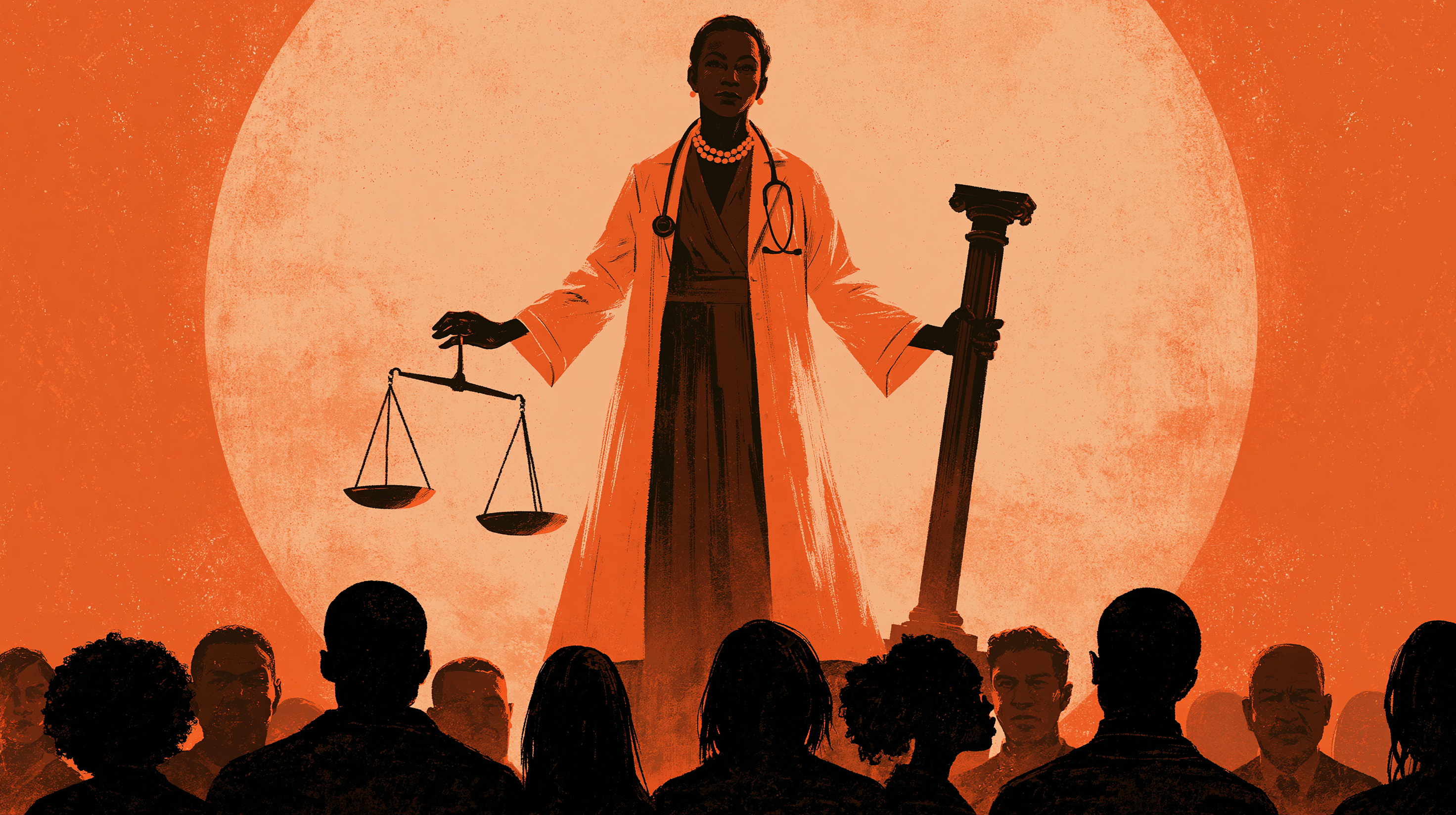
It's worth pausing on what was actually sued here. Not a hospital. Not a clinical protocol. Not a billing practice. A directory. A tool designed to help patients find doctors who understand their bodies.
That is what someone decided needed to be dismantled.

What the Research Actually Says
Do No Harm's legal filing calls racial concordance — the clinical concept that patients may have better outcomes with physicians who share their racial or cultural background — a "pernicious and debunked myth."
The research says otherwise.
A Stanford University study found that Black men were substantially more likely to agree to preventive screenings and medical interventions when treated by Black doctors. Separate research found that Black newborns had higher survival rates under the care of Black physicians. These aren't political findings. They're published, peer-reviewed clinical data about what happens in the room when a patient feels understood.
This matters because trust is not a soft variable in medicine. It's a clinical one. What a patient tells a doctor, how fully she describes her symptoms, whether she follows through on a recommendation, whether she comes back — all of it is shaped by whether she believes the person across from her will actually hear her. That belief is built on more than credentials. It's built on whether she's had to translate herself before she could be treated.
For Black women navigating midlife health changes — symptoms that are frequently minimized, attributed to stress, or measured against research that didn't include them — a physician who understands the full picture isn't a preference. It's access to accurate care.
This Isn't the First Time
This lawsuit didn't appear in a vacuum. Do No Harm previously sued Penn Medicine's Black Doctors Directory. That case settled. As part of the resolution, the directory was renamed and its criteria broadened. The name that reflected its purpose — gone. Replaced with language neutral enough to satisfy a legal complaint while the original mission quietly narrowed.
That's how this works. Not always through a dramatic ruling. Sometimes through the cost of defending a lawsuit. Sometimes through the exhaustion of fighting something that shouldn't have to be fought. Sometimes through a settlement that sounds reasonable and functions as erasure.
It's the same logic that removed bias training from medical schools, rolled back diversity initiatives in hospital systems, and is now working its way through directories, fellowships, and grant programs. Each individual action can be framed as a neutral application of equal treatment. Taken together, they represent a systematic removal of the infrastructure that made culturally competent care possible.
The Connection to Episode One
In the first post in this series, I wrote about Wisconsin's APRN law and what happens when a system decides physician-level depth is overhead it can't afford. The logic there was economic. Replace the most trained with the least expensive and call it access.
The logic here is legal. Replace the infrastructure that routes patients to physicians who understand them, call it equality, and let the outcomes sort themselves out.
Both decisions land in the same place. The woman who needed someone to read the full picture of her body is left with fewer people qualified to do it.
The physicians being systematically removed from directories, leadership pipelines, and medical school pathways are disproportionately the same physicians whose patients already carry the heaviest health burden. That's not a coincidence. It's a pattern. And patterns in medicine have consequences that show up in bodies long before they show up in policy discussions.
Black women in menopause already face longer symptom duration, more severe cardiometabolic risk, more sleep disruption, and more clinical dismissal than any other group in the research literature. The Study of Women's Health Across the Nation has been documenting this for decades. If the physicians most likely to recognize those patterns, take those symptoms seriously, and understand the cultural context they arrive in are being systematically pushed out of the rooms where care happens — that's not a workforce diversity issue. That's a patient safety issue.
A system that can't explain its worst outcomes is an incomplete system. A system that actively dismantles the tools designed to address those outcomes isn't making care more equal. It's making the gap harder to close.

What This Means If You're the Patient
If you've ever sat in a medical office and had to spend half the appointment translating your experience into language the room would accept — if you've ever left with an answer that fit the template but didn't fit your life — you already know what's at stake when the physicians who don't require that translation disappear from the options available to you.
The lawsuit against Find A Black Doctor isn't a story about one directory. It's a story about who gets to decide what care looks like, and whose body the system was built to understand.
That's the question worth sitting with.
And it's worth noting that the patients using Find A Black Doctor aren't only Black. White patients have said publicly they use the directory because they receive more thorough, more attentive, more culturally competent care from the physicians listed there. That's not a racial preference. That's a patient making a reasonable decision about where the quality of care is actually higher. When patients of every background are actively seeking out Black and South Asian physicians because they feel better heard and better treated, the directory isn't segregating medicine. It's exposing a gap the whole system created.
That same gap is why patients are now turning to AI. Not because a chatbot is better medicine. Because it stays in the room. Because it asks a follow-up question. Because it doesn't make a patient feel like an inconvenience for needing more than one answer. The directory, the chatbot, the healer on Instagram, the Facebook group at midnight — these are all the same decision made by patients who went looking for the care the system stopped providing. Until medicine closes that gap, people will keep finding workarounds. And they shouldn't have to.
Take the Next Step
If the standard care model hasn't explained your body, the Color Archetype Quiz is a starting point for understanding how your nervous system is actually wired — and what it needs right now.
Take the Free Color Archetype Quiz →👇🏽

Sources
Black Enterprise. White Physician Sues Find A Black Doctor Directory For Alleged Racial Discrimination. May 2026. https://www.blackenterprise.com/white-doctor-sues-find-a-black-doctor-directory/
BET. White Dermatologist Sues Find A Black Doctor Directory Over Discrimination. May 2026. https://www.bet.com/article/m0c5dm/white-dermatologist-sues-find-a-black-doctor-directory-over-discrimination
The Daily Pennsylvanian. Penn Medicine settles discrimination lawsuit, moves to rename Black Doctors Directory. March 2025. https://www.thedp.com/article/2025/08/penn-medicine-lawsuit-settlement-wurd-radio-directory-renamed
Dr. Stacey Denise is a board-certified surgeon transitioned into lifestyle medicine specializing in the menopause transition. She sees patients in California, Georgia, Kentucky, Maryland, Ohio, Texas, and Virginia.