Bedroom Color Ideas Every Woman in Perimenopause Should Know -- A Neuroaesthetic Guide
Updated: April 14, 2026
The Room That Was Never Hers
She grew up in rooms that belonged to someone else.
Maybe it was a shared bedroom with no privacy. Maybe it was a space designed by whoever could afford the furniture, whoever made the rules, whoever needed the house to look a certain way for other people. Her preferences were not part of the conversation. Her sensory needs—the light that felt too harsh, the pattern on the wallpaper that made it hard for her brain to settle, the colors that activated something in her chest she could not name—none of that was considered. Because nobody knew to consider it. Because she did not know herself yet that her nervous system was reading every room she entered and making a decision: safe or not safe.
She carried that lesson into adulthood.
Rooms are just rooms. You decorate them to look right. You pick colors from a magazine. You choose what matches, what's trending, what the designer suggested. You make the space beautiful for other people before you make it restoring for yourself—because that's what you were taught. That beauty was performance. That space was for others. That your own body's needs were secondary.
And now she is in her fifties. She is the Silver Goddess in the making—the woman who has moved through the proving and the performing and is beginning, finally, to ask what she actually needs. She got on HRT. Her hot flashes have quieted. Her doctor says her labs look good.
And she still wakes up at 2am, heart racing, unable to fully rest.
The nervous system eats first. And her bedroom has been feeding it the wrong information for decades.
What Childhood Taught Her Nervous System About Space
Here is what most menopause providers will never tell you: the spaces you grew up in helped wire your nervous system.
Not metaphorically. Literally.
When a child grows up in an environment that feels unsafe, unpredictable, or out of their control—whether that is outright trauma or simply the chronic low-grade stress of never feeling like a space belongs to them—the hypothalamic-pituitary-adrenal axis, the body's primary stress response system, learns to run at a higher baseline. The nervous system calibrates to a world that requires vigilance. Cortisol rhythms shift. The threat detection system becomes exquisitely sensitive. And that sensitivity does not disappear when we leave those childhood spaces. It travels with us into every room we enter for the rest of our lives.
I pulled a few studies from PubMed, I want to share what I've been reading because I think you deserve to see the data, not just take my word for it. Research published in Psychoneuroendocrinology confirmed that childhood adversity is associated with persistent HPA axis dysregulation in adulthood—meaning the stress response system that should activate and deactivate appropriately instead stays primed, responding to environmental cues as threat signals even in objectively safe spaces. (DOI: 10.1016/j.psyneuen.2017.11.004)
And we already know from the Mayo Clinic's landmark study of 1,670 women—women who experienced four or more adverse childhood experiences had nearly ten times the odds of severe menopausal symptoms, even after controlling for depression, anxiety, and hormone therapy use.
Her bedroom is one of those environmental cues her nervous system is still reading. Every night. While she is trying to sleep.
If that bedroom was designed—consciously or not—with colors, lighting, and visual complexity that signal alertness rather than safety, her nervous system is receiving that message loud and clear. No amount of melatonin will override it. No supplement will quiet it. And even HRT, as powerful as it is, cannot fully compensate for a nervous system that is reading its environment as a reason to stay awake.
Why HRT Alone Does Not Fix the Bedroom
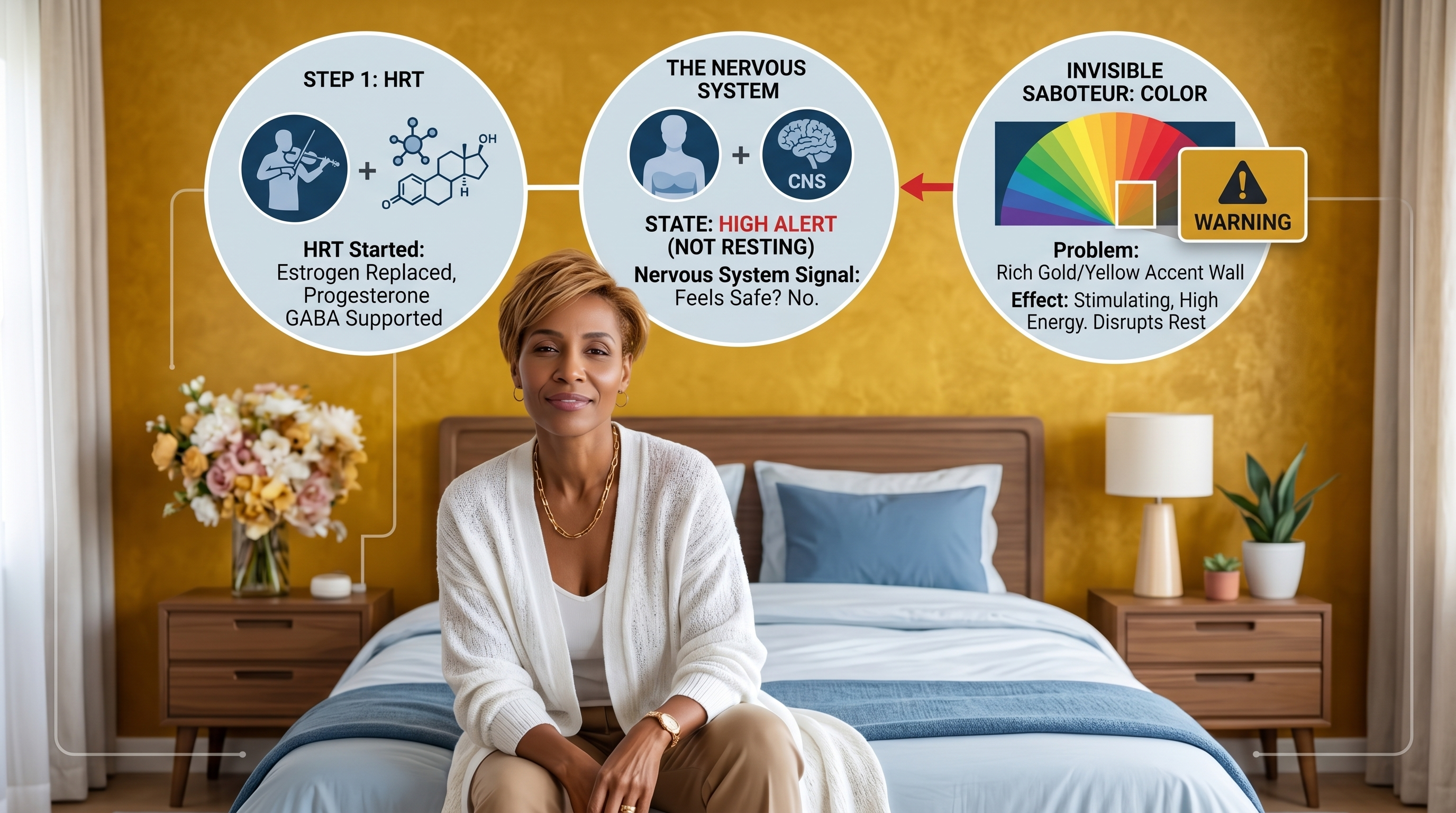
She did the right thing. She advocated for herself, found a provider who listened, and started hormone therapy. Her estrogen is being replaced. Her progesterone is supporting her GABA receptors. The biological orchestra is being conducted again.
But here is what I tell every woman in my practice: HRT is one instrument in that orchestra. If the nervous system does not feel safe, the body will not fully rest. And the bedroom environment is one of the most powerful nervous system signals that most menopause providers never address—because nobody trained them to look at it.
The invisible saboteurs hiding in bedroom design are not on any lab panel. They do not show up in an FSH result or a cortisol draw. But they are working against everything HRT is trying to accomplish, every single night.
Color is one of them. And it is the one we are going to talk about today.
The Invisible Saboteurs in Your Bedroom Color
Your nervous system is reading the color in your bedroom before you have consciously registered anything. This is not interior design theory. This is neuroscience.
Color is wavelength. Wavelength is processed by your visual cortex and your limbic system simultaneously—which means color reaches your emotional brain and your threat detection system at the same speed it reaches your conscious awareness. By the time you have decided whether you like the color on your walls, your amygdala has already voted.
For women in perimenopause, this matters more than it ever has. Declining estrogen narrows the thermoneutral zone and makes the sympathetic nervous system more reactive. The sensory inputs that your hormones were buffering before—the harsh light, the visually complex pattern, the activating color—now land differently. What felt manageable at 35 can feel genuinely dysregulating at 50. This is not you becoming more sensitive. This is your biology asking for more precise environmental support.
Here are the four invisible saboteurs hiding in bedroom color:
Saturation. Highly saturated, vivid colors increase arousal. A deeply saturated red or bright orange on a bedroom wall is telling your sympathetic nervous system to stay alert. This is not a preference issue—it is a physiological response. Muted, low-saturation versions of the same colors do the opposite. The difference between a saturated crimson and a dusty rose is the difference between activation and rest.
Temperature. Warm colors advance visually and increase perceived energy. Cool colors recede and calm. A bedroom dominated by warm amber and terracotta tones may feel cozy—but for a woman in perimenopause whose nervous system is already running warm, those tones can sustain sympathetic activation when the room should be supporting parasympathetic recovery. This does not mean you cannot have warmth in your bedroom. It means the warmth needs to be muted and low-contrast, not bright and saturated.
Contrast. High-contrast environments—stark white walls against dark furniture, bold graphic patterns, bright accent colors against neutral backgrounds—require the brain to keep processing visual information. The visual cortex does not rest when there is contrast to resolve. For neurodivergent women especially, visual complexity in the bedroom is a sleep saboteur that never shows up on a lab panel but shows up every night at 2am.
The circadian color trap. Based on articles retrieved from PubMed, blue-spectrum light from standard LED overhead lighting—the kind installed in most modern bedrooms—suppresses melatonin production by up to 56% compared to warm 2700K lighting during evening hours. (DOI: 10.1177/07487304241311652) When cool-toned paint on your bedroom walls reflects that blue-spectrum overhead light, the effect compounds. Your paint color and your light source are conspiring to tell your brain it is noon when it is midnight.
This is the part nobody talks about. The color on your walls does not exist independently of the light that illuminates it. Designing a bedroom for nervous system regulation means designing for both—and understanding that the same paint color looks completely different under a 5000K overhead bulb versus a 2700K bedside lamp.
Color by Nervous System State -- The Neuroaesthetic Reset Method™ Guide
The Neuroaesthetic Reset Method™ does not prescribe one universal bedroom palette. Because there is no universal nervous system. There is your nervous system—in its current state, during this particular transition, shaped by everything you have carried.
Here is how to identify which color direction supports your specific nervous system:
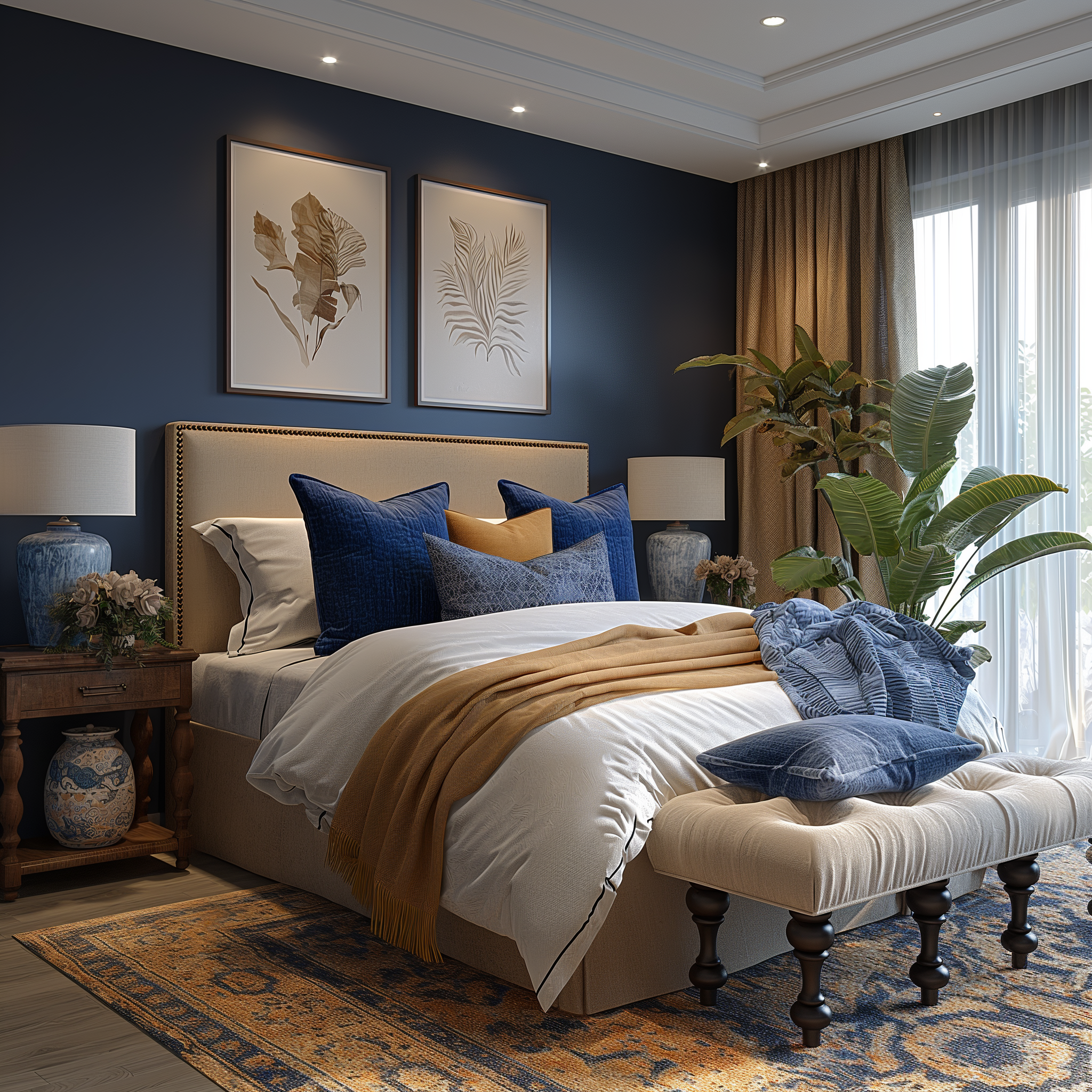
If you run hot and reactive—your hot flashes are your dominant symptom, you wake feeling wired rather than tired, your mind is busy even when your body is exhausted—your nervous system is in a sympathetic dominant state. Your bedroom needs to cool and quiet that response. Soft sage green, dusty blue-grey, warm white with cool undertones. Remove saturated warm colors from your sleep surfaces entirely—especially anything with red, orange, or bright yellow in it. Your bedding, your curtains, and your walls should all be working together to lower your arousal, not sustain it.
If you shut down and withdraw—you sleep too much and wake unrefreshed, you have stopped caring about things you used to love, you feel emotionally flat even when you know something should matter—your nervous system is in dorsal vagal territory. Your bedroom needs to gently invite you back without demanding anything. Warm cream, soft muted terracotta, dusty antique gold. Colors with enough warmth to signal safety but low enough saturation to avoid overstimulation. This is not a vibrant room. It is a gentle one.
If you scatter and cannot land—you lie in bed with your mind running, you startle easily, you feel restless even when you are physically tired, your thoughts loop—your nervous system is in a freeze-adjacent state that looks like anxiety but functions like a stuck alarm system. Your bedroom needs visual containment and grounding. Warm beige, dusty blush, soft brown, muted olive. Colors with weight and earth in them. Colors that say: you are not floating. You are here. You are held.

The Silver Goddess Reclaims Her Room
For the first time in her life she is designing a space for her own nervous system.
Not for what looks good in a listing photo. Not for what her mother would have chosen. Not for what the decorator recommended when she still believed rooms were about aesthetics and not about biology.
She changes one wall. She replaces the overhead light with a warm lamp at bedside height. She removes the three decorative pillows she never liked but kept because they matched. She swaps her crisp white bedding for something in a dusty sage that her eyes stop scanning when she closes them.
And for the first time in months she sleeps through until 5am.
That is not a small thing. That is her nervous system finally receiving the signal it has been waiting for—not just through her hormones, not just through her supplements, but through the actual physical environment of the room she returns to every night.
Listen. You have been trying to fix your sleep from the inside out. Labs, hormones, supplements, magnesium, melatonin. All of that matters. But the nervous system eats first. And it is eating whatever your bedroom is feeding it every single night.
Your bedroom was the first place you could not control as a child. It can be the first place you reclaim as the Silver Goddess.
That's all I'm saying.
Start With One Change
You do not need to repaint every wall. You do not need to buy new furniture. You need to make one change this week.
Identify your nervous system state from the three profiles above. Then change one thing in your bedroom that matches what that state needs. One lamp. One set of pillowcases. One piece of art replaced with something quieter.
Let your body tell you whether it worked. If you sleep better—that is data. If nothing changes—that is also data. We adjust from there.
Your nervous system has been reading your environment your entire life. For the first time, you get to choose what it reads.
Want to understand which invisible saboteurs are keeping you awake—not just in your bedroom, but in your biology?
Take the Sleep Saboteur Quiz →
And if you want to be in a room full of women who are done being dismissed and ready to design their way back to rest -- come join us.
Join the Auntie Menopause Circle →
Understand the full science of how your environment shapes your nervous system during menopause: What Is Neuroaesthetics? The Gentle Science of How Beauty Heals Your Brain →
And read this next -- the clinical companion that explains why trauma, neurodivergence, and menopause amplify each other: Why Trauma, Neurodivergence, and Menopause Collide -- And Why Your Doctor Keeps Missing It →
For the complete guide to designing your bathroom for sleep and nervous system regulation: Designing Your Bathroom Sanctuary: A Neuroaesthetic Guide for Women in Perimenopause →
Sources (via PubMed)
O'Connor DB et al. Effects of childhood trauma on cortisol levels in suicide attempters and ideators. Psychoneuroendocrinology. 2017. DOI: 10.1016/j.psyneuen.2017.11.004
Kapoor E et al. Association of adverse childhood experiences with menopausal symptoms. Maturitas. 2020. DOI: 10.1016/j.maturitas.2020.10.006
Hartstein LE et al. The Circadian Response to Evening Light Spectra. J Biol Rhythms. 2025. DOI: 10.1177/07487304241311652
NOTE: This post was originally published on Ceyise Studios, my design and neuroaesthetics platform, and has been brought here to drstaceydenise.com because it is foundational to the clinical work I now do with neurodivergent women navigating perimenopause and menopause. Some of those original posts have been retired. Others have been expanded into updated companion pieces that go further than the original could. Where a newer version exists, you will find a link to it at the top or bottom of this post.