
Why Houston Women's Sleep Got Worse in Perimenopause
In Houston, you can smell certain nights before you see them. The sharp tang that hangs over the ship channel when the wind shifts. The faint chemical note in the air after a long day of flares at the refineries. The way your tap water sometimes tastes just a little off, even when the city says it's fine. And somewhere in the middle of all that, your sleep quietly fell apart right as perimenopause showed up, and nobody connected those two stories for you.
But here's what they didn't tell you.
If you live in Houston or anywhere along the Gulf Coast petrochemical corridor—your sleep problems aren't just about estrogen and progesterone. They're also about the endocrine disruptors you're breathing, drinking, and absorbing every single day from the air and water around you.
Let me walk you through this.
Why perimenopause makes you more vulnerable to environmental toxins
Your body has been filtering and managing chemical exposures your whole life. Your liver, your kidneys, your skin, your gut—they've been working overtime to process plastics, solvents, pesticides, and industrial byproducts that never existed when your grandmother was your age.
But in perimenopause, a few things shift at once.
- Your liver is managing hormone breakdown differently. As estrogen and progesterone start fluctuating, your liver has to metabolize more hormone byproducts while also dealing with everything else you're exposed to. That's a lot of work.
- Your detoxification pathways slow down. When progesterone drops, so does your body's ability to buffer stress and clear toxins efficiently. Your nervous system becomes more reactive. Your sleep becomes more fragile.
- Your ovaries are more sensitive to disruption. Endocrine-disrupting chemicals—substances that mimic, block, or interfere with your hormones—don't just mess with your thyroid or your metabolism. They also affect how your ovaries age and how early you hit menopause.
And if you've been living in a place like Houston for years or decades, your body has been processing a higher chemical load than most people realize.
You follow what I'm saying?
What's actually in Houston's air and water (and why it matters for your sleep)
Houston sits in the middle of one of the largest petrochemical production regions in the United States. The ship channel, Baytown, Pasadena, Channelview—these areas are home to hundreds of refineries, chemical plants, and industrial facilities.
And that means the air you breathe and the water you drink carry things most people don't think about.
PFAS in Houston's water supply
PFAS—"forever chemicals"—are synthetic compounds used in nonstick pans, fast-food wrappers, stain-resistant fabrics, and firefighting foam. They don't break down. They accumulate in your body over time.
Houston's water system has detectable levels of PFAS, particularly in areas near the San Jacinto River basin. Nearly 500,000 Texans live within three miles of sites with extremely contaminated groundwater, and Houston is one of the affected areas.
Here's what research from the University of Michigan and the Endocrine Society has found:
- Women with high PFAS exposure reach menopause up to two years earlier than women with lower exposure.
- Higher PFAS levels are associated with a 1.3 to 1.6 times increased risk of earlier menopause across multiple studies.
So if you're 42 and your labs already look like you're 48, and your mom didn't hit perimenopause until her early 50s, the environment you've been living in deserves a seat at the table.
Phthalates and air pollution
Phthalates are plasticizers—they're in scented candles, air fresheners, vinyl flooring, cosmetics, and food packaging. They're also in the air in industrial areas.
A study published in Menopause (the journal of the North American Menopause Society) found that phthalate exposure is directly linked to sleep disruptions, insomnia, and restless sleep in perimenopausal women. Not just "a little tired"—measurably worse sleep architecture.
And Houston has some of the highest levels of airborne volatile organic compounds (VOCs) and fine particulate matter in the country because of refinery emissions and traffic pollution.
The chemicals you smell when you drive past the ship channel aren't just annoying. They're interacting with your estrogen receptors, your cortisol rhythm, and your nervous system's ability to downregulate at night.
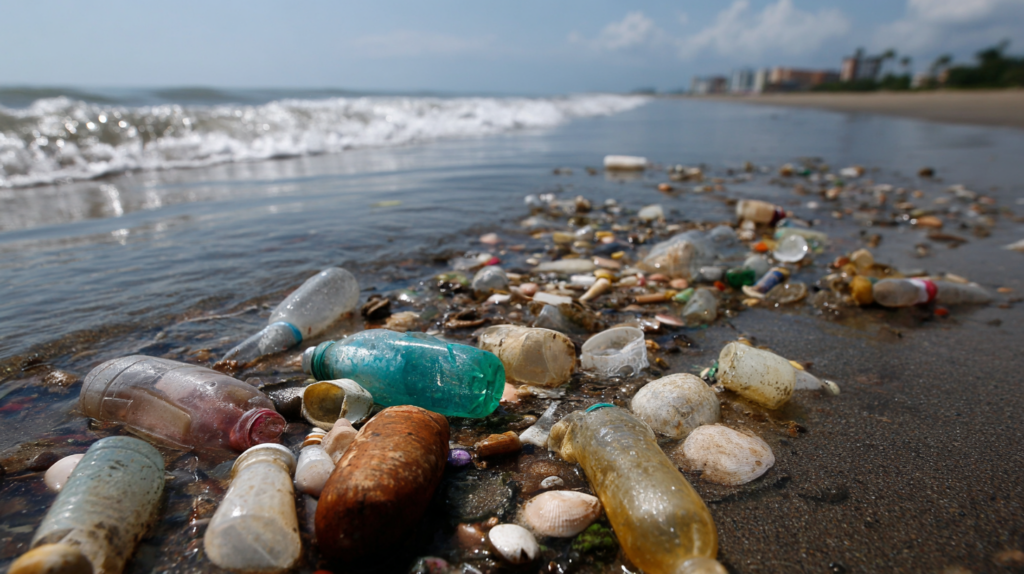
Microplastics in Gulf Coast water
The Gulf of Mexico is a microplastic hotspot. Rivers dump plastics into the Gulf, and that contamination cycles back into local water systems and seafood.
You're not just drinking trace plastics. You're also eating them if you consume Gulf seafood regularly. And plastics carry phthalates and bisphenols (BPA and its relatives) that act as endocrine disruptors.
So when your sleep changed, your weight shifted, your mood flattened, and your periods got unpredictable—your body isn't broken. Your ovaries and your nervous system are responding to decades of chemical load in an environment that was never neutral.
How endocrine disruptors steal your sleep during perimenopause
Let's connect the dots between the chemicals and the symptoms.
They disrupt your cortisol rhythm
Cortisol is supposed to be high in the morning and low at night. That's what helps you feel alert during the day and sleepy at night.
But phthalates, PFAS, and other endocrine disruptors interfere with your HPA axis—your body's stress response system. When your cortisol rhythm flattens or flips, you end up wired at night and exhausted during the day.
They interfere with progesterone
Progesterone is your calming hormone. It supports deep sleep, stabilizes mood, and balances estrogen.
Endocrine disruptors can block progesterone receptors or interfere with progesterone production. So even if your progesterone labs look "normal," your body may not be able to use it properly.
And without enough functional progesterone, your nervous system stays overstimulated. You wake up at 2 a.m. and can't fall back asleep. Your mind races. Your body feels like it's on alert even when nothing is wrong.
They accelerate ovarian aging
Studies show that women with higher burdens of persistent organic pollutants, PFAS, and phthalates tend to experience menopause two to four years earlier on average.
That means your FSH climbs sooner. Your estradiol swings more chaotically. And your sleep—which depends on stable estrogen and progesterone—falls apart faster than it should.
This isn't your fault. This is your physiology responding to what you've been living in.
The risky substances hiding in your home (and what to swap them for)
You can't move every refinery. You can't filter every molecule out of Houston's water. But you can lower your current load and stop adding more endocrine disruptors to a system that's already working overtime.
Here's what you need to know about the most common sources and what you can do instead.
| Substance/Source | Where Found | Risk/Effect | Safer Swap |
| Phthalates, VOCs | Air fresheners, cheap candles, synthetic fragrances | Hormone disruption, headaches, sleep disruption | Pure essential oil blends, or nothing (see my aromatherapy episode for safe scent options) |
| PFAS ("Forever Chemicals") | Nonstick pans, fast-food wraps, microwave popcorn bags | Endocrine disruption, thyroid issues, immune suppression, early menopause | Stainless steel or cast iron cookware, parchment paper, glass storage |
| Food Additives (e.g., BVO, artificial dyes) | Soda, processed snacks, flavored drinks | Brain fog, metabolic disruption, inflammation | Whole foods, herbal teas, sparkling water with fresh fruit |
| Alcohol, Nicotine | Social settings, stress coping | Sleep fragmentation, hormone disruption, hot flashes, mood swings | Mocktails, breathwork, aroma rituals (I walk through this in my podcast) |
| Bisphenols (BPA/BPS) | Plastics, can linings, receipts, cosmetics | Estrogen disruption, weight gain, insulin resistance | Glass or stainless bottles, BPA-free cans, mineral-based cosmetics |
You don't have to do all of this at once. Start with one or two swaps that feel doable, and build from there.
And if you're in Houston and you're heating your lunch in a plastic container in the break room or drinking from a disposable cup filled from a water fountain, you're adding to a load your body is already managing. Small changes actually matter here.
What you can do right now to protect your sleep and your hormones
1. Filter your water
If you live in Houston or another Gulf Coast city, consider a water filter that removes PFAS and heavy metals. Not all filters do this—look for NSF-certified filters that specifically address PFAS.
And stop microwaving food in plastic. Use glass or ceramic.
2. Swap your scent sources
I just released a podcast episode on aromatherapy and how to use essential oils safely without overloading your nervous system. A lot of women think they're being "clean" by using scented candles or plug-in air fresheners, but most of those contain phthalates and synthetic fragrances that disrupt sleep and hormones.
Watch it here: Aromatherapy for Sleep and Nervous System Support
3. Get your labs
If you're in perimenopause and your sleep is a mess, you need to see what's happening with your hormones and your metabolic and stress markers.
I look at:
- FSH, estradiol, progesterone to see where your ovaries are in the transition
- Thyroid (FT3, FT4, TSH) because PFAS and phthalates affect thyroid function
- Fasting insulin, A1c, hs-CRP to assess metabolic and inflammatory load
- Cortisol (ideally timed or salivary) to see if your stress rhythm is flipped
- Vitamin D, ferritin, B12 because deficiencies amplify sleep and mood problems
4. Support your liver and detox pathways
Your liver is doing the heavy lifting here. Support it with:
- Adequate protein (your liver needs amino acids to make glutathione, your body's master antioxidant)
- Cruciferous vegetables (broccoli, Brussels sprouts, cabbage) to support estrogen metabolism
- Hydration (filtered water, herbal teas)
- Sleep (your brain detoxifies during deep sleep, so this is circular—but it matters)
How we work on this together
If you're in Texas and you live in Houston or another area with high chemical exposure, and your sleep is destroyed and your labs look "older" than you are, the 90-Minute Deep Dive Consult is where we connect the dots.
Before we meet, I order the Sleep Foundations Panel: FT3, FT4, TSH, estradiol, progesterone, testosterone, fasting insulin, A1c, hs-CRP, vitamin D, B12/folate, iron and ferritin, lipid panel, CMP, CBC.
Then we sit down for 90 minutes and we look at your hormones, your environment, your history, and your nervous system together. We build a plan that respects your body and your reality—not a generic protocol that pretends you live in a vacuum.
👉🏽 Book your 90-Minute Deep Dive Consult
If you live outside Texas and you want data for your own education or to take to your local provider, the Lab Shop gives you access to professional-grade hormone and metabolic panels without gatekeeping. Results go directly to you.
👉🏽 Order labs through the Lab Shop
And if you just want to understand the five metabolic and sleep biomarkers I always look at next to your sex hormones—fasting insulin, hs-CRP, cortisol rhythm, vitamin D, and ferritin—download the 5 Biomarkers Guide. It'll give you language to talk to your doctor and context for what your labs actually mean.
👉🏽 Download the 5 Biomarkers Guide
You aren't imagining this. Your sleep didn't just fall apart because you're "getting older." Your body has been responding to what you've been breathing and drinking and absorbing for years, and perimenopause is when that load finally shows up in your symptoms.
You're not broken. You're responding.
And now we can do something about it.